How It Failed: The Truth Behind Sound Transit’s $34B Gap
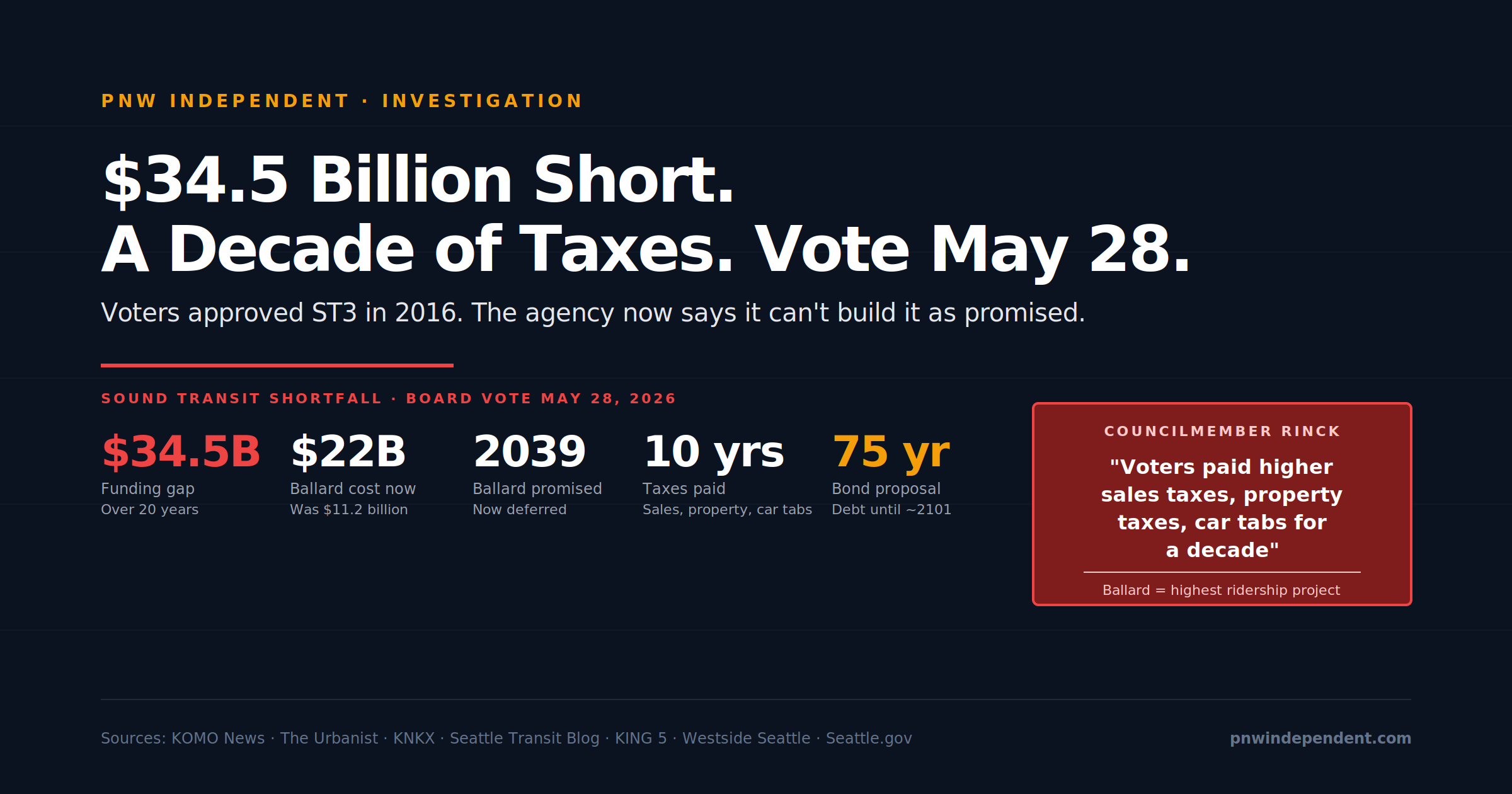
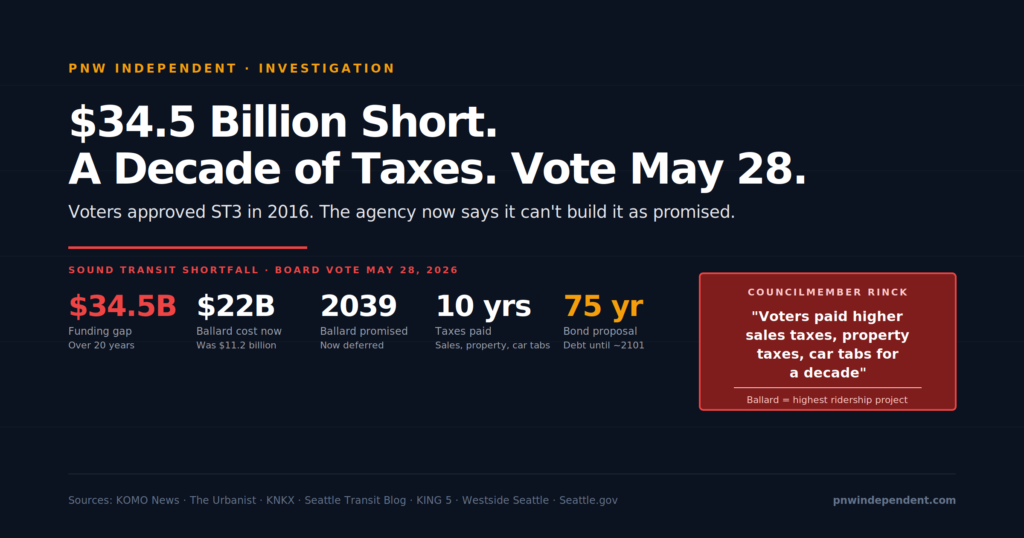
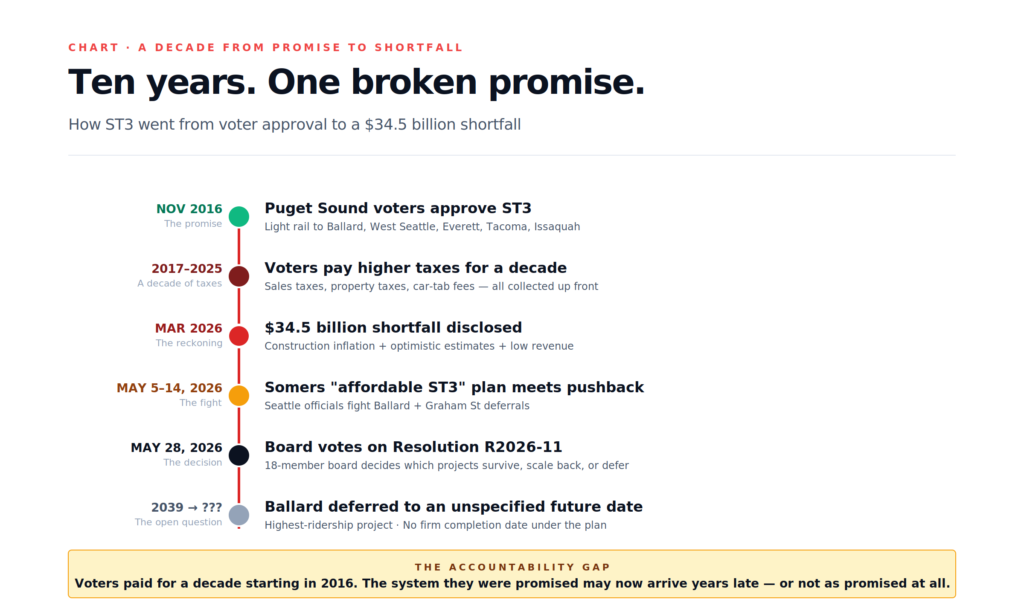
The Sound Transit shortfall has reached $34.5 billion over the next two decades. Specifically, the agency cannot afford to build the full light rail system that Puget Sound voters approved in 2016. Furthermore, a plan headed for a May 28 board vote would defer the Ballard extension and delay other promised projects. The Ballard project alone ballooned from about $11.2 billion to more than $22 billion — driven largely by a second downtown Seattle transit tunnel.
The Sound Transit shortfall forces hard choices. Specifically, the “affordable ST3” plan by board chair Dave Somers prioritizes the regional “spine” — Everett, Tacoma — while pushing Seattle projects to the back of the line. Furthermore, voters paid higher sales taxes, higher property taxes, and higher car tabs for a decade based on promises the agency now says it cannot keep on schedule. Some proposed fixes include 75-year bonds — debt that would outlive many of the riders who voted for the system. The gap is real. The promise is broken. The vote is in days. Here is what the documents actually show.
What the Sound Transit Shortfall Actually Is
The Sound Transit shortfall is a $34.5 billion gap between what the agency promised and what it can afford. Specifically, the gap covers the next 20 years of ST3 construction. Furthermore, the agency’s own long-range financial plan confirms the figure.
Where the Number Comes From
The shortfall did not appear overnight. Specifically, three factors drove the gap:
- Record construction inflation — material and labor costs surged
- Lower-than-expected tax revenue — the funding base underperformed projections
- More accurate cost estimates — early project budgets were too optimistic
Furthermore, the agency now estimates it needs roughly $34.5 billion in cost savings or new funding to fully build ST3 as voters approved it. Specifically, that figure represents the difference between projected expenditures and projected revenues across every subarea.
Why a Vote Is Legally Required
The shortfall triggers a legal obligation. Specifically, the voter-approved ST3 plan requires board action whenever a subarea’s projected expenses exceed projected revenues by more than 5%. Furthermore, in this case, every subarea has crossed that threshold.
Therefore, the board cannot simply continue as planned. Specifically, the financial policies built into ST3 force a rebalancing. Furthermore, the agency faces legal limits on committing money to expensive project phases until it adopts a balanced plan. The vote is not optional. It is a legal requirement triggered by the size of the gap.
The Scale of the Problem
The gap is one of the largest transit funding gaps in American history. Specifically, $34.5 billion exceeds the entire annual budget of most U.S. cities. Furthermore, the gap is roughly 15 times the size of the $2.3 billion FEMA denial PNW Independent has covered. Specifically, the scale puts the gap in the same fiscal category as the structural problems flagged in PNW Independent’s Moody’s downgrade investigation.
How the Sound Transit Shortfall Breaks the Voter Promise
The shortfall matters most because of what voters were promised. Specifically, in November 2016, Puget Sound voters approved ST3. Furthermore, that approval came with a decade of tax increases that residents have already been paying.
What Voters Approved in 2016
ST3 was sold to voters as a transformative regional system. Specifically, the plan promised light rail to Ballard, West Seattle, Everett, Tacoma, and Issaquah. Furthermore, the original timeline targeted West Seattle service in 2032 and Ballard in 2037-2039.
Voters approved the plan knowing the cost. Specifically, ST3 raised sales taxes, property taxes, and car-tab fees across the three-county district. Furthermore, those tax increases took effect immediately — long before any new train would run.
What Voters Have Already Paid
The central accountability issue is timing. Specifically, Seattle Councilmember Alexis Mercedes Rinck put it directly:
“Voters paid higher sales taxes, higher property taxes, higher car tabs for a decade.”
Furthermore, Rinck emphasized that the Ballard Link is the highest-ridership project in the entire ST3 program. Therefore, the project facing deferral is the one that would serve the most riders. Specifically, that is the project the plan pushes to the back of the line.
The Pierce County Parallel
PNW Independent’s Pierce County ST3 investigation documented a related pattern. Specifically, Pierce County voters rejected ST3 but still pay into the system. Furthermore, the shortfall now extends that pattern region-wide. Taxpayers across the district paid for a system that may not arrive as promised.
The pattern is consistent. Specifically, voters were taxed up front for benefits delivered years later — or, now, possibly not delivered on the promised timeline at all. Furthermore, that gap between payment and delivery is the core accountability question raised by the shortfall.
What the Sound Transit Shortfall Plan Actually Cuts
The agency’s response is a plan called “affordable ST3.” Specifically, board chair and Snohomish County Executive Dave Somers developed it. Furthermore, the plan sorts every ST3 project into three categories: fully funded, partially funded, or deferred.
What Gets Built
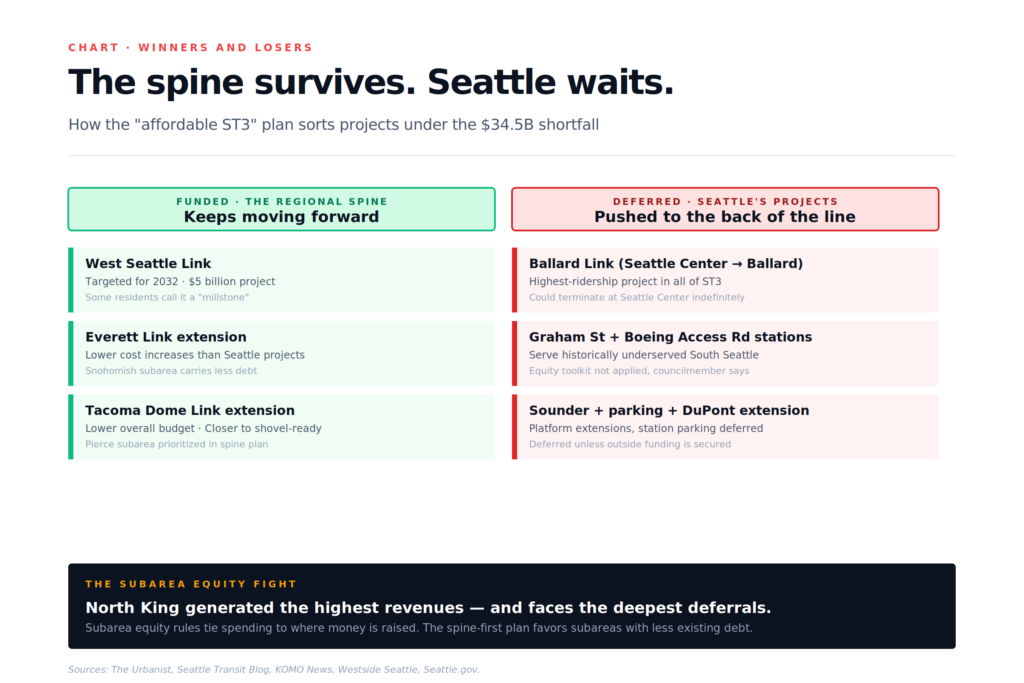
The plan prioritizes the regional “spine.” Specifically, the plan keeps moving:
- West Seattle Link extension — targeted for 2032
- Everett Link extension — lower cost increases than Seattle projects
- Tacoma Dome Link extension — lower overall budget
Furthermore, Somers framed the priority as completing the regional connection. Specifically, the spine projects had lower cost increases and are closer to shovel-ready. Therefore, the plan favors them over the more expensive Seattle work.
What Gets Deferred
The plan defers the most expensive and highest-ridership projects. Specifically, the deferred or partially funded list includes:
- The second half of the Ballard Link extension (Seattle Center to Ballard)
- Graham Street infill station
- Boeing Access Road infill station
- Sounder South platform extensions
- Parking facilities at Link, Sounder, and Stride stations
- The DuPont extension and additional Sounder service
Furthermore, the Ballard line could terminate at Seattle Center rather than reaching Ballard. Specifically, that would leave the Interbay and Ballard neighborhoods without the promised stations indefinitely.
The Ballard Cost Explosion
The gap is concentrated in one project. Specifically, the Ballard Link extension cost surged from about $11.2 billion to more than $22 billion. Furthermore, the increase is driven largely by a second downtown Seattle transit tunnel (DSTT2).
That tunnel is the crux of the problem. Specifically, building the full Ballard extension as currently designed would require borrowing levels that could delay projects in other areas for decades. Furthermore, the tunnel is treated as a regional investment rather than a North King subarea cost. The single most expensive element of ST3 is also the element the Sound Transit shortfall plan most directly threatens.
The Equity Criticism
The plan drew specific equity criticism. Specifically, Councilmember Rhonda Lewis criticized the continued deferral of the Graham Street and Boeing Access Road infill stations. Furthermore, she faulted the agency for not applying its racial equity toolkit to the new proposal.
Those stations serve historically underserved South Seattle communities. Specifically, deferring them raises questions about which neighborhoods bear the cost of the Sound Transit shortfall. Furthermore, the equity concern is now part of the board debate heading into the May 28 vote.
How the Sound Transit Shortfall Would Be Funded
The funding response includes controversial mechanisms. Specifically, the agency has explored several options to close the gap. Furthermore, some of those options carry long-term costs that extend well beyond the current generation of riders.
The 75-Year Bond Proposal
The most striking funding idea is extending bond terms. Specifically, the agency explored extending bond terms to 75 years. Furthermore, that means debt issued today would not be fully repaid until roughly 2101.
That proposal deserves scrutiny. Specifically, a 75-year bond means many of the taxpayers who voted for ST3 in 2016 would not live to see the debt repaid. Furthermore, the riders who eventually use the system would be paying for it three generations later. A 75-year bond shifts the cost far into the future — onto people who never voted on the plan.
Fare Gates and New Revenue
The response also includes revenue measures. Specifically, the agency explored:
- Installing fare gates at stations to reduce fare evasion
- Clean Fuels Standard carbon credits from fleet electrification
- Increasing the regional rental car tax rate
- Partnerships with other governments for direct funding
Furthermore, staff estimated that revenue could increase as the network expands and the fleet transitions to electric power. Specifically, the agency could generate carbon credits for station lighting and wayside power. Therefore, the funding plan combines new revenue with deferred spending.
The Debt Question
The plan raises a fundamental debt question. Specifically, the agency could take on more debt to build sooner. Furthermore, it could defer projects to limit borrowing. The plan does some of both.
That balance matters fiscally. Specifically, more debt today means higher interest costs over time. Furthermore, the Moody’s-style concerns about structural fiscal sustainability apply directly. Borrowing to build is not free. The interest costs compound over decades.
What State and Regional Officials Are Saying About the Sound Transit Shortfall
The shortfall has produced sharp public disagreement. Furthermore, the disagreement maps onto geographic and political lines. Specifically, Seattle officials are fighting the deferrals while regional leaders defend the spine-first approach.
Somers: “Hard Choices”
Board chair Dave Somers defended the plan directly. Specifically, Somers said:
“The $34.5 billion gap is real and it has required some very hard choices. There is no version of this plan that doesn’t involve trade-offs.”
Furthermore, Somers framed the affordable ST3 plan as a necessary step toward eventual full buildout. Specifically, he argued that adopting a balanced plan unlocks the legal ability to move shovel-ready projects forward. Therefore, his position is that the plan enables progress rather than abandoning promises.
Seattle Officials: “Close Enough Is Not Good Enough”
Seattle officials pushed back hard. Specifically, Councilmember Rinck argued that “close enough is not good enough” for neighborhoods like Ballard and South Seattle facing indefinite deferrals. Furthermore, King County Executive Girmay Zahilay used a transit-advocate slogan: “I think we need to build these damn trains.”
Mayor Katie Wilson — who sits on the Sound Transit board — also pushed back. Specifically, Wilson said: “Adopting this system plan is a starting point – not an end point. The work doesn’t stop until we fully deliver – build to Ballard and finish Graham.” Furthermore, Wilson’s position connects to her broader credibility challenges documented in PNW Independent’s Seattle World Cup homeless investigation.
The Subarea Equity Fight
The deepest structural disagreement involves subarea equity. Specifically, Sound Transit’s rules require locally generated funds to be spent in the subarea that generated them. Furthermore, cross-subarea spending is allowed only when a project serves a defined regional purpose.
That rule shapes the entire debate. Specifically, North King and East King subareas generate the highest revenues but have also spent the most on Link construction. Furthermore, Snohomish and Pierce subareas generate less revenue but carry less debt. Therefore, the spine-first plan effectively favors the subareas with less existing debt — which are also the suburban and exurban areas.
The West Seattle Split
Not all opposition runs the same direction. Specifically, the West Seattle Link extension drew mixed reactions. Furthermore, some residents wanted “shovels in the ground” while others called the $5 billion project a “millstone” that should be reconsidered to save the broader system.
That split reveals the complexity of the gap. Specifically, there is no consensus even among affected communities. Furthermore, every dollar spent on one project is a dollar unavailable for another. The shortfall forces zero-sum choices among communities that were all promised service.
How the Sound Transit Shortfall Connects to Broader Accountability Patterns
The Sound Transit shortfall connects directly to PNW Independent’s ongoing accountability reporting. Furthermore, the connections reveal a consistent regional pattern. Specifically, the same structural dynamics appear across multiple investigations.
Connection 1: The Pierce County Precedent
PNW Independent’s Pierce County ST3 investigation is the foundational documentation. Specifically, Pierce County voters rejected ST3 but pay into the system. Furthermore, the Sound Transit shortfall now threatens delivery region-wide. The Pierce County pattern has become the regional pattern.
Connection 2: The Moody’s Fiscal Context
PNW Independent’s Moody’s downgrade investigation documented Washington’s fiscal vulnerabilities. Specifically, the gap is exactly the kind of structural budget problem that rating agencies watch. Furthermore, the 75-year bond proposal is precisely the type of long-dated debt that affects credit evaluations.
Connection 3: The Two Machines Pattern
PNW Independent’s Two Machines analysis documented how regional power structures shape major decisions. Specifically, the Sound Transit board is composed of 18 regional leaders — mayors and county executives. Furthermore, the subarea equity fight is a textbook example of how regional power dynamics determine who gets served. The board’s composition shapes which neighborhoods win and lose.
The Regional Truth
The Sound Transit shortfall reveals a regional truth. Specifically, voters approved an ambitious system a decade ago. Furthermore, the agency now says it cannot deliver that system as promised. Specifically, the gap between democratic promise and fiscal reality is the core accountability question. The voters did their part. The delivery is in doubt.
What Should Happen Next on the Sound Transit Shortfall
The shortfall requires transparent decision-making. Furthermore, several specific actions could improve accountability. Specifically, each addresses a documented concern heading into the May 28 vote.
1. Full Cost Transparency
The agency should publish complete cost transparency. Specifically, every project should have a public breakdown of:
- Original 2016 cost estimate
- Current cost estimate
- Specific drivers of the increase
- Realistic completion timeline under the new plan
Furthermore, that transparency would let voters understand exactly how the Sound Transit shortfall developed. Specifically, the public deserves to know why Ballard doubled from $11.2 billion to $22 billion.
2. Honest Timeline Communication
The agency should communicate honest timelines. Specifically, deferred projects should have realistic estimated dates, not vague “future funding” language. Furthermore, telling Ballard residents their project is deferred indefinitely is more honest than implying it will arrive on an unspecified future date. Voters can plan around honest dates. They cannot plan around vague promises.
3. Subarea Equity Review
The board should publicly review the subarea equity implications. Specifically, the review should document which subareas bear the deferrals. Furthermore, it should explain why the spine-first approach is fair given that North King generated the highest revenues. Specifically, the equity toolkit Councilmember Lewis referenced should be applied transparently.
4. Debt Sustainability Analysis
The 75-year bond proposal requires independent analysis. Specifically, the board should commission a public review of:
- Total interest costs over the bond life
- Intergenerational equity implications
- Comparison to shorter bond terms
- Credit rating impact
Furthermore, taxpayers deserve to know the true cost of borrowing to build sooner. Specifically, a 75-year bond is an extraordinary commitment that should not be made without full public understanding.
5. Independent Performance Audit
The gap warrants an independent performance audit. Specifically, the Washington State Auditor should examine how the agency’s cost estimates went so wrong. Furthermore, PNW Independent’s King County DCHS investigation documented the value of independent oversight. Specifically, an audit could identify whether the cost overruns reflect inflation alone or also management failures.
6. Voter Re-engagement
The deepest question is whether voters should weigh in again. Specifically, the system being built is materially different from what voters approved in 2016. Furthermore, a project deferred from 2039 to an unspecified future date is arguably a different promise. Specifically, the board should consider whether major changes to ST3 require returning to voters. The voters approved a specific plan. A substantially different plan may warrant their input.
The Bottom Line on the Sound Transit Shortfall
What the Sound Transit Shortfall Actually Means
The Sound Transit shortfall is a $34.5 billion gap between promise and delivery. Specifically, voters approved a complete light rail system in 2016. Furthermore, the agency now says it cannot build that system as promised on the original timeline. The money voters paid is real. The system they were promised is now in doubt.
That outcome reflects multiple factors. Specifically, construction inflation, optimistic early estimates, and underperforming revenue all contributed. Furthermore, no single villain explains the gap. Specifically, the shortfall is a structural failure of long-range public infrastructure budgeting.
Why the May 28 Vote Matters
The May 28 board vote will determine which projects survive. Specifically, the “affordable ST3” plan prioritizes the regional spine while deferring Seattle’s highest-ridership projects. Furthermore, the vote will shape Puget Sound transit for decades.
The stakes are concrete. Specifically, Ballard could be deferred from 2039 to an unspecified future date. Furthermore, Graham Street and Boeing Access Road infill stations could be deferred indefinitely. Specifically, the communities those stations would serve have already waited a decade. The vote decides whether they keep waiting.
What This Means for Puget Sound Voters
The Sound Transit shortfall matters for every Puget Sound taxpayer. Specifically, residents have paid higher sales taxes, property taxes, and car tabs for a decade. Furthermore, the system they funded may not arrive as promised. Specifically, the accountability question is whether the agency can be trusted to deliver future commitments given this track record.
The practical takeaway is clear. Specifically, voters should demand cost transparency, honest timelines, and an independent audit. Furthermore, the 75-year bond proposal deserves intense scrutiny. A system funded by today’s taxpayers should not bury its costs in debt that outlives them.
The Structural Question
The deepest issue raised by the Sound Transit shortfall is structural. Specifically, can large public infrastructure projects deliver what voters approve? Furthermore, that question extends beyond transit. Specifically, it applies to every major public commitment that spans decades.
The answer requires honesty about cost estimation. Specifically, the original ST3 estimates were too optimistic. Furthermore, the agency now confronts the gap between those estimates and reality. Until cost estimation improves, voters will keep approving plans that cannot be built as promised.
For Puget Sound readers, the Sound Transit shortfall is not abstract. It is the light rail you were promised and the taxes you already paid. Furthermore, the documentation is now public — the $34.5 billion gap, the Ballard cost explosion, the 75-year bond proposal, the deferred stations. The accountability questions write themselves.
The clock is running. The board votes May 28. Over $34 billion in promised infrastructure hangs on that decision. The system that emerges will define Puget Sound transit for the rest of the century — and determine whether the decade of taxes voters already paid delivers the system they were promised.
Related Reading on PNW Independent
- Pierce County Voted No on ST3. Now They Lose the Train.
- Moody’s Downgrade: Washington State Built This Hole
- Seattle World Cup Homeless: A Brutal 43% Gap
- Who Really Runs Seattle: Two Machines, One Ruling Class
External Sources
- KOMO News — Sound Transit plans to close $34.5B shortfall over 2 decades, reshaping light rail future
- The Urbanist — Sound Transit Board Grapples with Plan to Rebalance ST3
- KNKX — ‘Difficult choices’: Sound Transit plan would defer Ballard light rail
- Seattle Transit Blog — Sound Transit Updates ST3 Plan Amid Financial Constraints
- KOMO News — Sound Transit to decide May 28 on rail cuts, delays and phased builds
- Westside Seattle — Sound Transit Board grapples with $34 billion shortfall as public demands accountability
- KING 5 — Sound Transit explores fare gates, new revenue amid multi-billion budget gap
- Seattle.gov — Light Rail Expansion project page
- Capitol Hill Seattle — Officials float proposals for cutting Sound Transit costs