How a Brutal Court Ruling Exposed Washington’s Police Crisis (Washington Sheriff Standards)
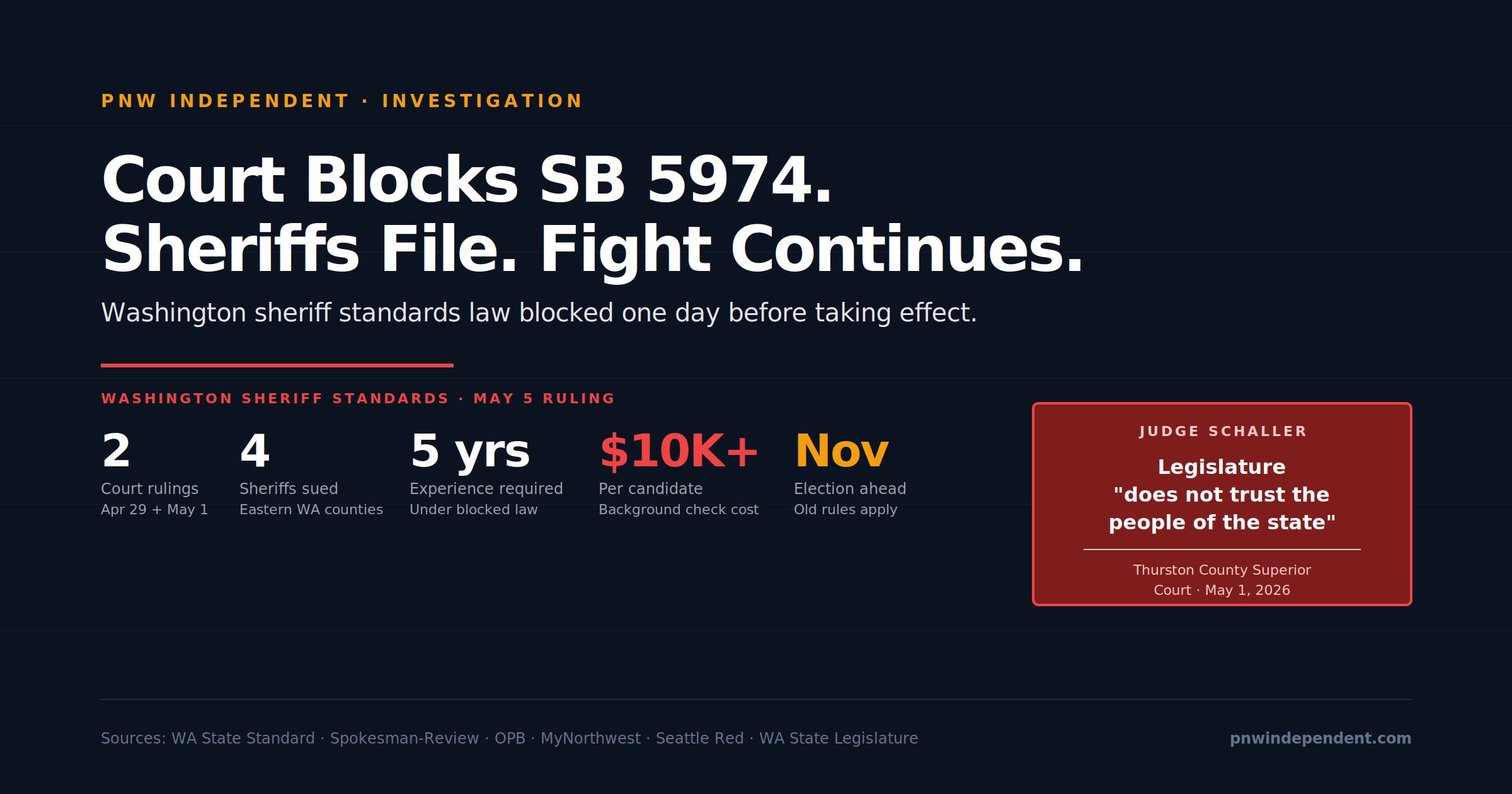
TL;DR: The Washington Supreme Court refused on May 5, 2026 to reinstate Senate Bill 5974 — the sweeping sheriff standards law that would have required elected sheriffs to meet the same eligibility criteria as appointed police chiefs. Specifically, a Thurston County Superior Court judge had blocked the law one day before it was set to take effect. Furthermore, the law was challenged by four Eastern Washington sheriffs — John Nowels of Spokane, Glenn Blakeslee of Pend Oreille, Brad Manke of Stevens, and Ray Maycumber of Ferry. A second lawsuit was filed by the Washington State Sheriffs’ Association and sheriff candidates from Kitsap and Asotin counties. Judge Christine Schaller ruled the law “fails to provide the kind of notice” needed for sheriffs to understand what conduct it prohibits. Furthermore, candidate filing for the November election is happening right now. The fight over Washington sheriff standards is far from over. Here is what the documents actually show.
What the Washington Sheriff Standards Law Actually Required
The Washington sheriff standards law — formally Substitute Senate Bill 5974 — was the most significant change to state sheriff eligibility in decades. Specifically, the law was sponsored by Senator John Lovick (D-Mill Creek) along with ten co-sponsors. Furthermore, the bill passed both chambers and was set to take effect on April 30, 2026.
The Specific Requirements
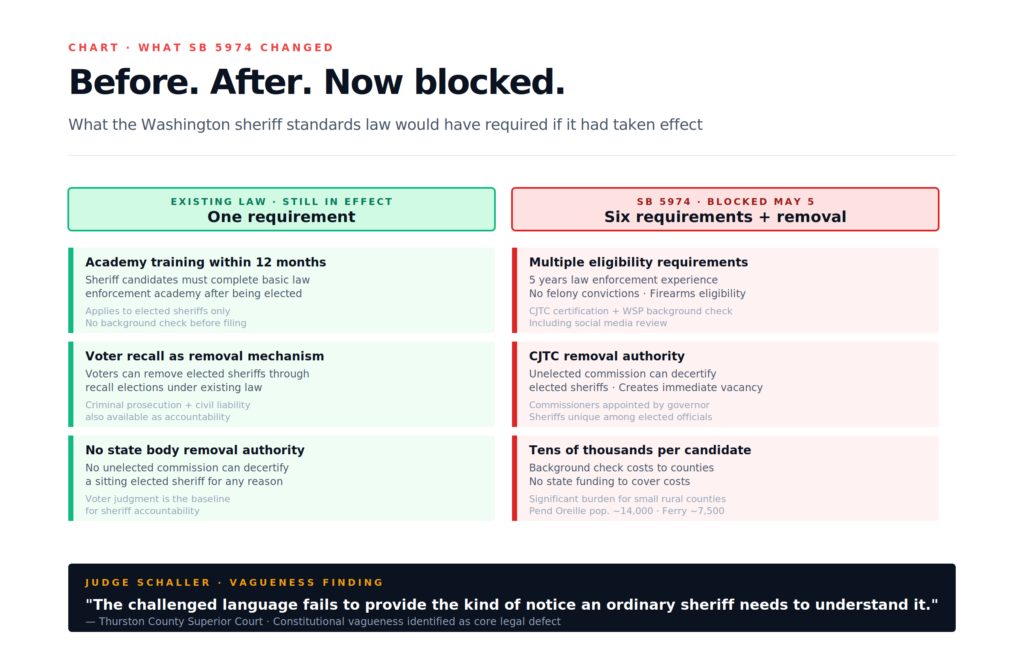
Under existing Washington law, the only requirement for elected sheriffs was completion of basic law enforcement academy training within 12 months of being elected. That requirement applied only to elected sheriffs — not appointed ones. Furthermore, sheriff candidates were not required to undergo background checks before running for office.
SB 5974 changed that significantly. The new Washington sheriff standards would have required candidates and incumbent sheriffs to meet the following criteria:
- No felony convictions
- Legal ability to possess firearms
- Five years of law enforcement experience minimum
- Criminal Justice Training Commission (CJTC) certification maintained throughout the term
- Background check from Washington State Patrol including social media reviews
- Sworn statement at the time of candidacy filing that the candidate meets the eligibility requirements
Specifically, sheriffs who failed to meet these requirements could have their certification revoked. Furthermore, decertification would create an immediate vacancy in the office.
The Removal Mechanism
The most controversial element of the Washington sheriff standards law was the removal mechanism. Specifically, the law gave the Criminal Justice Training Commission — a body whose members are appointed by the governor — the authority to decertify elected sheriffs for failing to maintain standards.
Therefore, an elected sheriff could be removed from office by an unelected commission. Furthermore, that mechanism applied to sheriffs even though they had been chosen by voters. Specifically, the bill’s structure mirrored existing decertification authority for appointed police chiefs and marshals — but those officials had never been elected in the first place.
The Stated Purpose
The Senate bill report identified the law’s underlying rationale: aligning sheriff standards with those of other law enforcement leaders. Specifically, the bill report noted:
“This bill will enhance public trust and confidence in law enforcement and align standards and eligibility requirements for all law enforcement leaders. People enforcing the law shouldn’t have a history of violating it.”
Furthermore, supporters argued that sheriffs already perform essentially the same duties as police chiefs. Specifically, both supervise armed officers, arrest people, and access criminal justice databases. Therefore, supporters argued, both should be held to equivalent eligibility standards.
That argument was the bill’s central justification. Voters, however, never got to weigh in directly.
How the Washington Sheriff Standards Lawsuit Got Filed
The legal challenge to SB 5974 came from multiple directions simultaneously. Furthermore, the speed of the litigation reflects how seriously sheriffs viewed the law. Specifically, two separate lawsuits were filed in the weeks leading up to the law’s effective date.
The Four Eastern Washington Sheriffs
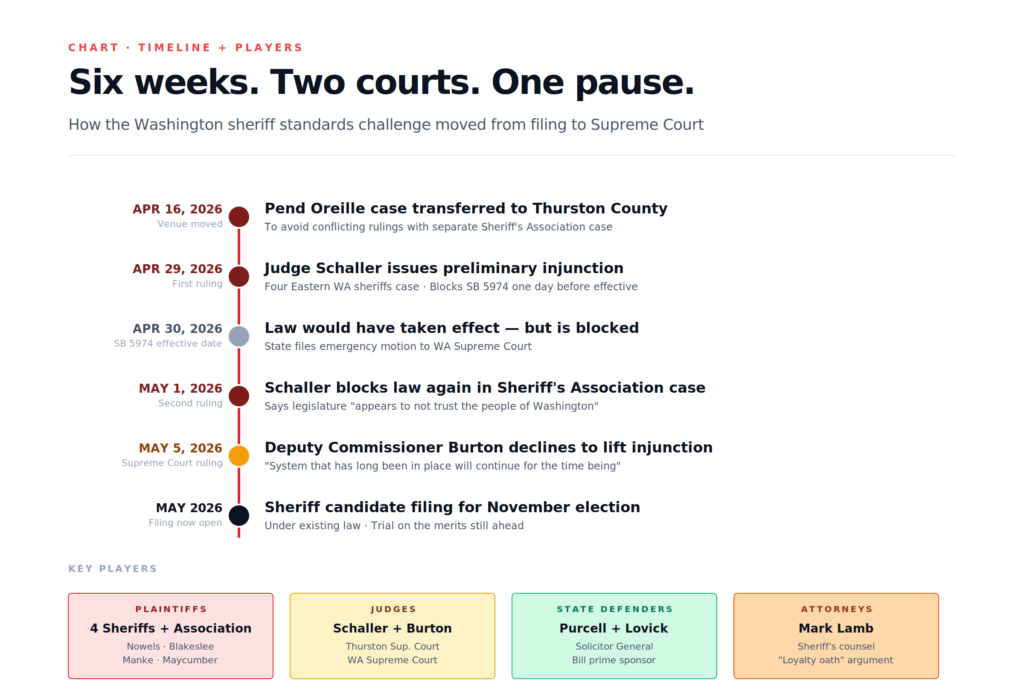
The first lawsuit was filed in Pend Oreille County by four sheriffs from Eastern Washington:
- John Nowels — Spokane County Sheriff
- Glenn Blakeslee — Pend Oreille County Sheriff
- Brad Manke — Stevens County Sheriff
- Ray Maycumber — Ferry County Sheriff
Specifically, all four sheriffs are up for election in November 2026. Furthermore, all four are Republican or right-leaning in counties that vote consistently Republican. Therefore, the case combines genuine constitutional concerns with significant political stakes.
The case was eventually moved to Thurston County by judicial order. Specifically, the move was made to avoid potentially conflicting rulings with a separate, related case already filed in Thurston County. Furthermore, Thurston County is also where Olympia is located — the venue typically used for cases challenging state legislation.
The Sheriff’s Association Lawsuit
A second lawsuit was filed by the Washington State Sheriffs’ Association along with sheriff candidates from Kitsap County and Asotin County. Furthermore, that case was assigned to the same judge handling the first lawsuit, Thurston County Superior Court Judge Christine Schaller.
That second lawsuit broadened the challenge beyond the four Eastern Washington plaintiffs. Specifically, including the candidates from Kitsap and Asotin meant the lawsuit represented not just incumbent sheriffs but also people seeking to run for the office. Therefore, the case argued the law affected First Amendment rights of would-be candidates, not just sitting sheriffs.
The “Loyalty Oath” Argument
Attorney Mark Lamb, representing the four Eastern Washington sheriffs, characterized the law starkly during the April 29 hearing. Specifically, Lamb argued the law amounted to a “loyalty oath” that would allow the state — rather than voters — to control who could run for sheriff. Furthermore, Lamb argued the requirement could infringe on free speech.
“We’re talking about the gravest possible consequence under the First Amendment, where time is of the essence,” Lamb explained. “In this situation, that an abridgment of a First Amendment right, even for minimal periods of time, unquestionably constitutes an irreparable injury.”
That framing matters. Specifically, the First Amendment argument shifts the case from a pure regulatory dispute to a constitutional question about who controls access to elected office. Furthermore, the courts have historically been highly protective of ballot access — even when the underlying motivation for restrictions is regulatory.
The State’s Counter-Argument
State attorneys, led by Solicitor General Noah Purcell, countered that sheriff candidates already certify similar standards under existing law. Furthermore, the state argued the lawsuit is based on a misunderstanding of the statute. Specifically, Purcell argued the law simply extends to elected sheriffs the same eligibility framework that already applies to appointed chiefs and marshals.
That argument has logic. However, Judge Schaller did not find it persuasive at the injunction stage. Specifically, the judge found constitutional questions sufficient to block the law pending full trial — a determination that survived Supreme Court review on May 5.
How Judge Schaller Reasoned the Washington Sheriff Standards Injunction
Thurston County Superior Court Judge Christine Schaller issued the preliminary injunction blocking SB 5974 on April 29, 2026. Furthermore, Schaller subsequently issued a second injunction in the related Sheriff’s Association case on May 1. Specifically, both rulings rested on similar constitutional concerns.
The Vagueness Finding
Schaller’s most consequential finding was that the Washington sheriff standards law was unconstitutionally vague. Specifically:
“I find that the challenged language in [SB 5974] is unconstitutional. It fails to provide the kind of notice that will enable an ordinary person, or an ordinary sheriff, to understand what conduct it prohibits.”
That vagueness finding matters for the long-term prospects of the law. Specifically, vagueness is a high bar for legislation to clear under Washington’s constitution. Furthermore, fixing vagueness typically requires substantive rewriting — not just procedural adjustments. Therefore, even if the state ultimately prevails on other arguments, Schaller’s vagueness conclusion could require the legislature to redraft the law entirely.
The Eligibility Standards Concern
Schaller went further on the specific eligibility requirements. Specifically, the judge concluded that the law unfairly held sheriffs to higher eligibility standards than other elected officials. Furthermore, Schaller found that no other elected officials in Washington can be removed by an unelected commission.
That conclusion is structurally important. Specifically, sheriffs are unique among elected officials in being subject to performance-based removal by a state body. Furthermore, the court found that uniqueness constitutionally problematic. Therefore, the law’s central enforcement mechanism — CJTC decertification — was identified as a fundamental problem, not a procedural detail.
The Free Speech Concern
Schaller voiced separate serious concerns about the law’s potential to target free speech rights. Specifically, Section 9 of the law opened the door for the CJTC to review past conduct — including social media posts and associations — when determining whether a sheriff should be decertified.
That review mechanism creates two concerns. First, it gives the commission broad discretion to consider speech-related conduct in eligibility decisions. Furthermore, it provides incentive for sheriffs and candidates to avoid public statements that might trigger commission review. Specifically, that self-censorship effect is itself a First Amendment concern, separate from any individual decertification decision.
The Judicial Comment That Defines the Case
In a separate hearing on May 1, Schaller made a comment that has come to define the political stakes of the Washington sheriff standards case:
“It appears that the Legislature does not trust the people of the state of Washington to have good judgment and to elect people to the office of county sheriff.”
Specifically, that framing captures the underlying tension. Furthermore, supporters of the law would characterize it as ensuring qualified officials regardless of voter preferences. However, Schaller’s framing treats voter judgment as the constitutional baseline. The court’s interpretation of which value takes precedence will determine the law’s ultimate fate.
What the Supreme Court Did on Washington Sheriff Standards
On May 5, 2026, the Washington Supreme Court took up the state’s emergency appeal of Schaller’s injunction. Furthermore, the result was significant — but procedurally specific. Specifically, the Court did not rule on the underlying constitutional questions. The Court simply declined to pause Schaller’s injunction while the case continues.
The Deputy Commissioner Ruling
The actual ruling came from Washington Supreme Court Deputy Commissioner Walter Burton. Specifically, Burton declined the state’s emergency motion to stay the injunction pending full Supreme Court review. Furthermore, Burton offered specific reasoning:
“Denying a stay essentially means that the system that has long been in place will continue for the time being. Petitioners do not show that immediate harm is likely to result from at least temporarily maintaining this status quo.”
That reasoning matters. Specifically, the state argued in its motion that allowing the injunction to remain in place during candidate filing would create lasting harm. Furthermore, the state argued that some candidates who could not have qualified under the new Washington sheriff standards would now file for office, creating future complications. Burton rejected that framing.
Specifically, Burton wrote:
“Staying the preliminary injunction, on the other hand, risks irreparable deprivations should the provisions applicable to sheriffs be invalidated by final judgment.”
In other words: the Court saw greater risk in temporarily enforcing a possibly unconstitutional law than in temporarily not enforcing a possibly constitutional one. That asymmetric risk analysis is standard in injunction cases — but it strongly favors the sheriffs going forward.
Why the Procedural Ruling Matters
The Supreme Court’s procedural decision functions as a partial preview of how the underlying case might be decided. Specifically, when appellate courts decline to stay lower-court injunctions, they typically have already concluded that the injunction has a reasonable chance of being upheld on the merits. Furthermore, the deputy commissioner’s reasoning suggests the law’s constitutional vulnerabilities are taken seriously by the higher court.
Therefore, while the Supreme Court did not rule on whether SB 5974 is constitutional, the decision to leave Schaller’s injunction in place signals concern. Specifically, the law remains blocked. Furthermore, sheriff candidates can file for the November 2026 election under existing standards — not under the new Washington sheriff standards.
The Filing Deadline Context
The Supreme Court ruling came at a critical moment. Specifically, the candidate filing deadline for the November 2026 election fell during the same week. Furthermore, four county sheriff positions held by the plaintiff sheriffs were on the ballot. Therefore, if the Supreme Court had reinstated the law during this period, the plaintiff sheriffs themselves could have been blocked from running. The Court’s decision preserved their ability to file.
That outcome is what Sheriff Manke characterized after the original injunction:
“We’re not hiding from accountability. We are absolutely accountable to the people that elect us. This is really about protecting free and fair elections and protecting our voters’ rights.”
Specifically, that framing positions the sheriffs not as opposing accountability but as defending voter prerogatives. Furthermore, that framing has political resonance in Eastern Washington counties where voter trust in state government is historically lower than in Western Washington.
What State Officials and Advocates Are Saying About Washington Sheriff Standards
The Washington sheriff standards case has drawn responses from both supporters and opponents of SB 5974. Furthermore, the responses reveal the political coalitions on each side. Specifically, the divide does not map cleanly onto urban-vs-rural or partisan lines — though those patterns are visible.
Sheriff Nowels: “Relieved”
Spokane County Sheriff John Nowels — the most prominent of the four plaintiffs — characterized the original injunction as a relief. Specifically, Nowels said after the hearing that he was “relieved” at Schaller’s ruling. Furthermore, Nowels has not publicly characterized himself as anti-accountability — he has framed the lawsuit as a defense of voter rights and electoral integrity.
That framing is consistent with how rural Washington sheriffs have historically positioned themselves. Specifically, the rural sheriff role combines law enforcement leadership with elected accountability — a hybrid that does not exist for police chiefs. Furthermore, the case for treating that hybrid as constitutionally different from appointed chiefs has substance, regardless of how it interacts with current political dynamics.
Coalition for Police Accountability: “Disappointed”
Debbie Novak, a member of the Washington State Coalition for Police Accountability (the advocacy group that pushed for SB 5974), expressed disappointment in the court rulings. Specifically:
“We’re not asking for anything of our leaders, meaning our police chiefs, our marshals and our chiefs, that we’re not already asking of our frontline officers. At the very least, they should have to meet the requirements that their subordinates have to meet.”
That argument has technical force. Specifically, line officers in Washington must complete CJTC certification, maintain it, and can lose it for misconduct. Furthermore, supervisory officers are subject to similar standards. Therefore, the Washington sheriff standards law was designed to extend the same framework to the chief executive of county law enforcement. Why should the leader of a department be held to lower standards than the officers the leader supervises?
That is a reasonable question. The court’s answer was: because the leader was directly elected by voters. Different constitutional category. Different rules.
Rep. Walsh: “Awful”
State Rep. Jim Walsh (R-Aberdeen) was one of the most vocal House Republicans against SB 5974. Furthermore, Walsh characterized the law as “awful” and argued the Democrats’ bill handed an unelected, governor-appointed commission the power to remove sheriffs voters chose to elect.
That framing — focusing on the unelected commission’s power over elected officials — is the strongest political argument against the law. Specifically, it works across partisan lines because Americans across the political spectrum are generally skeptical of unelected bodies overriding elected ones. Furthermore, that skepticism is what gave the lawsuit broad political resonance beyond Eastern Washington partisan dynamics.
Sen. Lovick: Defending the Law
Senate sponsor John Lovick (D-Mill Creek) has defended the law through the Senate bill report and public testimony. Specifically, Lovick’s argument is the parallel-standards framing — that sheriffs should meet the same standards as their subordinates and equivalent to police chiefs. Furthermore, Lovick framed the law as enhancing accountability without restricting voter choice.
That framing is technically accurate but understates the constitutional concerns. Specifically, the law did not just establish parallel standards — it gave an unelected commission removal authority over elected sheriffs. Those are not the same thing. Furthermore, the courts have now identified the removal mechanism as the constitutionally problematic element.
How the Washington Sheriff Standards Case Connects to Broader Accountability Patterns
The Washington sheriff standards case sits within the broader accountability landscape PNW Independent has documented. Furthermore, the case adds important nuance to the structural-failure thesis. Specifically, it raises the question: what happens when accountability legislation gets blocked in court?
The Accountability Lifecycle
Most of PNW Independent’s investigative coverage has documented accountability failures — KCRHA’s missing $13 million, Ferguson’s ethics violations and transparency crackdown, King County DCHS’s $813K alleged steered to family. Furthermore, those pieces document situations where accountability mechanisms either did not exist or failed to work.
This case is different. Specifically, this is a case where the legislature passed an accountability law that affected a category of elected officials. Furthermore, the courts then blocked it on constitutional grounds. Therefore, the case raises a more sophisticated question: how should constitutional protections balance against accountability infrastructure?
That question does not have a simple answer. Specifically, both values matter. Furthermore, the constitutional protections that block SB 5974 are the same protections that allow legitimate disagreement with state policy to flourish. You cannot have a robust democracy without both.
The Cost Concern
One specific element of the SB 5974 debate that deserves more attention: the cost to counties. Specifically, county-level testimony during legislative hearings noted that background checks for sheriff candidates would cost “tens of thousands of dollars” per candidate. Furthermore, counties would have to reimburse Washington State Patrol for those investigations.
That cost concern is not trivial. Specifically, for smaller counties like Pend Oreille (population ~14,000) or Ferry (population ~7,500), tens of thousands of dollars per candidate represents a meaningful portion of the county’s annual election budget. Furthermore, the law did not appropriate state funds to cover those costs. Therefore, even if SB 5974 had survived constitutional challenge, the operational reality would have been significant new costs for rural counties already facing budget constraints.
The November Election Stakes
The Washington sheriff standards case is not abstract. Specifically, four sheriff positions are on the November 2026 ballot — and the plaintiffs in this case occupy those positions. Furthermore, candidate filing happened this week. Therefore, the practical effect of the May 5 Supreme Court ruling is that the same sheriffs who challenged SB 5974 can run for re-election under the old rules.
That outcome is what the Court determined was the appropriate status quo while litigation continues. Specifically, voters in Spokane, Pend Oreille, Stevens, Ferry, Kitsap, and Asotin counties will weigh sheriff candidates under existing eligibility standards. Furthermore, those voters will also implicitly weigh whether they support the sheriffs’ position in this lawsuit. The November election is now part of the political record of the SB 5974 fight.
What Should Happen Next on Washington Sheriff Standards
The Washington sheriff standards case is not over. Specifically, the trial on the merits is still ahead. Furthermore, several distinct outcomes are possible — each with different implications.
1. Trial on the Merits
The case still requires full trial. Specifically, Judge Schaller’s injunction is a preliminary ruling. Furthermore, the underlying constitutional questions will be fully briefed and argued in the coming months. Therefore, the case could ultimately:
- Strike down SB 5974 in its entirety
- Strike down specific sections (likely Section 9) while preserving others
- Uphold the law against the constitutional challenge
- Send the case back to the legislature for substantive revision
Each outcome has different implications. Specifically, a complete invalidation would require entirely new legislation. Furthermore, a partial invalidation might allow some elements of the Washington sheriff standards framework to survive while others are struck down.
2. Legislative Revision
The cleanest path forward may be legislative revision. Specifically, the legislature could revise SB 5974 to address Schaller’s vagueness concerns and remove the most constitutionally problematic elements. Furthermore, the 2027 legislative session begins in January — which gives the legislature time to craft a replacement that addresses constitutional concerns.
Specifically, the revision could:
- Require more specific notice about what conduct triggers decertification
- Limit social media review to specific categories of unlawful speech, not general associations
- Provide direct legislative or judicial review of decertification decisions instead of unilateral CJTC authority
- Appropriate state funds to cover background check costs for rural counties
- Maintain parity between sheriffs and police chiefs without creating unique removal authority for sheriffs
Each revision addresses a specific constitutional concern Schaller identified. Furthermore, the resulting law could potentially survive constitutional challenge if drafted carefully.
3. Constitutional Amendment
A more aggressive path: amend the state constitution to clarify the legislature’s authority to set qualifications for elected sheriffs. Specifically, Washington’s constitution currently leaves the question of sheriff qualifications somewhat ambiguous. Furthermore, a constitutional amendment could resolve that ambiguity in either direction.
However, constitutional amendments require two-thirds majorities in both chambers and majority approval at the ballot box. Therefore, this path is more difficult than legislative revision. Specifically, the same political dynamics that led to SB 5974’s challenges would also affect a constitutional amendment.
4. Standardize Sheriff Selection
A more fundamental option: standardize how sheriffs are selected. Specifically, Washington could move toward appointed county police chiefs in some or all counties. Furthermore, that would eliminate the elected-vs-appointed dimension entirely. However, that approach would require constitutional amendment and would face significant political resistance — particularly in rural counties where elected sheriff accountability is highly valued.
5. Voter Education on Existing Mechanisms
Specifically, the existing system for sheriff accountability already includes:
- Recall elections — voters can remove sheriffs through recall
- County prosecutor oversight — sheriffs can be charged with criminal violations
- Civil liability — sheriffs and counties face civil suits for misconduct
- CJTC certification — sheriffs already must obtain certification within 12 months
Furthermore, public records requests, journalism, and county council oversight all provide accountability infrastructure. Specifically, the question is whether those existing mechanisms are sufficient — and if not, what targeted changes might address the gaps without raising constitutional concerns.
The Bottom Line on Washington Sheriff Standards
The Washington sheriff standards case is now in the books for the immediate future. SB 5974 is blocked. The injunction stands. Sheriff candidates can file for the November election under existing rules. Furthermore, the underlying constitutional questions will be decided in the months ahead.
That outcome is not a victory for accountability skeptics. Specifically, the courts did not endorse the position that sheriffs should be exempt from standards. Furthermore, the courts simply found that the specific Washington sheriff standards law SB 5974 had constitutional defects — including vagueness, potential First Amendment problems, and structural concerns about unelected commissions removing elected officials.
Those are legitimate constitutional concerns. Specifically, they are the concerns the courts exist to address. Furthermore, addressing them would actually strengthen any future Washington sheriff standards law, not weaken it.
The deeper question raised by the case is about how accountability infrastructure interacts with electoral democracy. Voters elect sheriffs. The legislature can set qualifications. Courts can rule on constitutional limits. Furthermore, all three of those mechanisms have legitimate roles. Specifically, the SB 5974 case represents a moment when those three mechanisms conflicted — and the courts had to determine which prevails when they do.
For Washington voters, the practical implication is now simpler. The November 2026 election will determine, in part, who occupies the sheriff offices challenged in this case. Furthermore, the legislative response in 2027 will determine whether a revised Washington sheriff standards law emerges from the constitutional challenge. Specifically, both Eastern and Western Washington voters now have the opportunity to weigh in on whether they support the underlying policy direction — and on which legislators they believe will draft a constitutionally durable version of it.
The court ruling closes one chapter. The political and legislative fights are still ahead. The clock is running on candidate filing. The clock is also running on what comes after.
The fundamental question — how does a democracy balance voter judgment with professional standards for the people enforcing the law? — has not been answered. Furthermore, that question will continue to define the Washington sheriff standards debate for years. The May 5 ruling determined the rules for this election cycle. The rules for the next one remain very much in play.
Related Reading on PNW Independent
- Ferguson Ethics: How Brutal Failures Exposed Olympia’s Crisis
- Washington Millionaire’s Tax: How a Brutal Court Ruling Exposed Washington’s Tax Crisis
- King County DCHS: How Brutal Failures Exposed the IG Gap
- Who Really Runs Seattle: Two Machines, One Ruling Class
External Sources
- Washington State Standard — WA Supreme Court rejects state’s attempt to unblock sheriff eligibility law (May 5, 2026)
- Spokesman-Review — Washington Supreme Court declines attempt to reinstate sheriff standards law (May 5, 2026)
- Washington State Standard — Judge blocks Washington’s new sheriff standards law (April 29, 2026)
- Spokesman-Review — Judge again blocks sheriff standards law (May 1, 2026)
- OPB — Judge blocks Washington’s new sheriff standards law
- MyNorthwest — Washington sheriff standards law partially blocked by judge
- Seattle Red — Washington Supreme Court refuses to lift SB 5974 injunction
- Washington State Legislature — SB 5974 Bill Text
- Washington State Legislature — SB 5974 Senate Bill Report