
Who Really Runs Seattle: Two Machines, One Ruling Class
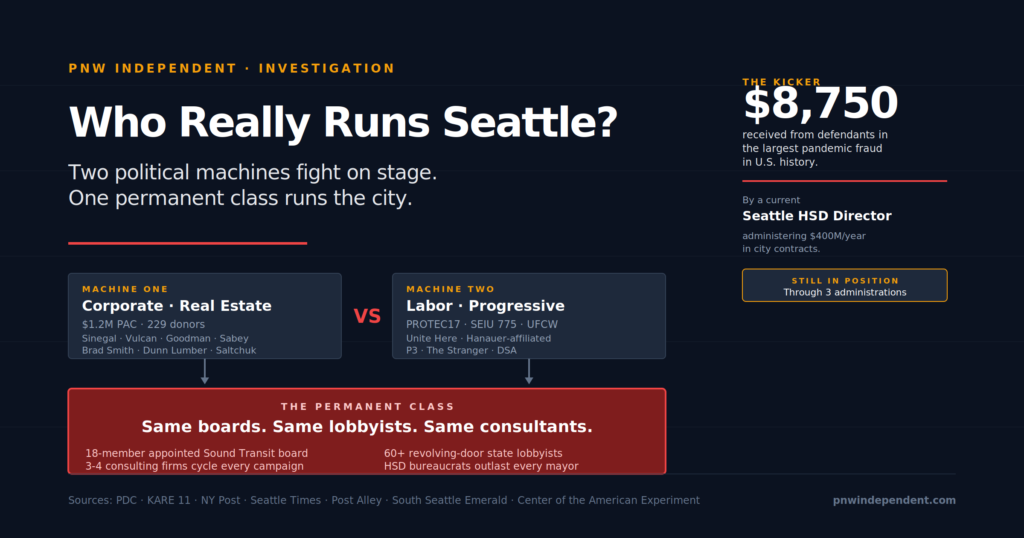
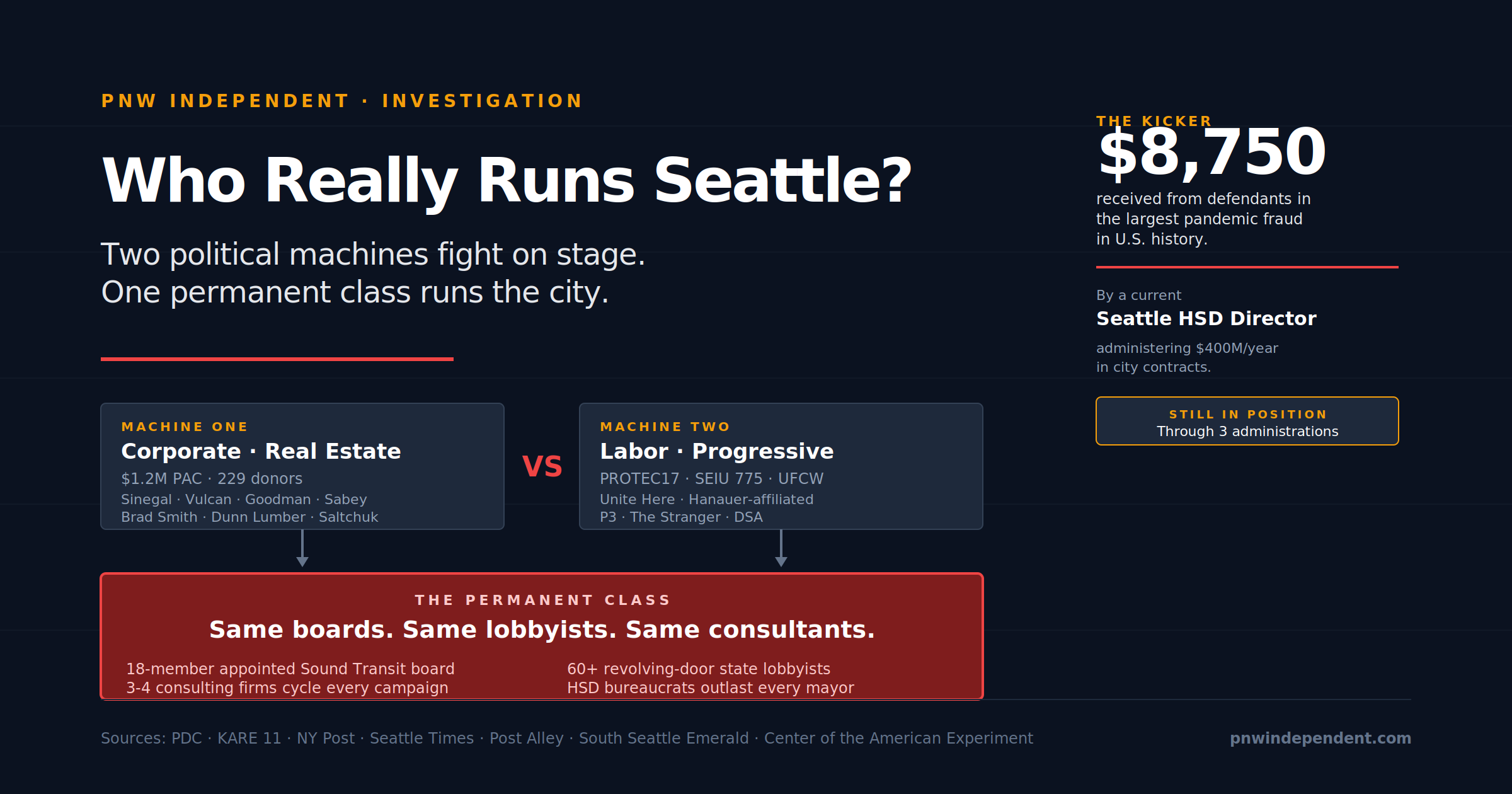
Who really runs Seattle? Not Bruce Harrell. Not Katie Wilson. The mayor’s office has changed hands twice in five years. The corporate-real estate machine and the labor-progressive machine spend millions fighting each other on stage. Behind them, the same 18-member appointed boards, the same three or four political consulting firms, the same 60-plus revolving-door lobbyists, and the same handful of bureaucratic appointees keep running the same departments through every election. This is who really runs Seattle. The candidates rotate. The ruling class doesn’t. And when you follow the money — including $8,750 from defendants in the largest pandemic fraud in U.S. history that ended up in the campaign account of a current Seattle Human Services Department director — the machine looks less like democracy and more like a permanent committee with elections as a sideshow.
Who Really Runs Seattle? Not Who You Voted For
The 2025 Seattle mayoral race was sold as a generational battle. Incumbent Bruce Harrell, a centrist Democrat backed by tech, real estate, and hospitality money, ran against challenger Katie Wilson, a self-described democratic socialist backed by labor unions and progressive nonprofits. Wilson won by 0.73 percentage points — the closest mayoral election in Seattle by margin since 1906.
Two completely different ideologies. Two completely different visions. Two completely different sets of donors. And yet, look at who actually administers the city’s $400 million human services budget, who sits on Sound Transit’s 18-member board, who staffs the consulting firms that run every campaign, and who lobbies the legislature in Olympia. The names don’t change. The mayors do.
If you want to know who really runs Seattle, you have to stop looking at the mayor’s office. Both machines feed the same permanent class.
Machine One: The Harrell Coalition
Mayor Bruce Harrell’s 2025 campaign was supported by an independent expenditure committee called Bruce Harrell for Seattle’s Future, which raised more than $1.2 million from approximately 229 donors before the November 2025 election. The largest individual donations included a single $100,000 contribution and multiple $50,000 gifts, according to reporting by the South Seattle Emerald, Post Alley, and KUOW.
The Donor Stack
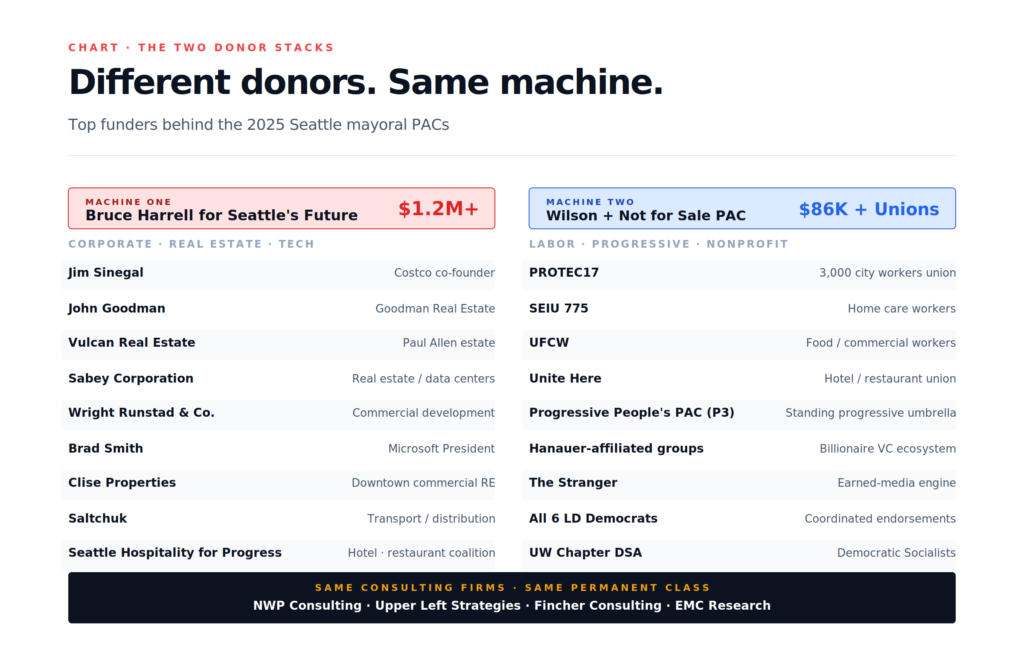
The donors to Harrell’s PAC, drawn from public PDC filings and reporting by the Seattle Times, KUOW, Post Alley, and the South Seattle Emerald, form a familiar Seattle establishment list. To understand who really runs Seattle’s corporate machine, look at this roster:
- Jim Sinegal — Costco co-founder, Issaquah resident, longtime Seattle political megadonor.
- John Goodman — Goodman Real Estate, named in multiple Seattle Times PAC analyses as a top contributor across multiple election cycles.
- Vulcan Real Estate — the Paul Allen estate’s real estate arm.
- Sabey Corporation — major Seattle property holdings.
- Wright Runstad & Company — Jon and Judith Runstad, longtime Seattle commercial development.
- Clise Properties — downtown Seattle commercial real estate.
- Brad Smith — Microsoft President, repeatedly named in IE filings.
- Dunn Lumber — $25,000 noted in 2023 cycle filings.
- Saltchuk — transportation and distribution conglomerate.
- Gordon Trucking — Steve Gordon, a recurring Harrell PAC donor.
- Seattle Hospitality for Progress — hotel and restaurant owner coalition that previously supported Jenny Durkan in 2017.
Many of these names recur in campaign filings going back to the Greg Nickels era (2002–2009). They are not unique to Harrell. They are the standing corporate-real estate establishment of Seattle, and they back whoever the establishment slate is in any given election.
Why This Matters
The PAC’s spending model tells you everything. According to Post Alley’s analysis, $20,000 of Bruce Harrell for Seattle’s Future money went to EMC Research for focus groups in August 2025 alone — money explicitly described in the filings as a “messaging exercise” looking for negative-campaign ammunition against Wilson. This is professionalized politics: the corporate donors don’t draft the policy, they fund the consultants who design the negative campaign.
Machine Two: The Wilson Coalition
Wilson’s primary supporting PAC, Katie Wilson for an Affordable Seattle, raised approximately $86,000 by early October 2025 — less than 8 percent of what the Harrell PAC raised. According to the South Seattle Emerald’s analysis, the largest single donation was $10,416.98 from a software engineer. The IE had zero organizational donations.
After Wilson finished the August primary 9 points ahead of Harrell — a result that visibly alarmed the establishment — the labor-progressive coalition belatedly built a second PAC, Seattle’s Not for Sale, which began raising small-dollar individual contributions and union money in late summer 2025.
The Wilson Donor Stack
The names here are different but the structure is just as concentrated. Drawing from PDC filings, reporting by the Seattle Times, Capitol Hill Seattle News, and the rondezvouswa.com PAC organizer’s own published account:
- PROTEC17 — the union representing approximately 3,000 city workers.
- SEIU 775 — Service Employees International Union home-care workers, historically one of Seattle’s largest political spenders.
- UFCW — United Food and Commercial Workers.
- Unite Here — hotel and restaurant workers.
- Progressive People’s PAC (P3) — the standing progressive umbrella PAC.
- Nick Hanauer-affiliated organizations — the billionaire venture capitalist whose foundation and personal-affiliated groups have funded progressive Seattle politics for over a decade.
- The Stranger — the alt-weekly that endorsed Wilson and acted as her primary earned-media engine.
Every single Democratic Party organization in Seattle endorsed Wilson in the primary, including all six legislative district Democrats and PROTEC17. That kind of unanimous early endorsement does not happen organically. It happens because a coordinated insider decision has been made.
The Wilson “Momgate” Fine
Wilson’s campaign was also fined $250 by the Seattle Ethics and Elections Commission in December 2025 after the agency determined that $10,000 her parents gave her for childcare during the campaign should have been disclosed as a campaign contribution. Wilson defended the gift in a CNN interview as “relatable,” but the SEEC found the campaign cut corners on disclosure rules. A small fine, a small story — but a documented finding, on the record, that even the candidate sold to voters as the anti-corruption alternative had her own campaign-finance issues.
The Permanent Class That Runs Seattle Regardless
Here is where the “two machines” framing breaks down — and why the question of who really runs Seattle has a different answer than which faction wins the mayoral race. Behind both machines sits a permanent class of bureaucrats, board appointees, consulting firms, and lobbyists who outlast every election cycle.
1. The Constantine Appointment Network
Dow Constantine served as King County Executive from 2009 to 2025. As we documented in PNW Independent’s Sound Transit Failure investigation, Constantine personally appointed or reappointed 9 of 18 members of the Sound Transit board during his 16-year tenure as County Executive. In April 2025, Constantine resigned as County Executive and the same Sound Transit board he had populated voted 15-0 to hire him as the agency’s CEO at a base salary of $450,000-plus, with potential to rise to $650,000 following a 2026 market study. Zero appointees recused.
But Constantine’s network goes far beyond Sound Transit. King County agencies, Metro, the regional planning bodies, the Best Starts for Kids initiative, and a web of nonprofit boards across the region are populated with Constantine appointees and former staffers. Whoever wins the mayor’s race in Seattle, whoever wins the Council races, whoever wins the County Executive race after Constantine — they all inherit a regional bureaucracy whose leadership Constantine put in place.
2. The Revolving-Door Lobbyist Problem
Washington State has no cooling-off period between leaving public service and registering as a lobbyist. According to a joint analysis by The Seattle Times and the Northwest News Network, nearly 1 in 5 of Washington’s roughly 800 registered lobbyists previously worked in state government or held elected office. That includes at least 60 lobbyists from high-ranking public positions — former state legislators, chiefs of staff, senior policy advisers, cabinet secretaries, and deputy directors at state agencies.
The examples are stark. Brian Bonlender, Governor Inslee’s Department of Commerce Director, stepped down in January 2019 and registered as a lobbyist less than a month later. Charles Knutson, a senior policy adviser to Inslee on economic development, left state service on December 22, 2020, and by January 6, 2021 — fourteen days later — had registered as a lobbyist for Amazon.
Bills to create a one-year cooling-off period have been introduced in the Washington Legislature every year since 2015. They consistently pass committee. They have never been brought to the floor for a vote. Senator Reuven Carlyle, who has sponsored most of these bills, told the Seattle Times: “The slow winter fog of political death seems to find its way toward this bill every single year.”
The bills die because the same legislators who would face cooling-off restrictions are the ones who decide whether the bills get floor votes. That is the permanent class protecting itself.
3. The Consulting Cartel
If you want to know who really runs Seattle on a day-to-day operational level, look at the consulting firms. A small number of them run essentially every Democratic, progressive, and centrist campaign in Seattle. Look across the 2021, 2023, and 2025 election cycles and you’ll see the same names attached to opposite-faction candidates:
- NWP Consulting — established 2001, Seattle-based, has worked on “hundreds of winning campaigns” by their own description, including the Fight for $15, marriage equality, and gun-background-check ballot measures.
- Upper Left Strategies — works on progressive campaigns across Washington, Oregon, and Idaho.
- Fincher Consulting — Crystal Fincher, also Political Director for Persist PAC, hosts the Hacks & Wonks podcast, on the team page of the Progress Alliance of Washington.
- Northwest Progressive Institute — research and consulting outfit that interlocks with multiple progressive PACs.
- EMC Research — corporate polling shop used by Harrell’s PAC.
These firms are paid out of every campaign cycle’s budget, regardless of which faction wins. The candidates change. The consultants don’t. They are the operators of the machine, and they get paid in any outcome.
4. The Endorsement Machine
When every Seattle legislative district Democratic organization, PROTEC17, the major unions, and the regional newspapers all endorse the same primary candidate before any vote is cast, that is not the result of independent democratic deliberation. It is the result of pre-coordination by a small number of insiders — political directors, executive directors, and consultants — who decide which candidate will be the consensus pick. The endorsements then arrive in waves to create the appearance of a groundswell.
This is how the machines actually work. Voters see the swell. Insiders organized it.
The Olow Case: Who Really Runs Seattle in Practice
If you want a single case that illustrates who really runs Seattle when the cameras turn off, consider the career of Dr. Shukri Olow, current Director of the Youth and Family Empowerment Division at the Seattle Human Services Department.
The facts that follow are drawn from PDC enforcement filings, KARE 11 News reporting, the New York Post, the Center of the American Experiment’s compiled campaign-finance analysis, and republication by IJR, AOL, the Post Millennial, and other national outlets.
The 2021 PDC Complaint
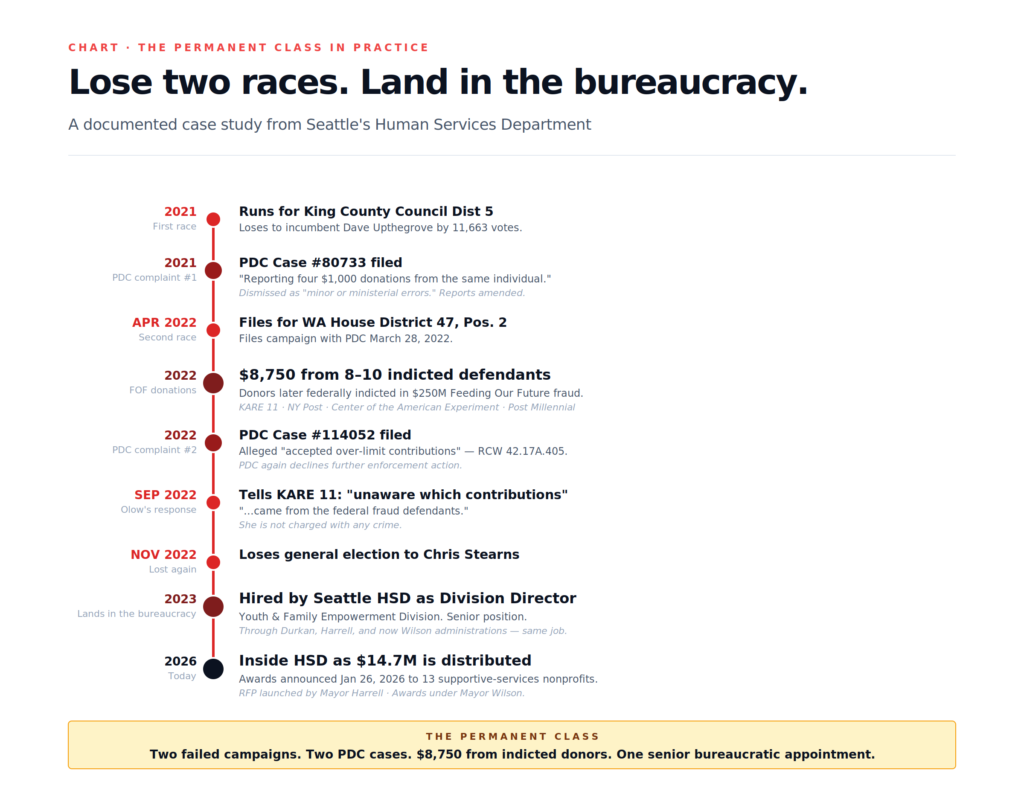
In 2021, Olow ran for King County Council District 5 and lost to incumbent Dave Upthegrove by 11,663 votes. During that campaign, a PDC complaint was filed alleging failure to timely and accurately disclose contributions — specifically, “reporting four $1,000 donations from the same individual” (PDC Case #80733). The PDC dismissed the complaint as “minor or ministerial errors” after the campaign amended its reports.
For context: four separate $1,000 donations from a single individual exceeds Washington state contribution limits and is one of the patterns campaign-finance investigators look for as a signature of straw-donor activity, in which one donor’s money is reported under multiple names to evade limits. The PDC found this case did not warrant further investigation. It does not, however, mean the underlying pattern was investigated and ruled out — only that PDC chose not to pursue it.
The 2022 PDC Complaint
In 2022, Olow ran for Washington House of Representatives in District 47, Position 2. A second PDC complaint was filed alleging she violated RCW 42.17A.405 by accepting over-limit contributions (PDC Case #114052). The PDC again declined to pursue further enforcement.
The Feeding Our Future Donations
During that same 2022 House race, Olow received approximately $8,750 in campaign contributions from individuals later federally indicted in the Feeding Our Future fraud scheme — the largest pandemic-era fraud case in U.S. history, in which roughly $250 million in federal child-nutrition funds were stolen by a network of Minneapolis-based defendants.
The number of indicted donors to her campaign is reported as 8 to 10 individuals depending on the source — KARE 11 reported 8 defendants, the Post Millennial and Center of the American Experiment reported 10. The dollar amount ($8,750) is consistent across all reporting.
According to the Center of the American Experiment’s spreadsheet (the underlying primary source republished by major national outlets), Olow’s donors also included Jamal Osman, a Minneapolis City Councilman who founded a nonprofit called Stigma-Free International that “figured into the alleged fraud after his departure,” according to the same source. Osman has not been charged.
Olow’s On-Record Response
When KARE 11 News contacted Olow about the donations in September 2022, the report stated: “When contacted by KARE 11 News, Olow was unaware which of the contributions came from the federal fraud defendants.”
That is her on-record response. She has not been charged with any crime. Federal indictments are against the donors, not the candidate. To be clear: receiving donations from individuals later charged with fraud is not itself a crime, and there is no public evidence that Olow knew about the fraud at the time.
But here is the question reasonable taxpayers are entitled to ask. Two PDC enforcement complaints in two consecutive election cycles, including one explicitly involving multiple max-out donations from a single individual — the textbook signature of a straw-donor pattern — and $8,750 from a network of defendants in the largest pandemic fraud in American history, is an unusual fact pattern for a candidate who lost both races.
Where the Permanent Class Lands
After losing the 2022 race, Olow was hired by the Seattle Human Services Department as Division Director, Youth and Family Empowerment. She has held the position since at least 2023 — appointed under HSD Director Tanya Kim, who was herself appointed acting director under Mayor Jenny Durkan in 2021 and confirmed by City Council in 2023.
Through all of this — the Durkan administration, the Harrell administration, and now the Wilson administration — Tanya Kim and Shukri Olow remain in place at HSD. The mayors changed. The bureaucrats didn’t.
The $14.7 Million Pipeline
In September 2025, Mayor Bruce Harrell launched the city’s 2025 Community Safety Request for Proposals, a $14.7 million funding opportunity to reduce gun violence and provide supportive services to communities. The RFP was administered by HSD. The application window closed November 12, 2025. Awards were announced January 26, 2026 — by which time Mayor Katie Wilson had taken office. Contracts began April 1, 2026.
Thirteen organizations were awarded supportive services funding, including African Community Housing & Development, API Chaya, Arms Around You, Bridging Cultural Gaps, CHOOSE 180, Freedom Project, If Project, Neighborhood House, Northwest Credible Messenger, REST, Seattle Children’s Hospital, Southwest Youth and Family Services, and Urban Family.
To be precise about the chronology: the RFP was Harrell’s. The award was made under Wilson. The bureaucracy that administered the entire process — HSD, with Tanya Kim as Director and Shukri Olow as a Division Director — did not change at all.
This is what “permanent class” means in practice. The mayor at the top of the press release changes. The grant pipeline does not. The same people who signed the checks under Harrell are signing the checks under Wilson, and the institutional memory that selects the awardees, sets the criteria, and writes the contracts sits with bureaucrats whose names voters will never see on a ballot.
The Democracy Voucher Paradox
Seattle voters approved the Democracy Voucher Program in 2015 and renewed its property tax funding in August 2025 for another decade. Every Seattle voter receives four $25 vouchers each cycle, redeemable for participating municipal candidates. The program is widely cited as a national model and has unquestionably increased small-donor participation — from less than 1.5 percent of Seattle adults donating to a campaign before 2017 to nearly 10 percent by 2021.
But here is the paradox the program’s defenders rarely address. PAC spending in Seattle elections has tripled since the voucher program took effect. In 2017, total independent expenditures across Seattle’s mayoral, city attorney, and council races came to about $1.1 million. By 2021, the same races saw approximately $3.4 million in independent expenditures. The 2025 cycle saw the Harrell PAC alone exceed $1.2 million.
The reason is structural. Under Citizens United, no public-financing program can ban PAC spending — only candidate fundraising can be capped. The democracy vouchers solved one problem (small donors couldn’t compete with wealthy ones) and created another (every dollar that used to flow to candidates now flows to PACs the candidates can’t legally coordinate with, run by consultants who answer to no one but the donors).
The voucher program is real reform. But it is not the reform that ends machine politics. It just rerouted the same money through a different door.
Wilson’s First-Day Problem
The question of who really runs Seattle isn’t just about the corporate machine. To be fair across the partisan ledger, Wilson has her own machine-politics issue from her first day in office.
On January 2, 2026 — her ceremonial swearing-in day — Wilson posted a statement on X declaring she “stand[s] with the Somali childcare providers who have experienced targeted harassment, and condemn[s] the surveillance campaign promoted by extremist influencers.” The statement referenced viral videos and reporting suggesting that fraud patterns similar to Minnesota’s Feeding Our Future scheme might be present in Washington State daycare programs.
At Wilson’s swearing-in, she was introduced by Iffy Abshir, a Somali immigrant from Rainier Beach now living in Minnesota. When KOMO reporters asked Abshir directly whether widespread fraud existed in Washington or Minnesota, Abshir said: “I don’t believe there’s widespread fraud at all.”
The Minnesota fraud has resulted in 78 federal indictments to date. Multiple major Minnesota Democratic officeholders, including Attorney General Keith Ellison, Mayor Jacob Frey, Representative Ilhan Omar, and Senator Omar Fateh, have collectively returned more than $50,000 in campaign contributions traced to indicted defendants. The U.S. Department of Health and Human Services has frozen approximately $185 million in federal childcare funding.
Wilson, on her first day in office, took a position on the federal investigation before any state audit of comparable Washington programs had been released. Whether that is principled solidarity with an immigrant community or premature dismissal of legitimate fraud concerns is a question fair-minded readers can answer for themselves. What it is not, however, is the action of a mayor independent of her coalition’s own pressure points.
Who Really Runs Seattle: The Honest Answer
Here is the answer the mayoral candidates will never give you:
The corporate-real estate machine and the labor-progressive machine collectively decide who can compete in Seattle politics. They split the donor universe, fund opposing slates, and cycle the same consultants between them. Whoever wins the surface fight, the back-end of city government — HSD, Sound Transit, the appointed boards, the regional planning bodies — keeps running. The bureaucrats who staff those agencies stay through every administration. The lobbyists who shape state legislation rotate freely between government service and private clients without a single day of cooling-off. The political consulting firms get paid out of every campaign budget, regardless of who wins. And the donor cap in Seattle’s celebrated democracy voucher program has produced a tripling of PAC money rather than reducing it.
This is who really runs Seattle. It is not a conspiracy. It is just the structure that the system has produced — and the structure that the people inside it have every incentive to protect.
What Real Reform Would Look Like
These are not partisan reforms. They are structural reforms. Both machines should oppose them, because both machines benefit from the status quo. That alone tells you the reforms are worth pursuing.
1. Mandatory Lobbying Disclosure for Multnomah and King County Contractors
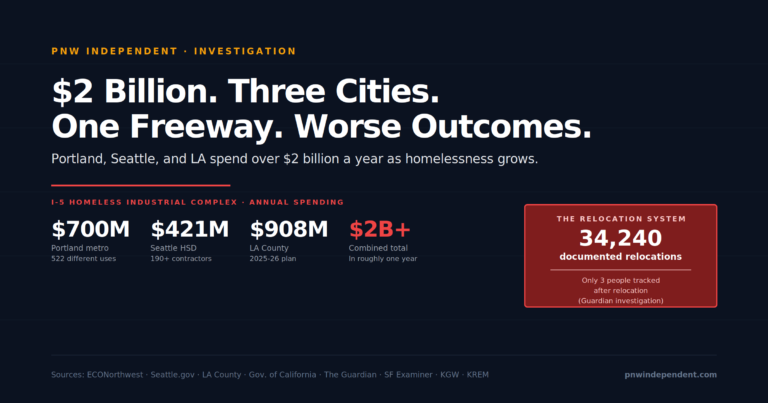
Washington State requires lobbyists to register. Seattle, the legislature, and most major West Coast jurisdictions require disclosure. King County does not require lobbyists for county contractors to register or disclose meetings with officials. Neither does Multnomah County, as we documented in Portland’s Homeless Industrial Complex investigation. Closing this loophole would cost the regional government nothing and would make every contracting decision more legible to the public.
2. State Cooling-Off Period for Lobbyists
A one-year cooling-off period before former state employees and elected officials can register as lobbyists has passed committee in the Washington Legislature every year since 2015. It has never received a floor vote. Bringing this bill to the floor — and forcing every legislator to take a recorded position — would be the single highest-leverage reform in Washington state government today.
3. Mandatory State Performance Audit of Seattle HSD
The Washington State Auditor’s Office and JLARC (the legislative auditor) should jointly conduct a comprehensive performance audit of Seattle’s Human Services Department, covering contracting practices, awardee selection, executive compensation, and the standing relationships between HSD bureaucrats and the nonprofits receiving the largest contracts. The Multnomah County Auditor’s parallel work on JOHS produced concrete findings that drove real reform conversations. Seattle has had nothing comparable.
4. Direct Election of the Sound Transit Board
The 18-member Sound Transit board has zero directly elected members. Reform would replace the appointed structure with a directly elected board, on the model of most successful European transit agencies and several large U.S. transit districts. Direct accountability ends the cross-appointment loops that allowed the Constantine self-appointment.
5. Real Outside Audit of the Democracy Voucher Program
The program is celebrated. It is also producing the perverse outcome of tripling PAC spending. Voters should know the full picture, audited by a body that does not depend on the program’s continued existence for its operating budget.
6. Public Disclosure Database for All Returned Donations
When campaigns return donations from indicted defendants — as Ellison, Frey, Fateh, Omar, and Olow’s campaigns variously have — the returned donations are typically reported in subsequent PDC filings but not flagged in a single public-facing database. A simple state-level Returned Donations Registry would let any voter or journalist quickly see which campaigns have refunded contributions tied to ongoing federal investigations, without having to comb through hundreds of pages of separate filings.
The Bottom Line on Who Really Runs Seattle
If you’re still asking who really runs Seattle after reading this, here’s the honest answer: Seattle is not run by Bruce Harrell. It is not run by Katie Wilson. It is run by the permanent class that connects them — the donors, the consultants, the bureaucrats, the lobbyists, and the appointees who outlast every election cycle and whose names voters never get to vote on.
This is not unique to Seattle. Portland’s homeless services pipeline, as we documented previously, is structurally identical: government pass-through agency, network of connected nonprofits, no lobbyist disclosure rules, executive compensation packages voters never approved, and outcomes that get worse as spending grows. The Sound Transit failure, as documented here, follows the same pattern: appointed boards, self-appointed CEOs, generational cost overruns, and zero accountability mechanisms voters can directly trigger.
The two-machine model — corporate-establishment versus labor-progressive — is the surface fight. It generates the headlines. It produces the campaign signs. It funds the consultants. It is what voters are told the political contest is about.
The permanent class is the actual contest. And until Washington state passes a cooling-off period, until King County requires lobbyist disclosure for its contractors, until Sound Transit’s board is directly elected, and until the Seattle Human Services Department gets a state performance audit, the question of who really runs Seattle has the same answer no matter who wins the next election.
The candidates rotate. The ruling class doesn’t.
Related Reading on PNW Independent
- The Portland Homeless Industrial Complex: Inside the $700M Machine
- Sound Transit Failure: $185B Boondoggle Run by Insiders
- Black Panther Park Skyway: The Funded Double Standard
- King County Parks Levy: Where the $1.5 Billion Actually Goes
External Sources
- Washington State Public Disclosure Commission — PDC Case #80733 (Olow 2021 KCC complaint)
- Washington State Public Disclosure Commission — PDC Case #114052 (Olow 2022 House complaint)
- KARE 11 — Which politicians received donations from Feeding Our Future defendants?
- Center of the American Experiment — Ask, and ye shall receive (Feeding Our Future donor spreadsheet)
- Post Millennial — Ilhan Omar and state leadership connected to Minnesota Somalian fraud scheme
- South Seattle Emerald — Everything Is Political: Big Money in Seattle’s Mayoral Race
- Post Alley — Adding up the Money in the Seattle Mayor’s Race
- Seattle Times — PAC spending in Seattle elections tops $3 million
- Seattle Times — From elected official to lobbyist in just days: Revolving door in Olympia
- Capitol Hill Seattle — Wilson campaign hit with $250 ‘Momgate’ fine
- Mayor Harrell’s Office — $14.7M Community Safety RFP announcement (September 2025)
- Seattle Medium — Seattle Invests $14.7M In Community Programs To Reduce Gun Violence
- Seattle Human Services Department Leadership Page
- Seattle Ethics & Elections Commission Campaign Finance Disclosure
- Washington State PDC Political Disclosure Database
17 Comments