Sound Transit Failure: $185B Boondoggle Speed Run
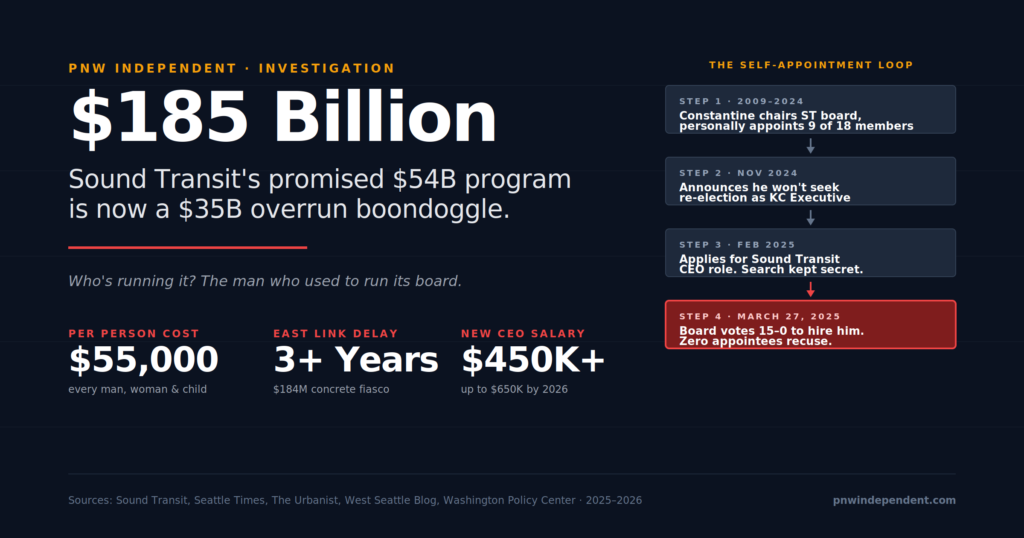
The Sound Transit failure is now officially a $185 billion boondoggle with a $35 billion cost overrun and a $20-30 billion affordability gap through 2046. Every man, woman, and child in the three-county tax district now owes roughly $55,000 toward a rail system most of them will never ride. Pierce County voted against ST3 and is being deprioritized anyway. Seattle builds light rail for $179 million per mile — roughly nine times what Salt Lake City, Norfolk, or Santiago, Chile pay for comparable systems. The agency is governed by 18 unelected appointees. In April 2025, the former board chair hired himself as CEO at $450,000-plus with a 15-0 vote from board members he had personally appointed. This is the Sound Transit failure nobody running it wants you to understand.
The Sound Transit Failure Nobody Voted For
Let’s start with the number that matters. On September 4, 2025, Sound Transit staff briefed the agency’s board on “updated bottom-up cost estimates” for the voter-approved ST3 program. The number they delivered: $14 billion to $20 billion in new capital costs in 2025 dollars, or $22 billion to $30 billion in year-of-expenditure dollars. Add that to the prior ST3 baseline, and the total Sound Transit program cost now reaches approximately $185 billion — a $35 billion overrun on a plan voters approved in 2016.
Divide that by the 3.4 million people inside the Sound Transit tax district — parts of King, Pierce, and Snohomish counties — and the result is stark: roughly $55,000 per resident, including every infant and retiree. And that figure does not include long-term debt service running into the 2060s, which will fall on Washingtonians who have not yet been born.
For context, the median U.S. household income in 2024 was approximately $80,000. Sound Transit has now committed every family of four in its tax district to contribute an amount equal to roughly 2.75 times their annual gross income over the life of the program. And the trains still do not run on time. Or, in much of the district, at all.
This is the Sound Transit failure. And it has a face.
Who Runs Sound Transit? Start with the Self-Appointed CEO
Dow Constantine served as King County Executive from 2009 to 2025. That role comes with an automatic seat on the 18-member Sound Transit board. Furthermore, the King County Executive has the sole power to appoint the county’s other nine board members. Over his 16 years on the board, including multiple terms as board chair, Constantine personally appointed or reappointed nine of the 18 members who now govern the agency — a working majority.
In November 2024, Constantine announced he would not seek a fifth term as King County Executive. In February 2025, his name surfaced as a candidate for the Sound Transit CEO job. The board’s executive committee, which he had chaired, then conducted a CEO search that the agency refused to make public. When transit advocates filed public records requests, Sound Transit declined to disclose the identities of the other 60 applicants, the final shortlist, or the scoring process.
On March 27, 2025, the Sound Transit board voted 15-0 to hire Dow Constantine as CEO at a base salary of $450,000 per year, with “two one-year renewal options” and a market study to be completed at the end of 2025 that could push the salary as high as $650,000. Constantine recused himself from the vote. Nine of the remaining board members owed their seats to Constantine’s appointment. Not one of them recused. Not one of them asked for a public comparison of the 60 applicants.
This is not corruption in the sense of bags of cash. It is something subtler and, in certain ways, worse: a closed loop in which the same small group of regional politicians appoint each other, hire each other, and vote on each other’s contracts, all while the Sound Transit failure they collectively presided over grows by tens of billions of dollars.
The Seattle Subway Response
The grassroots transit advocacy group Seattle Subway — which actually wants the light rail system to succeed — called Constantine’s self-appointment a “massive breach of ethical standards.” Spokesperson David Scott asked the board directly during public comment: “Are you willing to defend that position to state and federal auditors? How about legislators? Do you really want to force that conversation every single time this agency applies for grants?”
The Transit Riders Union submitted a letter calling Constantine’s candidacy a “very large conflict of interest.” The Urbanist — normally supportive of transit expansion — ran the headline “Sound Transit Picks Dow Constantine, Elevating Board Insider to CEO.”
Here is the ratio nobody at Sound Transit has an answer for. The CEO of New York’s MTA earns $400,000 per year running a system with 1.9 billion annual rides and a $19 billion annual budget. Constantine will earn $450,000 minimum, potentially $650,000, running a system with 42 million annual rides and a $3 billion annual budget. Sound Transit serves 2 percent of MTA’s ridership on 16 percent of its budget — and pays its CEO more money.
The Sound Transit Failure by the Numbers
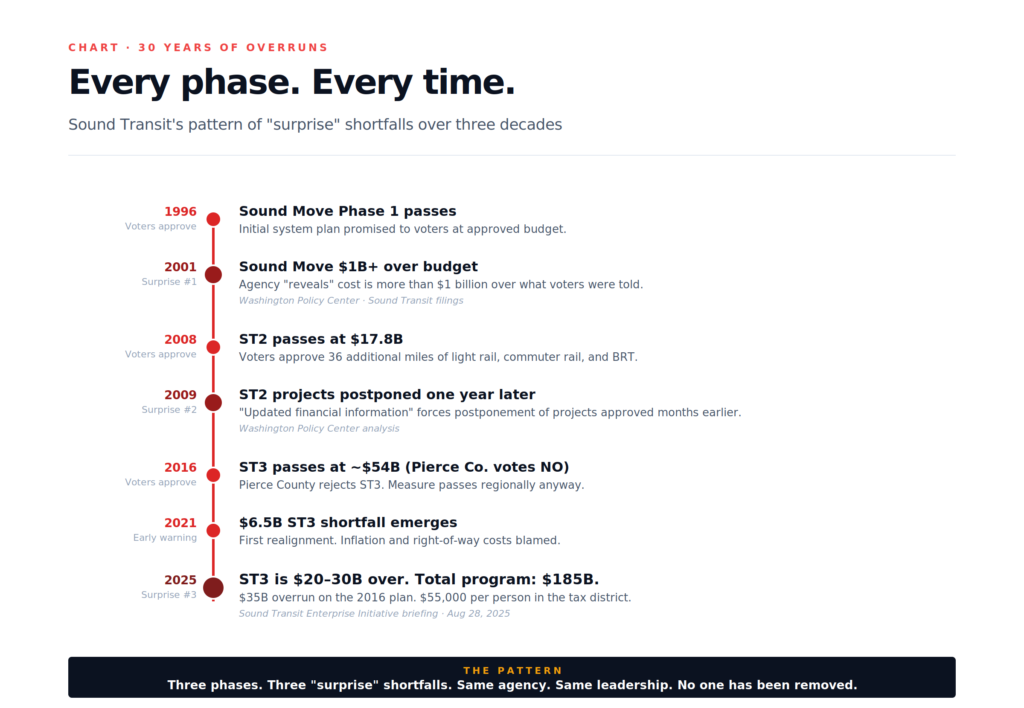
The cost overrun did not happen overnight. Rather, it is the culmination of three decades of what the Washington Policy Center calls a pattern of “underestimating.” Every phase has blown through its budget. Every phase has missed its deadlines.
Phase 1: Sound Move (1996)
Voters approved the original Sound Move plan in 1996 with a promised price tag. By 2001, Sound Transit revealed that the original plan was more than $1 billion over what voters had been told. The agency nearly collapsed. It was saved only through federal intervention and a dramatically scaled-back plan.
Phase 2: ST2 (2008)
Voters approved ST2 in 2008. By 2009, “updated financial information” forced Sound Transit to postpone projects approved only months earlier. The agency scaled back again.
Phase 3: ST3 (2016)
Voters approved ST3 in 2016 with a projected cost of roughly $54 billion. By 2021, Sound Transit announced a $6.5 billion shortfall. By August 2025, the agency’s own “Enterprise Initiative” briefing confirmed an additional $20-30 billion gap — a total overrun now approaching $35 billion on a single program.
Three phases. Three “surprise” shortfalls. Same agency. Same leadership team. Every single one blamed on inflation, COVID, labor costs, and unforeseen complexity. However, no one responsible has ever been removed for consistently underestimating costs by double-digit billions.
Show Image
The East Link Fiasco
If you want a single project that captures the Sound Transit failure, consider East Link — the line connecting Seattle to Bellevue and Redmond across Lake Washington.
Voters approved East Link as part of ST2 back in 2008. The original target opening: mid-2023. The current scheduled opening: March 28, 2026 — more than three years late.
Why? During construction of the line across the I-90 floating bridge, contractor Kiewit-Hoffman installed thousands of defective concrete plinths — the raised blocks that hold the light-rail tracks to the roadway. All of them had to be ripped out and replaced. Kiewit-Hoffman filed claims seeking roughly $184 million in extra compensation for the rework. Sound Transit drew down contingency reserves to cover the fix.
The result: a single construction defect cost $184 million and three years of delay on a project voters approved 18 years ago. Sound Transit opened a temporary “Eastside starter line” in April 2024 from South Bellevue to Redmond — a disconnected rail segment that goes nowhere most commuters actually need to go — to pretend the project was moving. Full service from Lynnwood through Seattle to Redmond will not exist until March 2026 at the earliest. The Starter Line costs roughly $150 million per year to operate while delivering zero of the network’s promised regional benefit.
Cost Comparison: What Seattle Pays Versus What the World Pays
Here is where the Sound Transit failure becomes impossible to excuse. Rail projects are not some black art that only Americans can understand. Cities across Europe, Asia, and Latin America build light rail and metro systems every year. Their costs are documented. Their track records are public. Furthermore, the comparison is brutal.
The Seattle Number
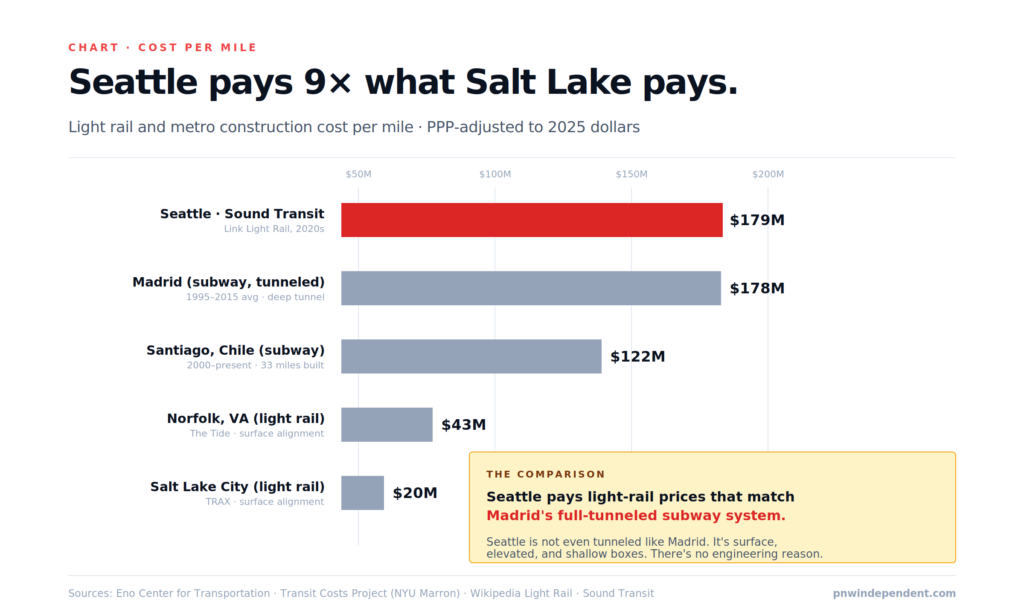
According to published cost analyses, Seattle’s Link Light Rail has reached approximately $179 million per mile to construct, driven by deep tunneling, elevated sections, and complex urban station boxes. Sound Transit’s own 2026 project estimates place new ST3 construction at $280 million to $540 million per mile depending on tunneling depth and station complexity.
How Peer Systems Compare
Consider what other cities have built, with all figures adjusted for purchasing power parity and inflation to 2025 dollars:
- Norfolk, Virginia: $43 million per mile for the Tide light rail
- Salt Lake City, Utah: under $20 million per mile for the TRAX system
- Sacramento, California: under $20 million per mile
- Baltimore, Maryland: under $20 million per mile
- Camden, New Jersey: under $20 million per mile
Therefore, Seattle is paying four to nine times what comparable American cities paid for comparable light rail systems. And that is before we look abroad.
The International Benchmark: Madrid and Santiago
Madrid, Spain built its modern metro system between 1995 and 2015 at an average construction cost of $178 million per mile — including deep-tunnel subway work, not light rail. That is roughly the same per-mile cost as Seattle’s light rail, for a system that is faster, higher-capacity, and more heavily tunneled.
Santiago, Chile built 33 miles of new subway since 2000 at an average of $122 million per mile, with an average construction timeline of 3.9 years per phase. Santiago delivered a full metro system in the time Sound Transit has spent struggling to fix concrete blocks on one floating bridge.
The Eno Center for Transportation, which maintains the largest comparative database of transit construction costs globally, identifies the factors behind low-cost systems: centralized planning, stable staff expertise, favorable contracting rules, and strong project-management culture. Each of these is something Sound Transit measurably lacks.
Show Image
The Japan Efficiency Comparison
Japan is not the world’s cheapest transit builder. In fact, Japan’s per-mile tunneling costs are among the world’s highest — averaging $748 million per mile for recent tunneled projects, according to Eno’s international database. Therefore, anyone who claims “Japan builds transit cheaper” is simply wrong.
However, Japan is the global benchmark for something Sound Transit seems incapable of: operational reliability.
What Japanese Operational Performance Looks Like
Consider the performance standards the Japanese transit system meets every day:
- JR East Shinkansen: average annual delay per train of 0.9 minutes — including delays caused by earthquakes, typhoons, and snow.
- Tokyo Metro: approximately 99.9 percent on-time performance, with “on-time” defined as within 60 seconds of schedule.
- Tokyo’s combined rail network: carries 40 million passenger trips per day — roughly what Sound Transit carries in a full year — with fewer service disruptions per capita than almost any network on Earth.
- Japanese train operators routinely issue written apologies to passengers for delays of two minutes.
What Sound Transit’s Operational Performance Looks Like
In the past year alone, according to Cascade PBS reporting, Sound Transit riders have experienced:
- Frequent electrical issues and breakdowns resulting in lengthy delays on the 1 Line.
- Concrete plinth defects on East Link that required total reconstruction.
- Ridership recovery below pre-pandemic levels even as the region’s population continues to grow.
- Escalator and elevator outages so chronic that stations routinely operate without functioning vertical access.
The question is not “why can’t Seattle build as cheaply as Madrid?” The better question is this: if Japan can achieve 99.9 percent reliability at $748 million per mile, why can Sound Transit not achieve even 95 percent reliability at $179 million per mile? The answer is not money. The answer is management competence.
The Counties That Pay but Don’t Get Service
Here is the part of the Sound Transit failure that nobody at the agency discusses in public. The tax is regressive by geography. Specifically, residents of all three tax-district counties pay the same Sound Transit taxes. However, they will not all receive comparable service. Some of them will receive almost none at all.
Pierce County Voted Against ST3 and Is Being Deprioritized Anyway
Pierce County voters rejected ST3 in November 2016. The measure passed regionally only because King and Snohomish County majorities overrode Pierce County’s “no” vote. Nine years later, Pierce County residents are still paying the ST3 taxes in full — sales tax, motor vehicle excise tax, property tax — while the Tacoma Dome Link extension promised to them remains unbuilt and is now one of the projects Sound Transit’s “Enterprise Initiative” may scale back, defer, or cancel entirely as part of the affordability gap response.
In other words: Pierce County voted no, lost the regional vote, has paid for a decade, and may still not get the train.
South King County and Sparse Outer Suburbs
The same pattern holds for less-affluent portions of the district. The Ballard Link extension, a second downtown Seattle tunnel, is the single most expensive project in the entire ST3 package. Its cost, all alone, has now risen from an estimated $4.2 billion to $7.9 billion — a nearly $4 billion increase on a single line within the wealthiest corridor in the region.
Meanwhile, the Tacoma Dome extension, the Everett extension, the Issaquah-Kirkland line, and the Graham Street and Boeing Access Road infill stations — the projects serving working-class neighborhoods and the more distant suburbs — are all on the list of potential scope cuts. King County Councilmember Claudia Balducci has publicly questioned whether the second downtown tunnel is even necessary. But the regional board, dominated by Seattle-centric appointees, has so far declined to put it on the chopping block.
The pattern is clear: the neighborhoods that can afford the tax get the extensions; the neighborhoods that can’t get the invoice.
The Accountability Problem at the Heart of the Sound Transit Failure
The Sound Transit board is comprised of 18 members. Zero are directly elected to the role. Instead, they are local officials from King, Pierce, and Snohomish counties — mayors, city council members, county councilmembers, and county executives — who receive Sound Transit board seats as an automatic consequence of their primary political job.
This creates four structural accountability failures:
1. No Direct Voter Recall
A Sound Transit board member cannot be removed from the Sound Transit board by voters. The only way to remove a Sound Transit board member is to vote them out of their underlying local office. Consequently, their performance as Sound Transit stewards is never directly on a ballot.
2. Cross-Appointment Loops
As demonstrated by the Constantine self-appointment, the structure allows board members to appoint each other, hire each other, and vote on each other’s compensation with minimal public scrutiny. The Seattle Mayor sits on the board. The three County Executives sit on the board. The King County Executive appoints half of the members. Therefore, the entire body can easily become a network of patronage among people who already owe each other political favors.
3. Scattered Political Incentives
A Seattle city council member serving on the Sound Transit board has almost no electoral incentive to care about Pierce County service delivery — and vice versa. As a result, dollars flow to the places with the most board influence, not the places with the most need.
4. No Dedicated Inspector General
Sound Transit has a Citizens Oversight Panel and an internal auditor. Neither has the authority to compel policy change. Washington State has a State Auditor and JLARC (the legislative auditor). However, neither has performed a comprehensive performance audit of Sound Transit’s contracting, cost estimation, or project delivery practices — despite repeated calls from policy analysts across the political spectrum.
The CEO Revolving Door
Consider the recent leadership history. Peter Rogoff was CEO from 2016 to 2022. The board voted 14-3 not to renew his contract in September 2021, yet paid him a full year’s salary of $379,600 as severance. Julie Timm served as CEO from September 2022 to January 2024 — 16 months. She resigned by “mutual agreement” and was paid a full year’s salary of $375,000 plus benefits on her way out. The board canceled her performance review. No public explanation was offered for the payout. Goran Sparrman served as interim CEO until May 2025. Now Dow Constantine, the man who chaired the board during all of the above, runs the agency — at the highest base salary in the position’s history.
Three full-year severance packages in five years. All for CEOs departing an agency with a $35 billion cost overrun.
What the Sound Transit Failure Says About the Region
At this point it is worth asking the honest question. Why is Seattle, a globally prominent city in one of the world’s wealthiest states, incapable of building transit at the cost and reliability standards that Madrid, Santiago, Seoul, or Istanbul achieve routinely?
The factors are not mysterious. Academic research, Eno Center case studies, and the Transit Costs Project at NYU all converge on the same list:
1. Excessive Outreach and Veto Points
Sound Transit’s planning process, by the agency’s own account, involves years of “community engagement” at every project phase. Furthermore, every single neighborhood, business group, and advocacy organization with a grievance can effectively delay a project until design changes are made. Each delay compounds. Each redesign adds cost. Madrid and Santiago build within a single planning cycle with a centralized national decision on alignment.
2. Over-Consultanting
Sound Transit outsources enormous portions of its engineering and project management to private consulting firms. The agency that oversees the consultants has a staff too small to critically evaluate the consultants’ work. Consequently, the agency pays consultants to estimate costs, then pays different consultants to evaluate those cost estimates, then pays a third set of consultants to recommend cost reductions. Each layer adds overhead. None creates accountability.
3. American Station Gold-Plating
American transit stations are substantially more expensive than their international peers. Reasons include overbuilt mezzanines, excessive escalator and elevator counts, “iconic architecture” that serves no transportation purpose, and disability-compliance interpretations that exceed the requirements in cities that achieve equivalent accessibility at a fraction of the cost. Sound Transit is among the most aggressive gold-platers in the American industry.
4. Contracting Practices That Reward Underbidding
American transit agencies typically select the lowest-bid contractor. Lowest-bid contractors routinely underbid deliberately, knowing they can file “change orders” and claims for additional compensation once construction begins and the agency is locked in. Sound Transit’s East Link concrete plinth fiasco — and the resulting $184 million claim from Kiewit-Hoffman — is a textbook example. European and Japanese systems use qualifications-based selection that considers track record, firm stability, and delivery history rather than bottom-line price alone.
The Sound Transit Failure Solutions Nobody in Charge Wants to Discuss
Nobody wants to kill light rail in the Puget Sound region. The honest critics — the Washington Policy Center, the Mountain States Policy Center, Seattle Subway, the Transit Riders Union — all want better transit. The question is whether Sound Transit’s current structure can deliver it. The evidence says no. Here is what could.
1. Mandatory State Performance Audit
The Washington State Auditor’s Office and JLARC should jointly conduct a comprehensive performance audit of Sound Transit, covering contracting practices, cost estimation methodology, project delivery, executive compensation, and board governance. This is the baseline reform every serious critic has asked for. It has not happened.
2. Direct Election of Sound Transit Board
Board members should be directly elected to the role by district. This is how Madrid, Santiago, and most successful European transit agencies structure their governing bodies. Direct accountability means board members cannot hide behind their underlying local office. It means a bad performance as a Sound Transit steward becomes directly politically costly.
3. Dedicated Inspector General
An independent Sound Transit Inspector General with subpoena power, reporting to the state legislature rather than the Sound Transit board itself, would provide the accountability function that the Citizens Oversight Panel cannot.
4. Mandatory Cost-Estimate Disclosure
Every Sound Transit project should be required to publish, at each phase, complete cost estimate methodology, assumptions, consultant inputs, and comparisons to peer systems internationally. Sunlight is the cheapest anti-corruption tool available.
5. Pierce County Opt-Out
The counties where majorities voted against ST3 and are not receiving proportional service should be granted a formal opt-out mechanism. If Pierce County is going to be deprioritized in project delivery, Pierce County residents should not be paying the same tax rate as residents of project areas.
6. Tie CEO Compensation to Actual Performance
A CEO paid $450,000-plus should not receive automatic 3.5 percent annual raises or one-year severance packages on a system with the cost-overrun and reliability record of Sound Transit. CEO compensation should be tied to project delivery milestones, cost-containment performance, and on-time performance metrics — with clawback provisions for failure.
The Bottom Line on the Sound Transit Failure
On April 1, 2025, Dow Constantine resigned as King County Executive and walked across the street to take his $450,000-plus-bonuses job as CEO of Sound Transit. The agency he had helped govern for 16 years, whose board he had appointed the majority of, and whose $35 billion cost overrun he had personally presided over.
Nine of the 18 board members who voted to hire him owed their seats to him. The other nine raised no objection. The public was shown no list of other candidates. The transit advocates who have spent their careers defending public transit — Seattle Subway, the Transit Riders Union — called it a “massive breach of ethical standards.” The board’s response was to schedule another market study that could raise Constantine’s salary further in 2026.
Meanwhile, a Pierce County family that voted against ST3 in 2016 is paying roughly the same Sound Transit tax burden as a Seattle family that voted for it. The Seattle family will get the second downtown tunnel. The Pierce County family may not get the Tacoma Dome extension. Both families are paying for Constantine’s salary.
This is the Sound Transit failure. It is not a technical problem. It is not an inflation problem. It is not a pandemic problem. It is a governance problem — a closed loop of regional politicians appointing each other, hiring each other, and rewarding each other’s failures with taxpayer money. Until that loop is broken by a state audit, direct board elections, or an independent inspector general, the cost will keep rising, the deadlines will keep slipping, and the Sound Transit failure will continue producing exactly the results its structure was designed to produce.
Madrid built a world-class metro in 20 years for less per mile than Seattle’s light rail. Santiago built 33 miles of subway in less time than Sound Transit has spent fixing concrete blocks on a floating bridge. Tokyo runs its trains at 99.9 percent reliability on a network that moves the population of Seattle every single morning. None of these cities are richer than the Puget Sound region. None of them have better engineering talent. They simply have governance that works.
Sound Transit’s governance is working too — for the people running it. Just not for anyone else.
Related Reading on PNW Independent
- The Portland Homeless Industrial Complex: Inside the $700M Machine
- Black Panther Park Skyway: The Funded Double Standard
- King County Parks Levy: Where the $1.5 Billion Actually Goes
- Who Really Runs Seattle? A Guide to the Regional Political Machine
External Sources
- Sound Transit Enterprise Initiative Board Briefing (August 28, 2025)
- The Urbanist — Sound Transit Hires Constantine as CEO (March 2025)
- Seattle Times — Sound Transit approves contract with new CEO Julie Timm
- Seattle Times — Departing Sound Transit CEO gets big payout (Dec 2023)
- West Seattle Blog — $450,000+ starting-salary contract for Constantine
- Lynnwood Times — Sound Transit $34.5 Billion Budget Shortfall
- Washington Policy Center — Billions in cost overruns may finally bring a day of reckoning
- Mountain States Policy Center — Sound Transit rail program balloons to $185 billion
- Eno Center for Transportation — International Transit Construction Cost Analysis
- Transit Costs Project, NYU Marron Institute
- The Urbanist — Sound Transit Faces $20-$30B Shortfall (Trains Magazine)
- KOMO News — Sound Transit delays new CEO decision amid ethical complaints