How Brutal Ferguson Ethics Failures Exposed Olympia’s Crisis
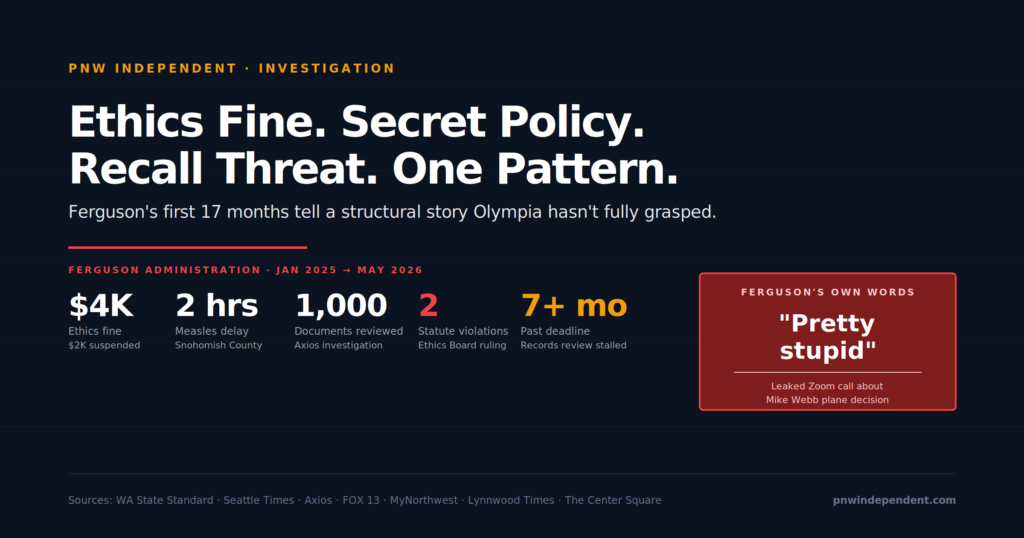
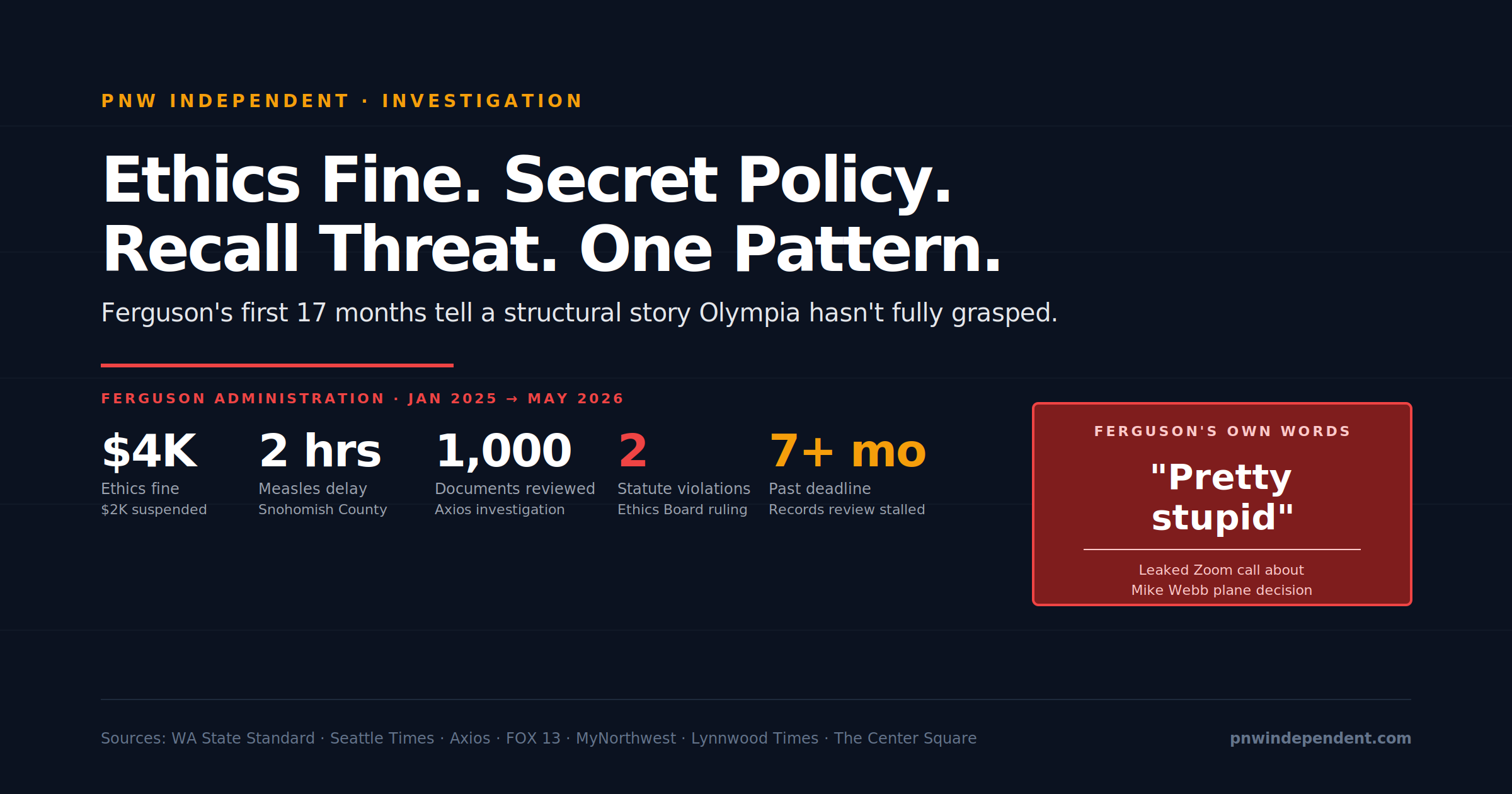
Washington Governor Bob Ferguson agreed to a $4,000 ethics settlement after admitting he violated state ethics law by flying former adviser Mike Webb on a State Patrol aircraft. Furthermore, the same week the settlement was announced, Axios revealed a secret approval policy requiring most state agencies to clear press releases and reporter responses through the governor’s office — delaying a measles alert by two hours during a Snohomish County outbreak. A recall effort ended only after Ferguson filled two long-vacant Public Disclosure Commission seats. The auto-deletion of public records review missed its own deadline by months. This is a governor who spent more than a decade as attorney general positioning himself as Washington’s top ethics enforcer. Seventeen months into his term, the pattern is the story. Here is what the documents actually show.
What the Ferguson Ethics Settlement Actually Says
The Ferguson ethics settlement covers a specific incident with documented facts. Furthermore, the settlement requires Ferguson to formally admit violating state ethics law. Specifically, the Washington Executive Ethics Board signed off on the agreement after months of negotiation.
The June 26, 2025 Flight
Ferguson invited Mike Webb, his longtime friend and former chief strategy officer, onto a Washington State Patrol aircraft for an official trip to the Tri-Cities. Specifically, Webb had resigned in March 2025 — three months before the flight — amid allegations that he had created a hostile workplace for some women in the governor’s office. Therefore, at the time of the June flight, Webb was not a state employee.
The flight itself cost $2,094.68 per flight hour according to Washington State Patrol records. Furthermore, employees of the governor’s office occupied six of the plane’s seven seats. Webb sat on a seat positioned over the plane’s toilet.
During the trip, Webb:
- Sat in on a meeting Ferguson had with Adam Glickman, the secretary-treasurer of SEIU 775, the politically influential home healthcare worker union
- Attended a political fundraiser for the governor’s reelection campaign
- Conducted his own meeting with union leaders in his new role at the Singleton Schreiber law firm
Therefore, the trip provided Webb with documented professional and political benefits. Furthermore, those benefits were facilitated by his presence on a state-funded aircraft.
The Ethics Board Findings
On January 9, 2026, the Washington State Executive Ethics Board concluded there was “reasonable cause” to believe Ferguson violated state ethics law. Specifically, the board’s executive director Kate Reynolds found that the governor provided “a special privilege” to Webb by allowing him to travel on the state aircraft.
The board identified two specific statute violations:
- Using state resources “for the private benefit or gain of a non-state employee”
- Using his position to secure “a special privilege” to a non-state employee by allowing them to travel on a state aircraft
Therefore, the Ferguson ethics violation was not procedural. Specifically, the board found two distinct statutory breaches.
Ferguson’s “Pretty Stupid” Comment
In a leaked staff Zoom call from months before the formal ruling, Ferguson addressed his decision directly. Specifically, he called his choice to invite Webb “pretty stupid.” That audio surfaced early in his administration and provided a glimpse into the dysfunction surrounding the first months of Ferguson’s office.
Furthermore, Ferguson later told investigators that “in short, I made a mistake, and it will not happen again.” That admission was incorporated into the settlement language.
What Ferguson Argued Before Settling
Before agreeing to the settlement, Ferguson initially fought the violation finding. Specifically, in a written response to investigators, he argued the case should be dismissed:
“It did not create additional cost in terms of fuel, staffing, or time. The state incurred no financial burden or misuse of taxpayer resources.”
Furthermore, Ferguson argued the use was “de minimis in nature” and not for private gain. He went further, telling investigators that “allowing an individual to travel as a guest neither interfered with official duties nor provided that individual with any improper advantage derived from state office.”
The ethics board rejected those arguments. Specifically, the board found Ferguson had illegally provided “a special benefit” to Webb.
The $4,000 Settlement Structure
The settlement structure includes:
- $4,000 total civil penalty
- $2,000 suspended as long as Ferguson commits no additional ethics violations for two years
- Effective $2,000 paid by Ferguson
- Maximum possible penalty was $5,000 per violation plus restitution and other costs
- Two violations were found by the board
Therefore, Ferguson settled for less than half the maximum possible penalty for one violation, despite the board finding two distinct statute breaches. Furthermore, the settlement specifically allowed Ferguson to avoid a public hearing that would have generated additional media coverage.
The five-member ethics panel was scheduled to consider the proposed settlement at its May 8 meeting with authority to accept, reject, or modify it.
How the Ferguson Ethics Settlement Connects to the Transparency Crackdown
The Ferguson ethics settlement broke the same week as a separate Axios investigation revealing a documented pattern of communications restrictions across state agencies. Furthermore, the timing was not coincidence. Specifically, both stories trace to the same underlying governance pattern.
The Approval Policy
In July 2025, the Ferguson administration implemented a new requirement that most state agencies obtain governor’s office approval before issuing press releases or responding to reporter questions. Furthermore, the policy was not announced publicly. Specifically, internal documents obtained by Axios show that agencies were instructed not to disclose the new approval requirements to the media.
That secrecy is itself notable. Specifically, the Public Records Act in Washington establishes a presumption of governmental transparency. Furthermore, a policy designed to control public communications about government operations would normally be announced publicly — not hidden from the agencies that have to follow it and the public it affects.
The Documented Delays
Axios reviewed nearly 1,000 documents from the governor’s office and five state agencies. Specifically, the agencies involved include the Washington State Department of Health (DOH), Washington State Department of Transportation (WSDOT), and the Washington State Patrol (WSP). The documents show specific instances where the policy delayed urgent public information:
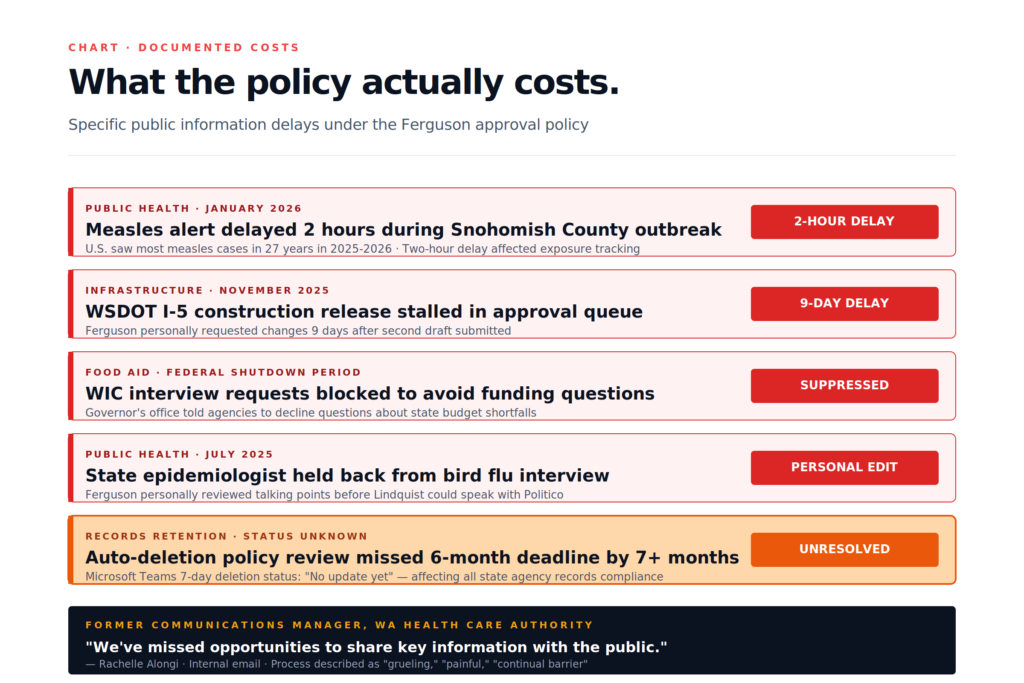
1. Measles outbreak alert (January 2026): During a measles outbreak in Snohomish County, reporters seeking information from the Department of Health faced a roughly two-hour delay before an urgent alert was released. Furthermore, after receiving multiple media inquiries, a DOH communications worker had to ask the Governor’s Communications Office whether approval was needed for an official response.
2. Bridge repair updates (November 2025): Discussing a WSDOT news release about I-5 construction, communications director Brionna Aho wrote that a second draft was “closer to what the governor was looking for, but I think missing some details he said he felt strongly about.” Specifically, that comment came nine days after the second draft had been submitted for approval.
3. Bird flu information (July 2025): Ferguson personally reviewed interview talking points before state epidemiologist Scott Lindquist was cleared to speak with Politico about bird flu. Furthermore, a Ferguson staffer apologized to DOH officials for the delay.
4. WIC food aid program (Federal shutdown period): Records indicate the governor’s office instructed agencies to decline interview requests about the Women, Infants, and Children (WIC) food aid program — specifically to avoid questions about why the state lacked backup funding for that program during the federal shutdown.
Internal Frustration
The internal communications obtained by Axios document widespread frustration among agency staff. Specifically, Rachelle Alongi, a former communications manager with the Washington State Health Care Authority, wrote in an email to agency staff in September 2025:
“We’ve missed opportunities to share key information with the public. The approval process is grueling, painful, and a continual barrier.”
Furthermore, Alongi described the system as creating a “tremendous bottleneck, where we are waiting days or weeks for a response.”
Other internal communications documented staff saying “we cannot do our jobs” due to the approval delays. Therefore, the policy is producing operational dysfunction inside state government — not just affecting external communications.
The “Tell Reporters Nothing” Instruction
Documents obtained by Axios point to internal messages suggesting state agencies were specifically told to keep the policy secret. Specifically, internal emails showed an instruction characterized as “the Governor’s Office does not want to tell reporters about this policy.”
Reporter Melissa Santos of Axios summarized the issue plainly: “You do have to wonder if it’s a policy that you think is good, why not justify it to reporters? Why then pretend it doesn’t exist?”
Therefore, the policy is not just slowing public information. Specifically, it is being implemented in ways that prevent the public from understanding the policy itself exists.
What State Officials Are Saying About Ferguson Ethics
The administration’s response to both the ethics settlement and the transparency crackdown has been muted. Furthermore, the response language follows a consistent pattern.
Ferguson’s Office: “Different Ways of Doing Things”
Communications Director Brionna Aho defended the approval policy in an email to Axios on April 28, 2026:
“A new administration has different ways of doing things. People are used to doing things a certain way, and change can be hard.”
That framing is worth examining. Specifically, the policy does not just change “ways of doing things” — it imposes a centralized approval requirement that did not exist under three previous Washington governors. Furthermore, staffers for those three former governors confirmed to Axios that no such policies were in effect during their administrations.
Therefore, this is not an incremental change. Specifically, it is a structural shift in how state government communicates with the public.
Ferguson’s Office: “Coordination and Collaboration”
Aho also told Axios the policy is intended to “increase collaboration across state government.” Furthermore, the office said Ferguson has personally reviewed “only a small fraction of agency materials.”
That last claim deserves scrutiny. Specifically, the documented examples include:
- Ferguson personally reviewing bird flu talking points
- Ferguson personally requesting changes to WSDOT bridge repair releases
- The governor’s office instructing agencies to decline WIC interviews
Therefore, “small fraction” depends heavily on how you count. Furthermore, the documented instances all involve high-public-interest topics — public health alerts, infrastructure, food aid — where centralized approval most affects citizen access to information.
The Open Government Response
Jamie Nixon, an open-government advocate who has previously sued the state over public records issues, characterized the broader pattern bluntly:
“Are we going to sit around here for another three and a half years and not have him tell us anything? It’s very strange.”
Furthermore, Nixon connected the transparency crackdown to a separate ongoing controversy: the public records auto-deletion policy Ferguson said he would review six months ago. That deadline passed seven months ago without an announcement. The administration has provided no public update on whether the auto-deletion policy has been reinstated or remains suspended.
Republican Response: Ethics Erosion Pattern
State Senate Republican Caucus and other GOP leaders have characterized the pattern as systemic erosion of ethics standards. Specifically, State Senator Mark Schoesler noted that Ferguson’s recent appointments to the Public Disclosure Commission included two attorneys with documented ties to Democratic causes:
“Clearly neither of these people identify with the minority party. If it is not a violation of the law, it is a violation of the spirit of the law.”
Furthermore, the appointments were made only after a recall effort threatened Ferguson’s office. Specifically, campaign finance activist Conner Edwards filed a recall petition on April 1, 2026 — alleging that Ferguson’s failure to fill the PDC vacancies within the legally prescribed 30-day timeline amounted to “misfeasance and a violation of his oath of office.”
How the Ferguson Ethics Pattern Got Here
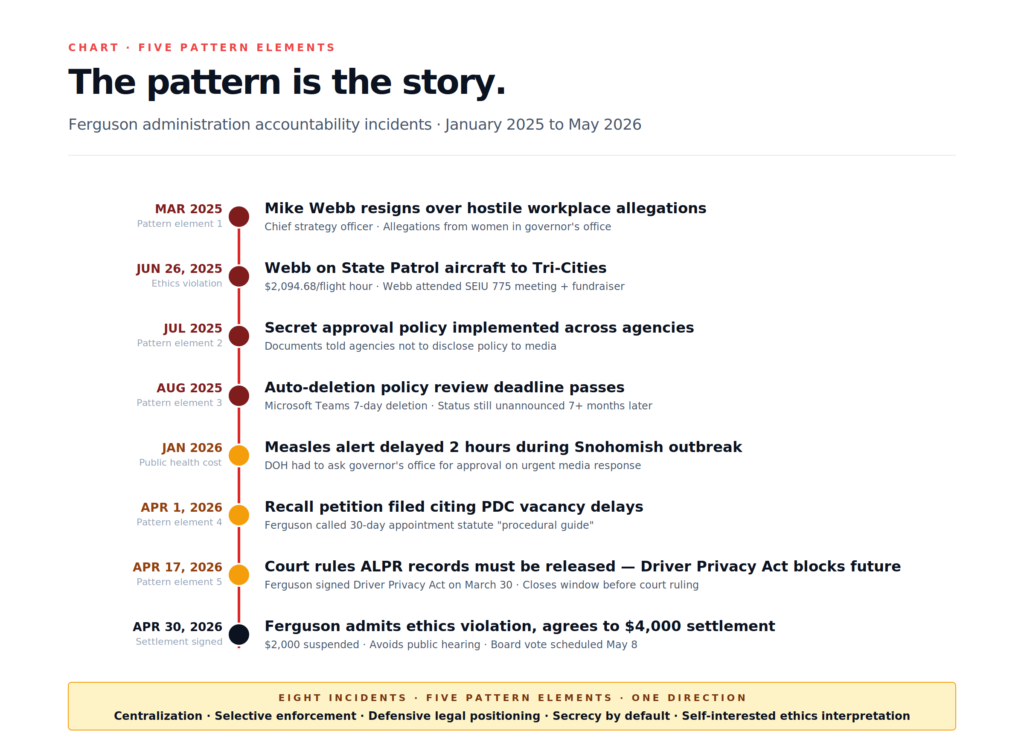
The Ferguson ethics issues did not emerge in isolation. Specifically, multiple documented incidents have accumulated across the first 17 months of his administration. Furthermore, the pattern is what makes this story consequential.
Pattern Element 1: The Mike Webb Hostile Workplace Allegations
Before the State Patrol aircraft incident, Mike Webb’s tenure as Ferguson’s chief strategy officer ended under documented circumstances. Specifically, Webb resigned in March 2025 amid allegations that he created a hostile workplace for some women in the governor’s office.
Therefore, the State Patrol aircraft trip in June 2025 was Ferguson providing a state-funded benefit to a former adviser who had just resigned over hostile workplace allegations. Furthermore, Ferguson was aware of the resignation circumstances when he extended the invitation.
That context matters for evaluating the ethics board’s finding. Specifically, the board found Ferguson provided “a special privilege” to Webb. The privilege was not just a free flight — it was a state-funded reentry into political and union meetings just weeks after Webb’s hostile workplace exit.
Pattern Element 2: The PDC Vacancy Crisis
The Washington Public Disclosure Commission is responsible for enforcing campaign finance laws. Specifically, the panel requires a quorum of four members to conduct hearings and decide cases. Furthermore, with two vacancies, all three remaining members had to be present for any official action — making the panel effectively non-functional.
Ferguson was constitutionally required to fill those vacancies within 30 days. Specifically, he failed to do so for months. Furthermore, in a legal filing responding to the recall petition, Ferguson argued that the statute requiring 30-day appointments is merely “a procedural guide.”
That argument is consequential. Specifically, calling a statutory timeline a “procedural guide” is the same legal positioning Ferguson now uses for ethics standards more broadly. Furthermore, it was only the threat of a recall effort that prompted him to fill the seats.
Pattern Element 3: The Auto-Deletion Public Records Controversy
In February 2025, Ferguson temporarily suspended a policy that allowed state agencies to auto-delete Microsoft Teams messages every seven days. Specifically, the suspension was supposed to be reviewed in six months.
That review deadline came and went in August 2025. Furthermore, seven months later, Ferguson’s office has not announced whether the auto-deletion policy has been reinstated, modified, or remains suspended. Specifically, when asked, communications director Brionna Aho emailed: “No update yet, will let you know when there’s more.”
The auto-deletion policy is not theoretical. Specifically, it had been a documented public-records compliance violation according to memos that warned Ferguson and other officials “years ago” that the policy created “a massive legal risk” because Microsoft 365 “does not come out of the box with the ability to comply with Washington state’s public records retention laws.”
Therefore, Ferguson knew the auto-deletion policy was non-compliant before becoming governor. Furthermore, his administration has now stalled action on that compliance for nearly a full year.
Pattern Element 4: The Driver Privacy Act ALPR Records
On March 30, 2026, Ferguson signed the Driver Privacy Act, which exempts automated license plate reader (ALPR) images from future public disclosure. Specifically, the legislation came as a Skagit County Superior Court judge had just ruled on April 17, 2026 that Sedro-Woolley and Stanwood had to comply with public records requests for those exact ALPR images — a request from before the new law took effect.
Therefore, Ferguson signed legislation eliminating public access to surveillance camera records. Furthermore, that legislation took effect just before a court ruled that prior records had to be disclosed under the older transparency framework. The timing closes a transparency window that just opened.
Pattern Element 5: The Recall Effort
The combined effect of these issues triggered the recall effort. Specifically, campaign finance activist Conner Edwards filed a recall petition on April 1, 2026 — citing Ferguson’s failure to fill PDC vacancies within statutory timelines as “misfeasance and a violation of his oath of office.”
Furthermore, the recall ended only after Ferguson installed two new PDC commissioners — not after defending his actions on substantive grounds. Specifically, Ferguson appointed:
- Matt Segal, a founding partner at Pacifica Law Group and former King County Superior Court judge
- Teebah Alsaleh, a lawyer for Microsoft
Both appointees had small documented Democratic donations. Specifically, Alsaleh contributed to Sahar Fathi’s 2012 Seattle City Council campaign (Fathi is now one of Ferguson’s top advisers) and to Pramila Jayapal’s 2014 state Senate campaign. Furthermore, Senate Republicans had recommended retired GOP state senator Jim Honeyford for one of the seats. Ferguson did not consider that recommendation.
Therefore, Ferguson responded to the recall threat by appointing partisan-aligned commissioners. The recall ended. The substantive concern about ethics enforcement remained.
The Ferguson Ethics Pattern Has a Specific Cost
The Ferguson ethics pattern is not just a matter of political optics. Specifically, each element of the pattern has documented operational costs to Washington citizens.
Cost 1: Delayed Public Health Information
The two-hour delay on the measles alert is one documented case. Furthermore, measles is one of the most transmissible viral infections. Two hours of delayed public alert during an active outbreak directly affects exposure exposure tracking, vaccination outreach, and case identification.
The Snohomish County measles outbreak forced a state of emergency. Specifically, the U.S. has seen the most measles cases in 27 years in 2025-2026. Therefore, public health communication speed matters.
Cost 2: Delayed Infrastructure Information
The nine-day delay on a WSDOT I-5 construction release is an example. Furthermore, infrastructure information affects daily commuter decisions, contractor scheduling, and public planning. Therefore, delay translates into both inconvenience and economic cost across the travel-dependent population.
Cost 3: Suppressed Funding Discussions
The instruction to decline WIC interview requests is the most consequential documented case. Specifically, the governor’s office instructed agencies to avoid questions about why the state lacked backup funding for federal shutdown contingencies. Furthermore, that information would have been useful to the families relying on WIC, the legislators considering future budget structure, and the voters evaluating administrative competence.
Therefore, the policy is not just slowing public information. It is being used to actively prevent accountability conversations about budget decisions.
Cost 4: Compromised Records Retention
The auto-deletion review delay means that, as of May 2026, Washington state agencies’ records retention compliance status is publicly unknown. Specifically, every legal challenge to state agency decisions during this period faces an uncertainty about what records exist, what records were preserved, and what records were lost. Furthermore, this affects every public-records-driven accountability mechanism in the state.
Cost 5: Erosion of Ethics Enforcement
The combination of:
- The PDC vacancy crisis
- The partisan-aligned commissioner appointments
- The ethics violation settlement
- The “procedural guide” legal argument
Together produces a measurable erosion of ethics enforcement infrastructure. Specifically, the same governor who personally violated ethics law is now responsible for appointing the commissioners who will enforce ethics law going forward. Furthermore, his legal positioning treats statutory ethics requirements as flexible rather than binding.
That is a structural concern, not a partisan one. Ethics enforcement requires institutional independence from political pressure.
How the Ferguson Ethics Pattern Connects to the Moody’s Downgrade
The Ferguson ethics pattern matters most because of what it confirms about Washington’s broader governance picture. Furthermore, it directly compounds concerns documented in PNW Independent’s Moody’s Downgrade investigation.
What Moody’s Was Watching
Moody’s April 23 outlook downgrade flagged structural concerns including:
- Continued reliance on one-time budget solutions
- Projected narrowing of budgetary reserves
- Ongoing legal challenges to new revenues
Specifically, those concerns reflect underlying questions about governance discipline and fiscal transparency. Furthermore, rating agencies evaluate not just the numbers but the institutional capacity to manage those numbers honestly.
What the Transparency Crackdown Implies
A governor’s office that delays measles alerts, blocks WIC interviews, and edits agency releases is not a governor’s office optimized for transparent fiscal management. Specifically, the same operational pattern that suppressed measles information would suppress fiscal disclosure under pressure. Furthermore, the same approval bottleneck that delayed bridge repair information would delay budget transparency.
Therefore, the Ferguson ethics pattern is a leading indicator for Moody’s continued evaluation. Specifically, rating agencies care about institutional governance because it determines how reliable the public information about state finances actually is.
What the Records Retention Issue Implies
The auto-deletion policy controversy directly affects whether bondholders and rating agencies can rely on Washington state records. Specifically, when ratings agencies evaluate state credit, they review historical decision records, internal deliberations, and the documentary basis for budget choices. Furthermore, a state government with non-compliant records retention raises questions about the durability of that documentation.
Therefore, the auto-deletion delay is not just a transparency issue. It is a credit-rating issue.
What the Pattern Means Together
The Ferguson ethics settlement, the transparency crackdown, the PDC delay, the ALPR records loophole, and the records retention delay together represent a documented pattern. Specifically, the pattern shows:
- Ethics violations the governor admits but minimizes
- Transparency restrictions implemented secretly
- Statutory requirements characterized as “procedural guides”
- Public records compliance delayed indefinitely
- Surveillance records exempted from disclosure on the eve of court rulings
That pattern is exactly what credit rating agencies, bond markets, and federal funding partners watch. Furthermore, it is exactly what voters need to evaluate Ferguson’s broader competence.
What Should Happen Next on Ferguson Ethics
The Ferguson ethics pattern is now publicly documented. Furthermore, several specific actions could address the underlying issues. Each is achievable within current law.
1. Reject the Settlement and Pursue Full Hearing
The Executive Ethics Board has authority to reject or modify the proposed $4,000 settlement at its May 8 meeting. Specifically, the board could require Ferguson to face a public hearing on both violations rather than settling for less than half the maximum penalty. Furthermore, that hearing would generate the documentation that would deter future violations across state government.
A $4,000 settlement — half suspended — does not create meaningful deterrence. Specifically, the settlement is functionally a $2,000 fine for two violations of Washington’s Ethics in Public Service Act by the governor. That price is below the cost of a single business-class flight to Washington, D.C.
2. Public Disclosure of the Approval Policy
The Ferguson administration should publicly disclose:
- The full text of the approval policy
- The list of agencies subject to it
- The list of communications types requiring approval
- Average approval times by category
- The names of officials responsible for review decisions
- The rationale for keeping the policy secret from agencies and the public
Specifically, if the policy is good policy, it can withstand public scrutiny. Furthermore, if it is not good policy, it should be revised.
3. Auto-Deletion Policy Decision
Ferguson should announce by June 1, 2026 whether the auto-deletion policy has been reinstated, modified, or remains suspended. Furthermore, that decision should be public, with documented reasoning. Specifically, the public should not have to guess at the records-retention status of state agencies eight months past the original review deadline.
4. Independent Public Communications Review
The legislature should commission an independent review of the governor’s office approval policy. Specifically, the review should evaluate:
- Whether the policy meets the requirements of the Public Records Act
- Whether the policy violates the spirit of transparency statutes
- Whether the policy is being used to suppress legitimate public-interest information
- Whether the policy should be restricted to specific categories of communications
Furthermore, the review should be conducted by an entity outside the governor’s office. Specifically, the State Auditor or the legislative ethics committees would be appropriate venues.
5. Full Disclosure of the Webb Trip Itinerary
The Ferguson administration should publicly disclose the full itinerary of the June 26, 2025 Tri-Cities trip. Specifically:
- All meetings attended
- All people present
- All political activities conducted
- Whether Webb’s presence facilitated business outcomes
- Whether SEIU 775’s Adam Glickman interaction influenced subsequent state policy
Furthermore, that disclosure should be made under oath if possible. Specifically, the ethics settlement does not capture the full scope of what happened during that trip — only the question of whether Webb’s presence on the aircraft was a violation.
6. ALPR Records Review
The legislature should review the Driver Privacy Act timing. Specifically: did the legislative process anticipate that the law would take effect just before a court would rule on existing ALPR records requests? Furthermore, was the timing coincidental or coordinated? Both answers matter for the future of surveillance transparency in Washington.
The Bottom Line on the Ferguson Ethics Pattern
The Ferguson ethics pattern is not a single bad decision. Specifically, it is a documented sequence of decisions across 17 months that together reveal a particular operational approach to government:
- Centralization of communications authority in the governor’s office
- Selective enforcement of statutory requirements (PDC vacancies, records retention)
- Defensive legal positioning (calling statutes “procedural guides”)
- Secrecy as default (approval policy, decline-to-comment instructions)
- Self-interested ethics interpretation (de minimis arguments, special-privilege denials)
Each individual element can be defended in isolation. Specifically, an administration can argue that approval bottlenecks improve coordination, that ethics violations were inadvertent, that PDC delays were administrative, and that records retention delays reflect complexity. Furthermore, those defenses are exactly what the administration has offered publicly.
However, the pattern is the story. Specifically, when each element of governance is operating in the same direction — toward less accountability, less transparency, and slower public information — that is not coincidence. That is operational philosophy.
The Moody’s outlook downgrade flagged Washington’s structural budget problems. Furthermore, the structural budget problems exist within an institutional culture that is now demonstrably moving away from the transparency norms that allow honest fiscal management. Therefore, the Moody’s analysis and the Ferguson ethics pattern are not separate stories. They are the same story, told from different angles.
For Washington voters and bondholders, the practical question is now simpler. The ethics violations were admitted. The transparency crackdown is documented. The records retention status is unknown. The recall threat was real enough to force PDC appointments. Furthermore, those facts are now in the public record, regardless of how the governor’s office chooses to characterize them.
The Executive Ethics Board votes on the settlement at its May 8 meeting. The board can accept, reject, or modify the proposal. Specifically, the question for that meeting is not just whether $4,000 is the right number for one violation. The question is whether settling at all sends the right signal about the cost of ethics violations by Washington’s chief executive.
The pattern is the story. The next 18 months of the Ferguson administration will determine whether the pattern gets worse, gets corrected, or gets normalized. That outcome will affect not just Ferguson’s political future. It will affect every Washington state agency, every rating-agency evaluation, every public records request, and every voter’s ability to hold their government accountable through the rest of his term.
The clock is running. The documents are public. The choices are now visible.
Related Reading on PNW Independent
- Moody’s Downgrade: Washington State Built This Hole
- Washington Millionaire’s Tax: How a Brutal Court Ruling Exposed Washington’s Tax Crisis
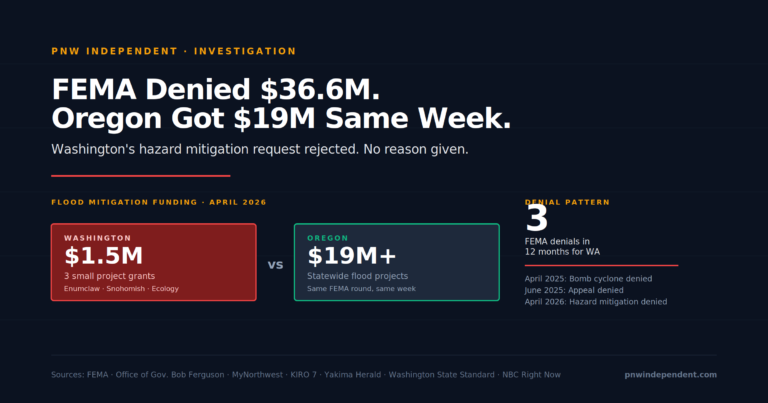
- FEMA Denial: Washington Loses $36.6M for Future Floods
- Who Really Runs Seattle: Two Machines, One Ruling Class
External Sources
- Washington State Standard — Ferguson accepts $4,000 ethics fine over Mike Webb state aircraft trip
- The Seattle Times via The Columbian — Washington Gov. Ferguson agrees to $4,000 settlement in ethics probe
- Axios Seattle — Governor sign-off rule snarls flow of information in Washington (April 28, 2026)
- FOX 13 Seattle — Gov. Ferguson’s new approval policy stalls public information
- MyNorthwest — The Governor’s Office does not want to tell reporters about this policy
- Washington State Standard — Recall effort against Washington governor ends
- Lynnwood Times — Ferguson accepts $4,000 ethics fine over Mike Webb state aircraft trip
- The Center Square — Gov. Bob Ferguson’s own deadline on public records auto-deletion review has come and gone
- Washington State Executive Ethics Board