
Pierce County Voted No on ST3. Now They Lose the Train. Sound Transit Series
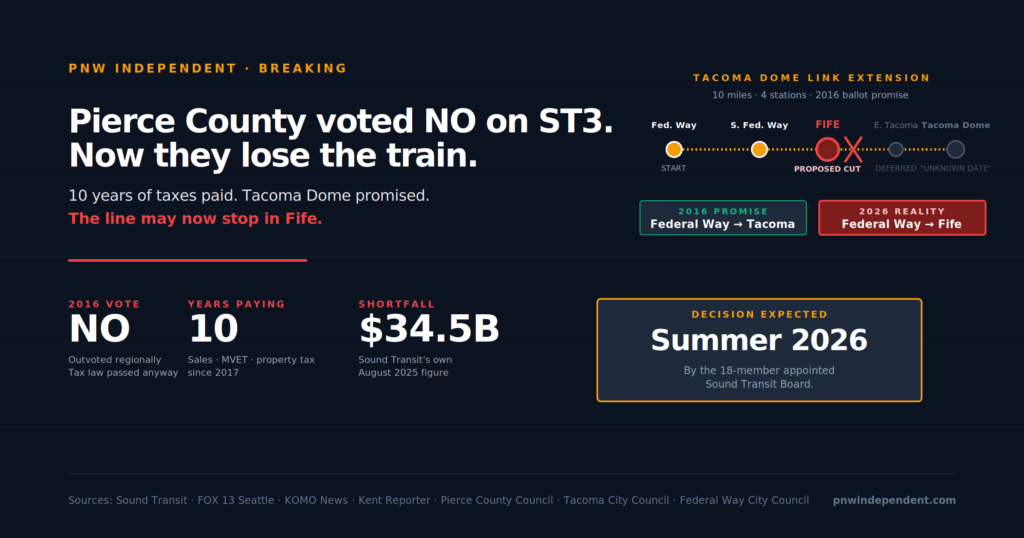
Pierce County voters rejected ST3 in 2016. They lost the regional vote, and have paid the Sound Transit tax for a decade. Now Sound Transit is proposing to terminate the long-promised Tacoma Dome Link Extension at Fife instead of completing the line to the Tacoma Dome — citing a $34.5 billion funding shortfall. Pierce County Council, Tacoma City Council, and Federal Way City Council have all sent formal letters opposing the proposal. Sound Transit’s response: a public survey. The decision is expected this summer. This is the exact Pierce County Sound Transit dynamic this site warned about three weeks ago.
What Just Happened with Pierce County Sound Transit
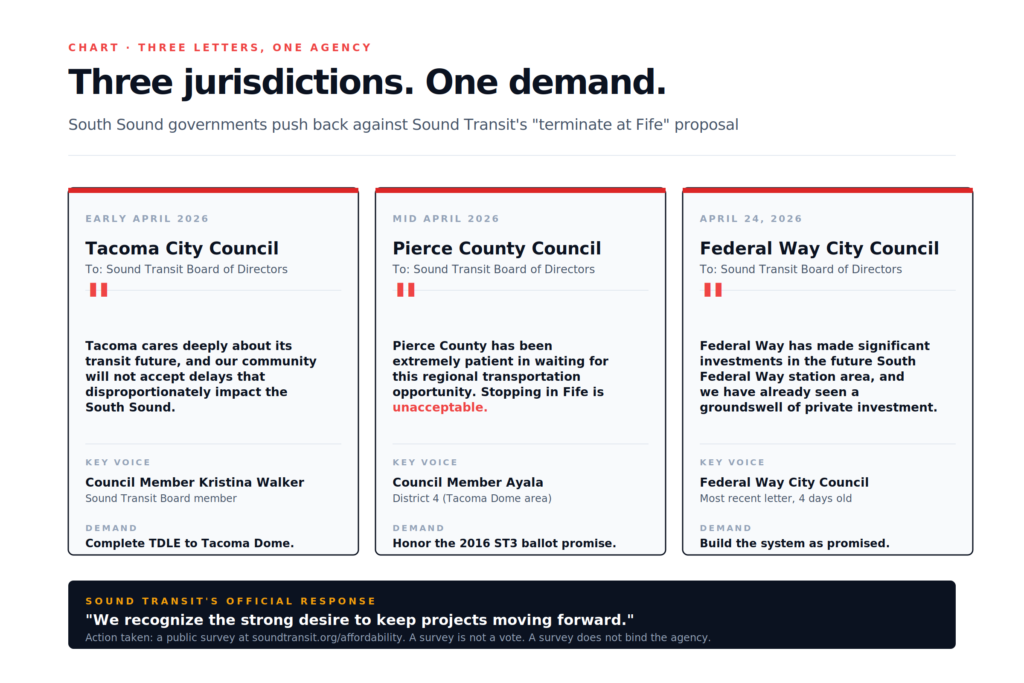
In the past three weeks, three South Sound jurisdictions have sent formal letters of protest to the Sound Transit Board. Each demands the agency keep its 2016 promise to build light rail all the way to the Tacoma Dome — not stop short at Fife.
Tacoma City Council — Council Member Kristina Walker, who sits on the Sound Transit Board, briefed colleagues on April 8 about cost-cutting options being weighed at a Sound Transit retreat. The full Council then sent a formal letter calling delays that “disproportionately impact the South Sound” unacceptable.
Pierce County Council — In a letter dated mid-April 2026, the Council called the Fife termination proposal “unacceptable” and warned it could worsen traffic congestion for the roughly one in four Pierce County residents who commute outside the county for work.
Federal Way City Council — On April 24, 2026, Federal Way joined the protest with its own letter to the Sound Transit Board, citing the city’s significant investments in the planned South Federal Way station area and “a groundswell of private investment based on the expectation that this infrastructure is coming.”
Three cities. Three letters. One agency. And so far, one response from Sound Transit: a public survey at soundtransit.org/affordability.
The 2016 Vote That Pierce County Sound Transit Critics Have Never Forgotten
Here is the documented chronology that makes the current Pierce County Sound Transit fight so significant.
In November 2016, ST3 went to voters across the three-county Sound Transit district. The measure raised $54 billion in new sales, property, and motor vehicle excise taxes for regional rail expansion — including the Tacoma Dome Link Extension (TDLE), a 10-mile light rail line from Federal Way to the Tacoma Dome with stations at South Federal Way, Fife, East Tacoma, and Tacoma Dome.
ST3 passed regionally. It did not pass in Pierce County. Pierce County voters rejected it. The measure became law because King and Snohomish County majorities outvoted Pierce County’s no.
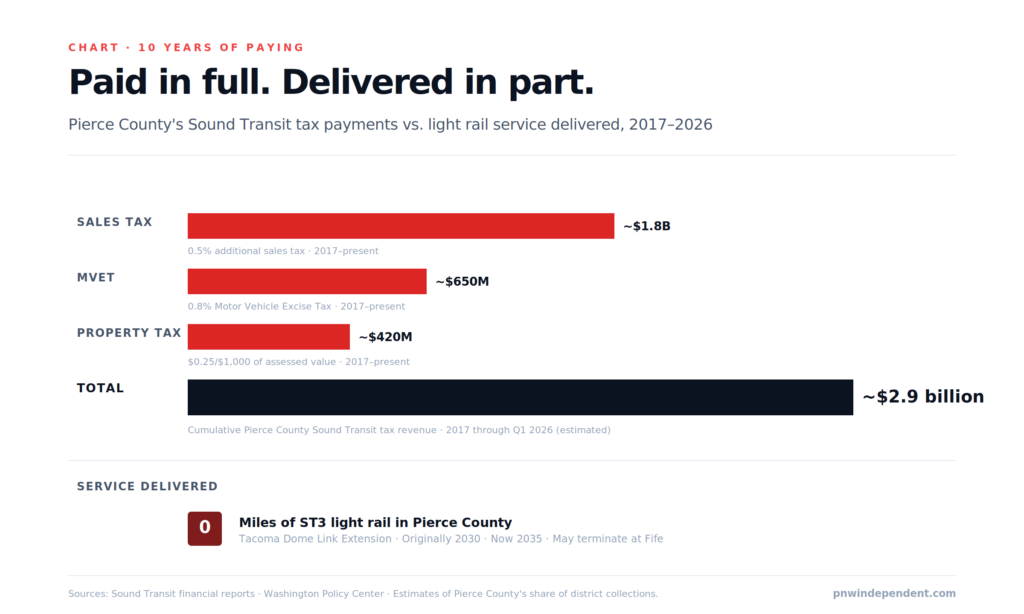
Since then, every Pierce County resident — including those who voted no — has been paying:
- Increased sales tax under ST3 authority
- Motor Vehicle Excise Tax on vehicle registrations
- Property tax on homes and businesses
For nearly ten years. And what they were told they were buying with that money was light rail to the Tacoma Dome by 2030.
Then 2030 became 2035. And now, in 2026, the line might stop in Fife instead. The Tacoma Dome — the part Pierce County voters were told would justify the tax — could be deferred to “an unknown future date,” according to documents Sound Transit briefed to its board in March 2026.
The Pierce County Sound Transit Numbers Don’t Lie
The arithmetic explains why South Sound leaders are publicly furious:
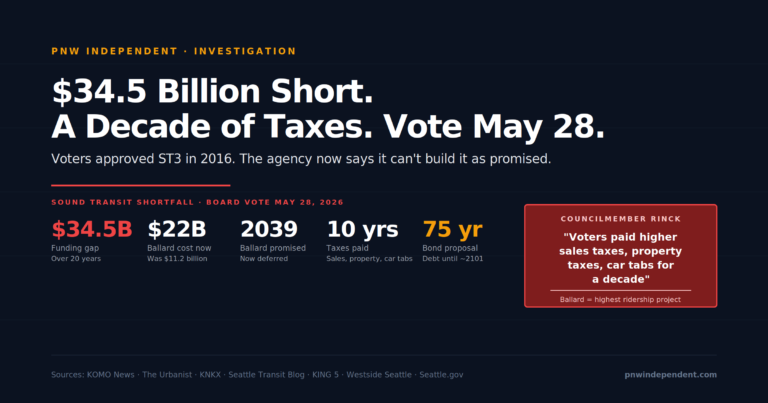
- $34.5 billion — Sound Transit’s current ST3 funding shortfall, per the agency’s own briefings.
- $185 billion — Total Sound Transit program cost as of August 2025, up from a $54 billion projection at the 2016 vote.
- $55,000 per person — Per-capita Sound Transit cost across the 3.4 million district residents.
- 9 of 18 — Sound Transit board members appointed by former King County Executive Dow Constantine over his 16-year tenure.
- 15-0 — Vote by which the same Sound Transit board hired Constantine as CEO in March 2025 at $450,000-plus base salary.
- 2 — Number of times Tacoma Dome Link Extension has now slipped past its original target. Original 2030 → realigned to 2035 → now possibly indefinite.
We documented the full picture in PNW Independent’s Sound Transit Failure investigation. What’s happening to Pierce County right now is not a one-off — it is the predictable result of an agency structure that has produced “surprise” cost overruns in every phase of every program it has ever delivered.
What Sound Transit Says, and What It Means
Sound Transit’s official response, paraphrased from agency statements: the board “recognizes the strong desire to keep projects moving forward” but is constrained by inflation, construction costs that have “surged 71.5% since the end of 2020,” and the unprecedented funding gap.
Translated: the agency is asking Pierce County to accept that, after a decade of paying, the train stops short.
The “Enterprise Initiative” — Sound Transit’s branding for its cost-cutting effort — is presenting the board with three approaches this summer:
- Build to Fife only, complete planning and 30% design on the full project, defer Tacoma construction indefinitely.
- Eliminate various stops across the program (which would also affect Snohomish County and Seattle projects).
- Build the full project on a longer timeline, with completion deferred to an unknown future date.
Notice what’s missing from this list: cutting executive compensation, restructuring the board to make it directly accountable to voters, suing contractors over defective work like the East Link concrete plinth fiasco, performance audits, or any structural change to how the agency operates. Every option on the table is a service cut to ratepayers. Zero options on the table touch the agency’s own cost structure.
What Pierce County Sound Transit Critics Are Actually Saying
The councilmember most directly representing the affected area, Pierce County Council Member Jani Hitchen (and District 4’s representative covering the Tacoma Dome area), framed the issue as a fundamental breach of trust:
“For us, primarily, Pierce County has been extremely patient in waiting for this regional transportation opportunity… I think there’s a lot of, I’ll categorize it as fear. Just fear that folks won’t have that access and connectivity. The other part is also a relationship breaking with government. Like, what does it mean for us to wait for so long, invest and wait so long to kind of reap those benefits?”
— quoted in FOX 13 Seattle reporting, April 2026.
The Tacoma City Council’s letter put it more bluntly: “Tacoma cares deeply about its transit future, and our community will not accept delays that disproportionately impact the South Sound.”
Federal Way’s letter: “Federal Way has made significant investments in the future South Federal Way station area, and we have already seen a groundswell of private investment based on the expectation that this infrastructure is coming.”
This is what local government looks like when it is told, in effect, that promises to one part of the region matter more than promises to another.
The Pattern: Pierce County Sound Transit Is Not Alone
The Pierce County Sound Transit fight fits a pattern PNW Independent has documented across the region. The agencies that distribute regional money — Sound Transit, Multnomah County’s Joint Office of Homeless Services, Seattle Human Services Department — share four common features:
- Appointed boards rather than directly elected ones. No voter can remove a Sound Transit board member from the Sound Transit board.
- Closed-loop governance. Board members appoint each other and hire each other. Constantine’s CEO hire is the textbook case.
- Cost overruns that always seem to fall hardest on the constituencies with the least board representation. Pierce County has the smallest representation among the three Sound Transit district counties. It is now first on the chopping block.
- “Engagement” as a substitute for accountability. Sound Transit’s response to three formal council letters is a public survey. A survey is not a vote. A survey does not bind the agency. A survey is the appearance of listening, with no obligation to act on what it hears.
What Could Actually Help Pierce County
The fix here is not complicated, even if it is politically difficult:
1. Direct election of Sound Transit Board members by district. End the cross-appointment loop. Make at least three of the eighteen board seats Pierce County-elected, by district, accountable to Pierce County voters and only Pierce County voters.
2. State performance audit of Sound Transit’s cost estimation methodology. The Washington State Auditor and JLARC have not conducted a comprehensive performance audit of Sound Transit’s contracting and cost-estimation practices despite three decades of “surprise” overruns. Senator Reuven Carlyle has tried; the bills die in committee.
3. Pierce County Sound Transit opt-out provision. If the county that voted no on ST3 is the first to lose the promised service, Pierce County residents should have a formal mechanism to opt out of the unfunded portions of the program. Continuing to extract tax revenue from a county whose promised services are being cut is not equitable governance.
4. CEO clawback provisions. Constantine’s $450,000+ contract should include performance milestones tied directly to project delivery — including the Tacoma Dome Link Extension — with clawback if the line stops short of the Tacoma Dome.
The Bottom Line on Pierce County Sound Transit
Pierce County voters were told the answer to “should you pay this tax?” in 2016. The majority said no. The regional vote overrode them. They paid anyway, on the understanding that — even if they hadn’t asked for the project — they would at least get the promised line to the Tacoma Dome.
In 2026, that promise is up for negotiation again. The decision is not coming from the people who voted yes or no. It is coming from an 18-member appointed board that none of them can vote on, advised by a CEO they had no role in selecting, presented with three options that all involve them losing service and zero options that involve the agency tightening its own belt.
This is not Sound Transit failing the South Sound by accident. This is the structure working exactly as designed — for the agency. Pierce County Sound Transit ratepayers have been paying for a service the agency now says it cannot afford to deliver, while the people running the agency continue to get paid.
The decision is expected by summer 2026. Public comments can be submitted at soundtransit.org/affordability. Whether comments will matter is a question only the board can answer — and the board is not on any ballot.
Related Reading on PNW Independent
- Sound Transit Failure: $185B Boondoggle Run by Insiders — the original investigation into Sound Transit’s governance structure, the Constantine self-appointment, and the three-decade pattern of cost overruns.
- Who Really Runs Seattle: Two Machines, One Ruling Class
- The Portland Homeless Industrial Complex: Inside the $700M Machine
External Sources
- FOX 13 Seattle — Pierce County urges Sound Transit to uphold ‘promise’ on light rail expansion (April 2026)
- KOMO News — Tacoma pushes back as Sound Transit weighs ending light rail line at Fife
- Kent Reporter — Federal Way urges Sound Transit to extend light rail to Tacoma (April 24, 2026)
- Tacoma Weekly — Pierce County News Briefs April 11–22, 2026
- Sound Transit — Tacoma Dome Link Extension project page
- Sound Transit Enterprise Initiative — soundtransit.org/affordability
- Washington Policy Center — Billions in cost overruns may finally bring a day of reckoning
One Comment