
KCRHA Audit: $13M Missing in Seattle’s Homeless Agency
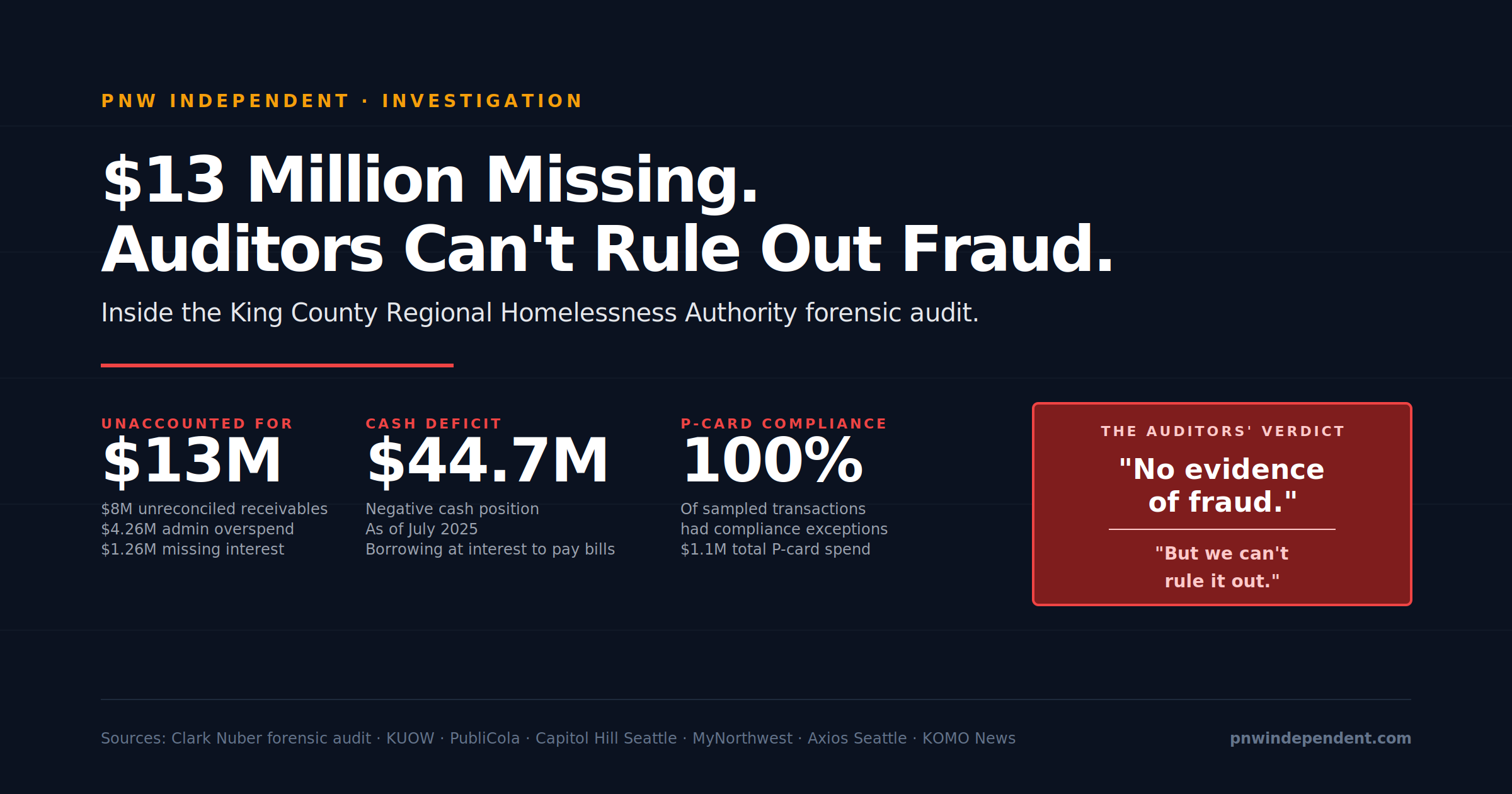
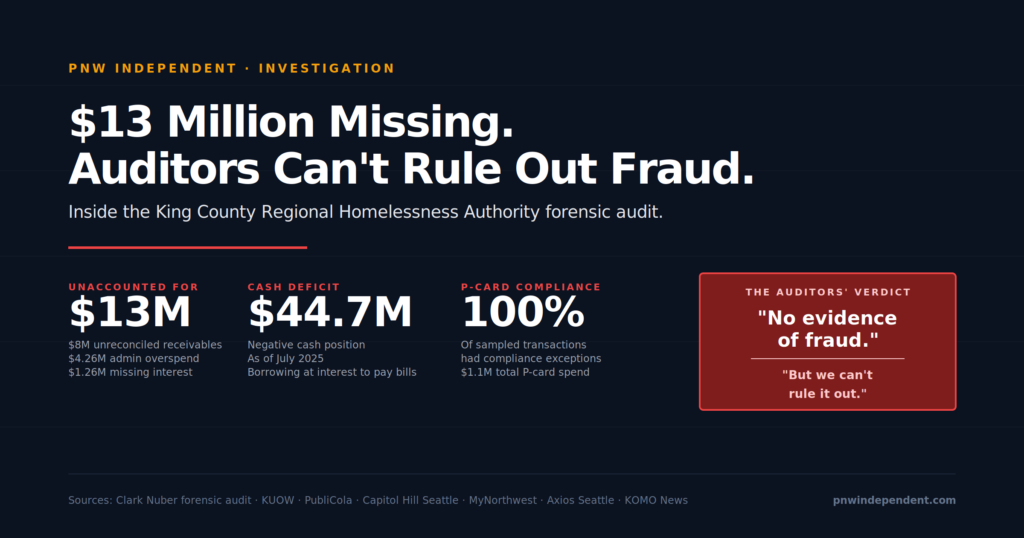
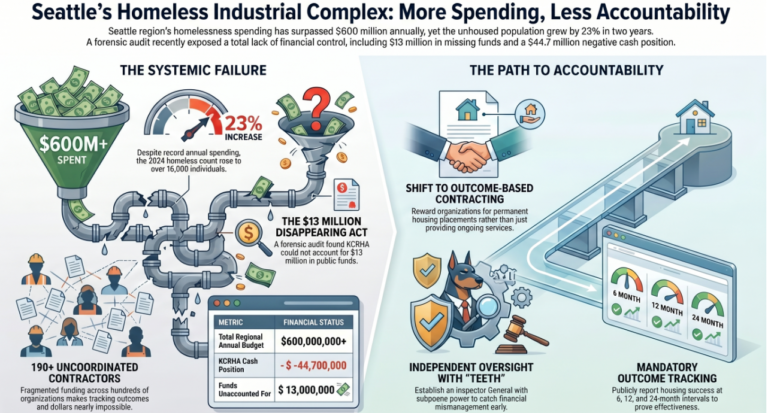
A KCRHA audit released April 22, 2026 found $13 million unaccounted for and a $44.7 million negative cash position at the King County Regional Homelessness Authority. The forensic review by Clark Nuber cost taxpayers $600,000. Auditors found no evidence of fraud — but stated they could not rule it out, citing missing records. Mayor Katie Wilson says “all options are on the table.” Two councilmembers want the agency dissolved within 12 months. The structural failure pattern matches every other regional pass-through agency PNW Independent has documented. However, the dollar amounts here are unprecedented for Seattle.
What the KCRHA Audit Actually Found
The audit was conducted by Bellevue accounting firm Clark Nuber. It covered the agency from its inception in 2021 through July 2025. The full report ran more than 100 pages. Several headline numbers stand out.
The $13 Million Question
The audit identified three buckets of missing or overspent money:
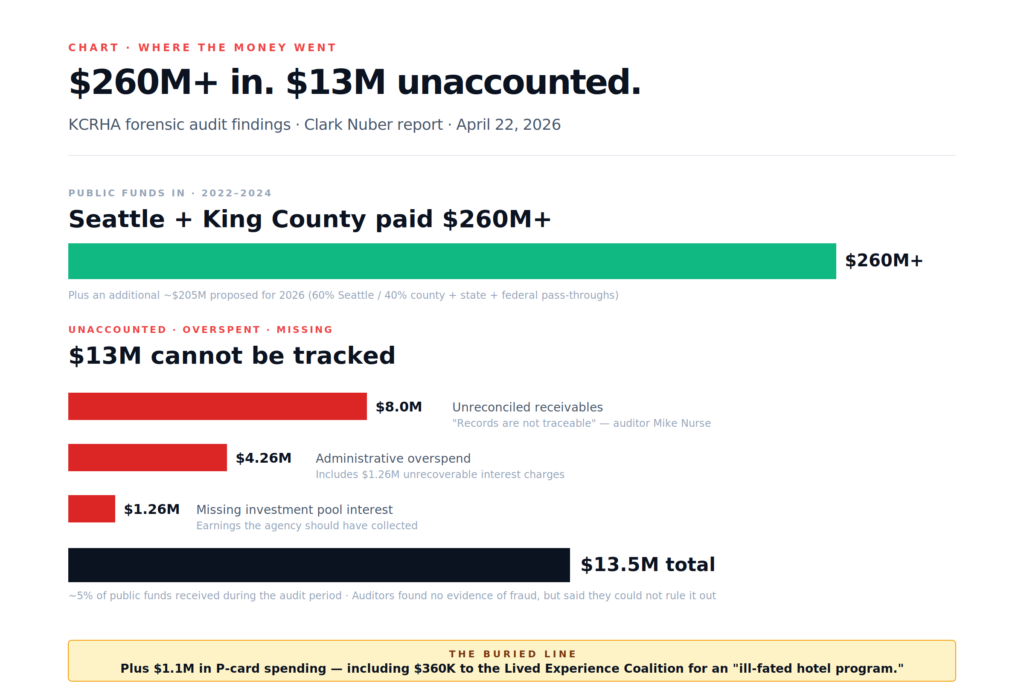
- $8 million in unreconciled receivables — money the agency cannot account for
- $4.26 million in administrative overspending — including $1.26 million in interest charges deemed unrecoverable
- $1.26 million in missing investment pool interest
Furthermore, lead auditor Mike Nurse told the KCRHA Governing Board on April 24: “The accounting records are such that the details around receivables are not traceable because the supporting information isn’t there.” When asked directly about fraud, Nurse said the answer “remains unclear.”
That’s not a clean bill of health. That’s “we can’t tell.”
The $44.7 Million Cash Hole
Beyond the missing money, the audit found the agency had been operating in the red for years. As of July 31, 2025, KCRHA’s negative cash position reached $44.7 million.
Meanwhile, the agency was borrowing money at interest just to pay its contractors. At one point, the gap between what the agency owed and the cash it had on hand was nearly $80 million.
This is not an accounting quibble. This is structural insolvency.
The Bookkeeping Problem
According to the audit, the agency’s accounting practices included:
- No formal monthly accounting close process
- No documented internal control framework (such as COSO, the standard most public agencies follow)
- Accounting system permissions that let the same person create, approve, and submit invoices
- 57% of King County invoices submitted more than 30 days late
- One billing cycle to Seattle was 16 months late
- Single fund used as a repository for earmarked money from various sources, then drained to cover unrelated expenses
In short: the agency was running on a system that made it nearly impossible to track where money went.
How the KCRHA Audit Got Commissioned
The audit didn’t appear out of nowhere. It came at the end of a documented pattern of warning signs.
The Warning Signs Came First
By summer 2025, KCRHA had:
- High leadership turnover (multiple CEO changes in three years)
- Delayed contractor payments
- State auditor findings
- Unverified accounting practices
- Cash flow problems flagged by funders
Consequently, the City of Seattle and King County jointly commissioned a forensic audit in August 2025. The contract went to Clark Nuber. The cost: $600,000 of public money to investigate where other public money had gone.
Eight months later, the answer came back: nobody knows where roughly $13 million went.
The Numbers That Funded the Hole
While the audit was being conducted, taxpayers kept paying. From 2022 through 2024, Seattle and King County combined supplied more than $260 million to the agency. Seattle’s annual contribution alone reached $113 million in 2024.
The proposed 2026 budget? $205 million, with about 60% from Seattle and the rest from the county and state and federal pass-through grants.
That money flowed in. Where it went, by the agency’s own accounting, is partially unknown.
The Purchase Card Problem the KCRHA Audit Exposed
Buried in the audit findings is a section that deserves its own headline. It concerns the agency’s use of purchase cards — credit cards meant for small, incidental expenses.
$1.1 Million in P-Card Spending
KCRHA staff charged more than $1.1 million on purchase cards over the four-year audit period. Typical agency policy limits these cards to office supplies and minor expenses. Instead, KCRHA staff used them for office furniture, clothing, and large housing payments that bypassed normal contract review.
Furthermore, 100% of sampled P-card transactions contained compliance exceptions, according to the audit. Every single one.
In a sample of 14 “high-dollar” P-card purchases, Clark Nuber found that every purchase raised concerns. Issues included:
- Purchases made by someone other than the cardholder
- Missing receipts
- Approvals by people not authorized to approve such expenses
The Lived Experience Coalition Hotel Program
A specific number jumps out. According to PubliCola’s reporting on the audit, the $1.1 million in P-card spending included about $360,000 for an “ill-fated hotel program” run by the Lived Experience Coalition.
PubliCola covered that hotel program extensively in 2023. The audit now confirms public money flowed into it through credit cards, bypassing normal contract oversight.
That detail alone deserves congressional attention. It probably won’t get it.
The KCRHA Audit on Executive Compensation
Among the most striking findings in the audit is what the agency paid for temporary leadership.
KCRHA spent $450,000 over 11 months on an interim CFO. The salary works out to roughly double what a permanent CFO would have made. Meanwhile, the agency was running an administrative deficit and missing routine financial obligations.
In other words: the agency was paying premium prices for the very people who should have been catching the financial problems. They didn’t.
Heavy Reliance on Contractors
The audit found that administrative costs were “driven by a reliance on high-priced temporary staffing.” This is a structural pattern PNW Independent has documented at other regional pass-through agencies. Multnomah County’s Joint Office of Homeless Services follows the same pattern. So does Seattle’s Human Services Department.
The pattern matters. When an agency relies on contracted staff instead of permanent employees, institutional memory disappears. Furthermore, oversight responsibility becomes ambiguous. As a result, nobody is in charge when the audit comes.
The Political Response to the KCRHA Audit
The audit findings dropped Tuesday evening, April 21. By Wednesday morning, every major elected official with skin in the game had a public statement.
Mayor Katie Wilson: “All Options on the Table”
Seattle Mayor Katie Wilson, in office since January 2026, said the audit “identifies serious failures of KCRHA’s internal controls, fiscal management and accountability.” She added: “Addressing homelessness is my highest priority, and I have serious concerns about KCRHA’s management of city funds. We need to take swift action to protect public dollars. All options are on the table.”
Wilson and King County Executive Girmay Zahilay sent a joint letter to KCRHA CEO Kelly Kinnison demanding:
- A written response by May 8, 2026 addressing the audit’s “high-risk” findings
- A full corrective action plan by May 23, 2026
- An immediate hiring freeze
- An immediate spending freeze
- A new financial oversight committee meeting biweekly
- A pause on any new agreements that increase costs
Councilmembers Want Dissolution
Two councilmembers went further. Seattle Councilmember Maritza Rivera and King County Councilmember Rod Dembowski announced plans to introduce companion legislation to dissolve KCRHA over a 12-month timeline.
Dembowski’s framing was direct: “They say that the road to hell is paved with good intentions. The King County Regional Homelessness Authority was set up six years ago with the best of intentions, but the tool that was set up has been given more chances than it deserves at this point, and it has failed again and again and again.”
Rivera called the audit findings “egregious” and “a damning indictment.”
King County Councilmember Reagan Dunn endorsed the dissolution proposal Friday.
CEO Kinnison’s Defense
KCRHA CEO Kelly Kinnison, who joined the agency in June 2024, defended the organization in a letter to the Governing Board. Kinnison attributed the financial turmoil to “startup conditions, the pandemic response, an initially fragmented governance framework, and a highly complex funding model.”
She stated: “Since that time, we have made meaningful progress. Governance has been restructured, and core operations — including contracts, data systems, and provider coordination — are functioning more effectively. Our financial systems have also improved, though additional strengthening is still needed.”
Kinnison clarified that the $4.26 million in administrative overspend was a result of “budget reclassification rather than inappropriate spending.” Additionally, she said work is underway to identify the missing $8 million in receivables.
That is the agency’s official position. Whether it survives the next two months of corrective-action deadlines remains an open question.
What the KCRHA Audit Means for Regional Governance
Step back from the dollar figures. The audit is the third regional pass-through agency PNW Independent has documented showing the same structural failure pattern.
The Pattern
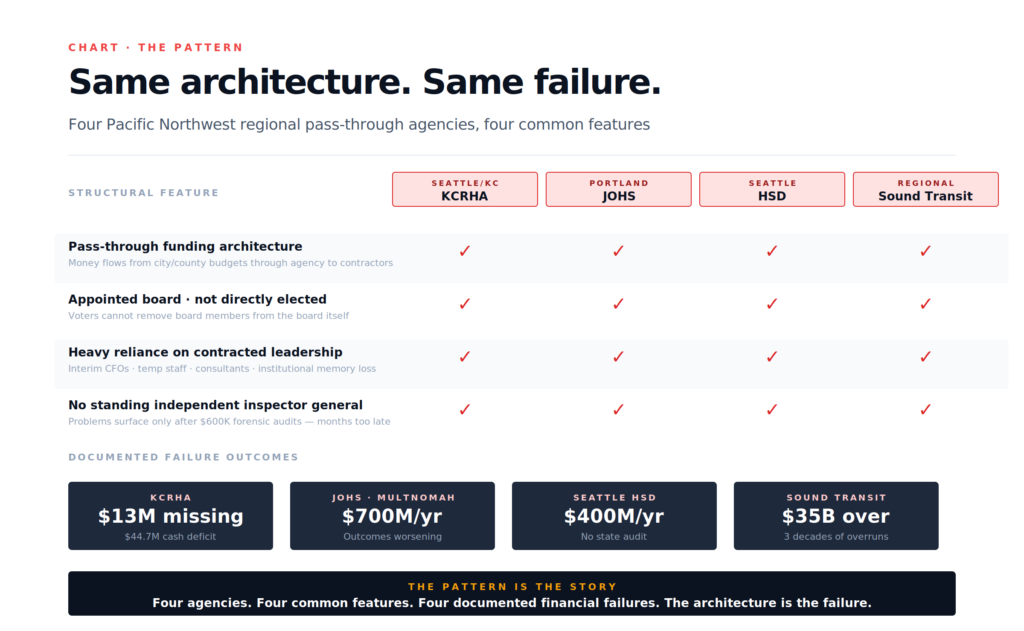
In Portland, Multnomah County’s Joint Office of Homeless Services distributes ~$700M/year to ~200 nonprofits with thin oversight. Outcomes have gotten worse as spending has grown.
In Seattle, the Human Services Department administers ~$400M/year through similar pass-through arrangements.
In transit, Sound Transit has racked up a $35 billion cost overrun under an 18-member appointed board accountable to nobody.
Now KCRHA. Same architecture. Same failure mode.
The Common Features
These agencies share four traits:
- Pass-through funding. Money flows from city and county budgets through the agency to contracted providers. Each transit point creates an oversight gap.
- Appointed boards rather than directly elected ones. Voters cannot remove a KCRHA board member from the KCRHA board.
- Dependence on contracted leadership. Interim CFOs, temp staff, consultants. Institutional memory vanishes between contracts.
- No standing inspector general. When problems emerge, the response is a $600,000 forensic audit — six months after the damage is done.
The Architecture Problem
Furthermore, none of these agencies were designed by accident. They emerged from a regional consensus that homelessness, transit, and human services were too complex for any single jurisdiction to handle alone. Consequently, regional bodies were created with broad mandates and narrow accountability.
That architecture is the failure. The audit is the evidence.
What Should Happen Next After the KCRHA Audit
The political reaction to the audit has focused on whether the agency should survive. That question matters. However, it is not the only question.
1. Independent State Audit
The Washington State Auditor’s Office should conduct its own performance audit of KCRHA. Clark Nuber is a private firm hired by the city and county that fund the agency. An independent state-level audit, free of funder influence, would carry more weight. Furthermore, it would establish whether the problems documented by Clark Nuber are limited to KCRHA or systemic across regional pass-through agencies.
2. Criminal Referral if Warranted
Auditors said they found no evidence of fraud but could not rule it out. That phrase has specific meaning in audit work. It means the records are too damaged to prove a negative. Therefore, the City of Seattle and King County Prosecutor’s Office should review the audit’s underlying documentation to determine whether any conduct rises to a criminal referral.
3. Lived Experience Coalition Audit
The Lived Experience Coalition received approximately $360,000 through KCRHA P-card transactions for an “ill-fated hotel program.” That program deserves its own forensic review. Specifically, where did the money go, what services were delivered, and why was P-card use deemed appropriate for an arrangement of that size?
4. Mandatory Disclosure for Regional Pass-Through Agencies
Washington State should require all regional pass-through agencies — KCRHA, Sound Transit, every regional housing authority — to publish monthly cash positions, contractor payment timelines, and P-card usage in machine-readable formats. Sunlight is the cheapest accountability tool available. Most regional agencies don’t currently provide it.
5. Permanent CFO Hiring Mandate
No agency administering hundreds of millions of dollars should rely on an interim CFO for 11 months at $450,000. State law could require regional pass-through agencies to maintain permanent senior financial leadership. This single rule would have caught the audit findings years earlier.
The Bottom Line on the KCRHA Audit
The audit is a structural failure document. $13 million is missing. The agency was operating with a $44.7 million cash deficit. 100% of sampled P-card transactions had compliance exceptions. The interim CFO cost double what a permanent hire would have. Auditors cannot rule out fraud because the records aren’t there.
These are not the findings of a young agency working through growing pains. These are the findings of a structural failure of governance. Whether KCRHA survives the next two months is up to its board, the City Council, and the County Council.
However, the broader question is whether any regional pass-through agency in the Pacific Northwest is operating with the controls necessary to handle the money it receives. Based on PNW Independent’s documentation of Multnomah County’s Joint Office of Homeless Services, Sound Transit, and now KCRHA, the answer appears to be: not yet.
The pattern is the story. The audit is the latest chapter.
Related Reading on PNW Independent
- The Portland Homeless Industrial Complex: Inside the $700M Machine
- Sound Transit Failure: $185B Boondoggle Run by Insiders
- Who Really Runs Seattle: Two Machines, One Ruling Class
- Pierce County Voted No on ST3. Now They Lose the Train.
External Sources
- Capitol Hill Seattle News — KCRHA $44.7M spending hole audit (April 23, 2026)
- PubliCola — Forensic Audit Finds Homelessness Agency Lacked Basic Accounting Standards (April 22, 2026)
- KUOW — KCRHA board votes to tighten purse strings following damning audit
- Axios Seattle — What’s next for King County homelessness agency after audit
- MyNorthwest — Auditors say tracing missing $13M will be difficult
- KOMO News — $13M missing: Seattle leaders call attention to ‘egregious’ regional homelessness audit
- Seattle City Council — Councilmembers Rinck and Foster Respond to KCRHA Audit
- Seattle City Council — Councilmember Kettle on KCRHA Audit
- Westside Seattle — Forensic audit uncovers $13 million missing
- KCRHA — Official Statement on Forensic Audit

3 Comments