How Brutal King County DCHS Failures Exposed the IG Gap
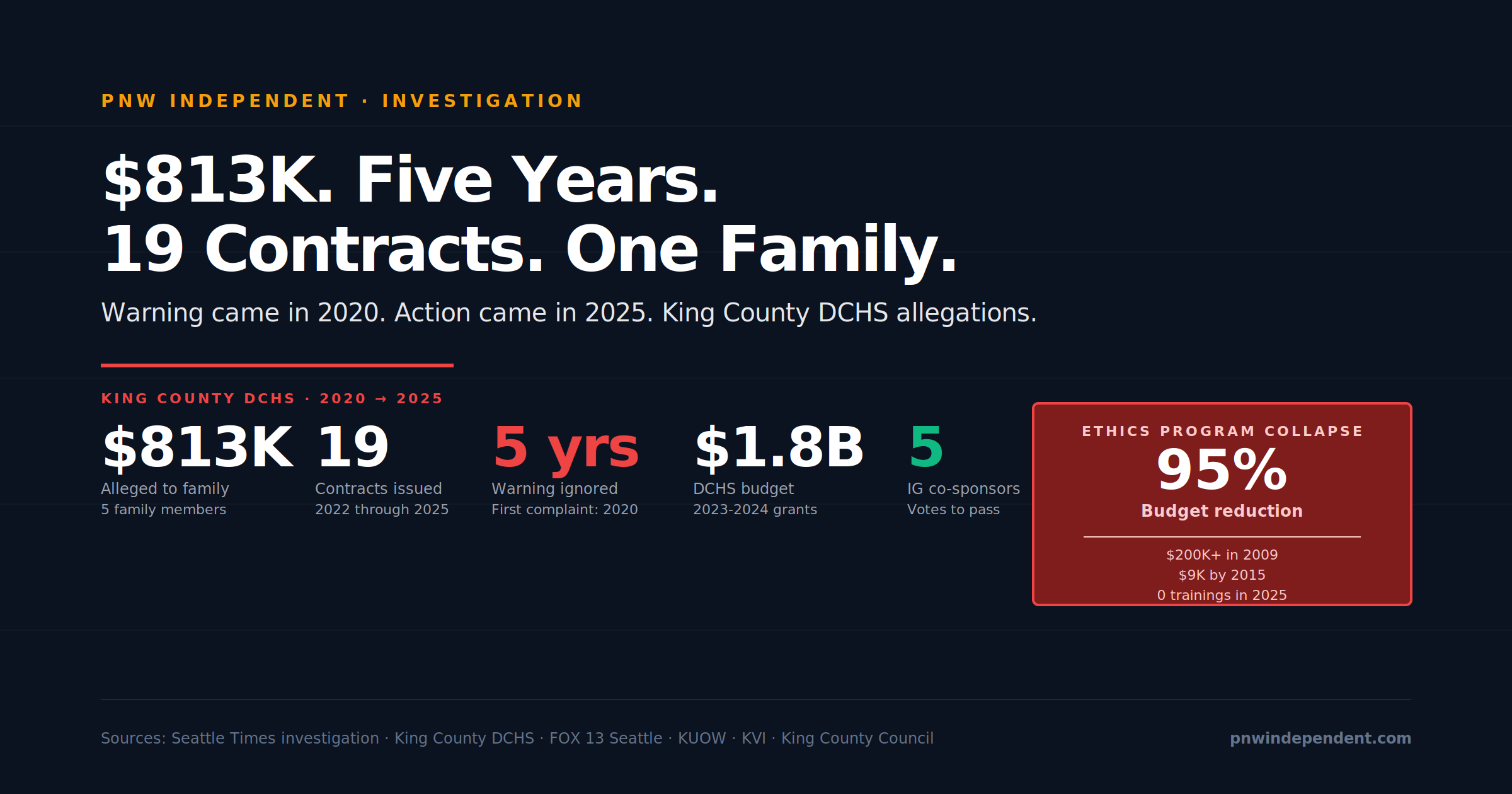
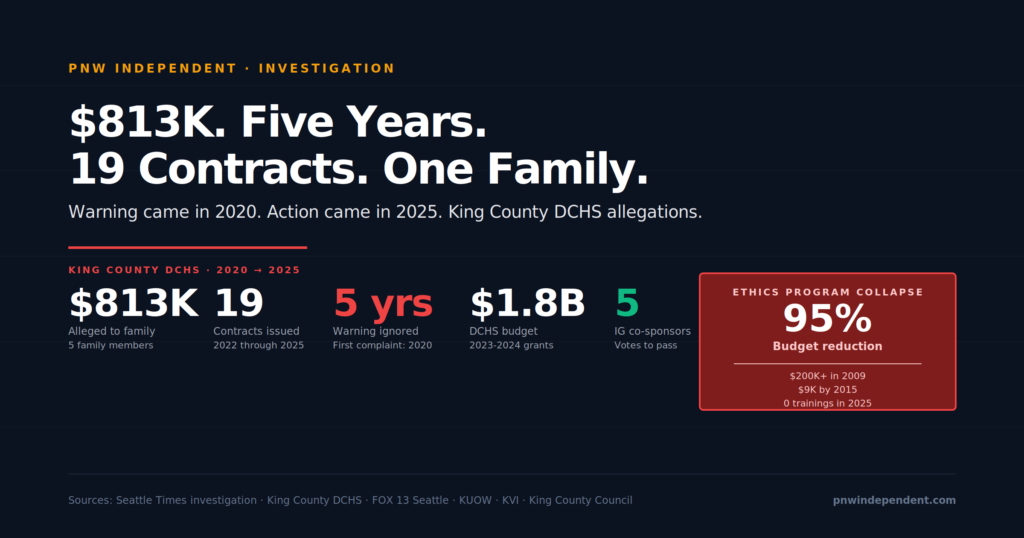
A King County DCHS program manager allegedly funneled approximately $813,000 in public grants to her own daughter, two brothers, a cousin, and a sister-in-law through 19 contracts issued between 2022 and 2025. Furthermore, county officials received a complaint about the conflict of interest as early as 2020 — and did not formally investigate until 2025. The Department of Community and Human Services budget grew from $22 million in 2019-2020 to over $1.8 billion in 2023-2024. King County’s ethics program was simultaneously gutted: from a $200,000+ budget in 2009 to one part-time employee today. Zero ethics training presentations in 2025. King County Councilmembers Rod Dembowski, Reagan Dunn, Sarah Perry, and Pete von Reichbauer are now introducing legislation to create an independent Inspector General with subpoena power. The legislation has the votes to pass.
What the King County DCHS Investigation Actually Found
The King County DCHS scandal centers on a December 2025 internal investigation report obtained by The Seattle Times through a public records request. Furthermore, the report and subsequent reporting documented a clear pattern.
The Top-Line Allegations
The investigation alleges that program manager Yolanda McGhee, who oversaw the Liberation and Healing from Systemic Racism (LHSR) program known as Liberated Village, directed grant funding to companies owned by five of her family members:
- Her daughter
- Two brothers
- A cousin
- A sister-in-law
Specifically, money flowed through 19 contracts issued between 2022 and 2025. The total allegedly steered to family-owned companies: approximately $813,000. The Liberated Village program itself distributed more than $10 million through those 19 contracts — meaning roughly 8% of program funds went to companies tied to the program manager’s family.
The Liberated Village Program Context
The Liberated Village was a real program with documented community work. Specifically:
- It was a mentorship initiative for Black and Brown youth in King County
- It was housed within the King County Department of Community and Human Services (DCHS)
- It was funded through Best Starts for Kids (BSK), a community-driven county initiative
- McGhee was recognized in July 2024 with a “Yolanda McGhee and the Liberated Village Weekend” proclamation by King County
- Furthermore, the program produced public-facing events including a 2023 Arts & Education Festival
That context matters. The allegations in the King County DCHS investigation are not about whether the program existed or whether community work was performed. The allegations are about the financial structure that channeled grant funds through entities with family ties to the program manager.
What McGhee Says
McGhee was fired in January 2026 for what the county characterized as serious policy violations. However, she is contesting her termination through her labor union and has disputed the county’s characterization of events. Specifically, she told The Seattle Times in writing:
“I have consistently taken ethics, disclosure, and financial reporting obligations seriously and made appropriate disclosures to the extent required.”
McGhee declined to answer detailed questions from The Seattle Times, citing her ongoing termination appeal.
Furthermore, separate commentary in alternative reporting has questioned whether family relationships were already known to County channels rather than concealed. PNW Independent has not independently verified those alternative claims. Therefore, this article documents what the official Seattle Times investigation, the December 2025 county report, and the public statements from elected officials show — while acknowledging that the personnel dispute is ongoing.
How the King County DCHS Warning Signs Were Missed
The most damning element of the King County DCHS story is not the alleged misconduct itself. Specifically, it is the documented five-year gap between when concerns were first raised and when formal investigation began.
The 2020 Complaint
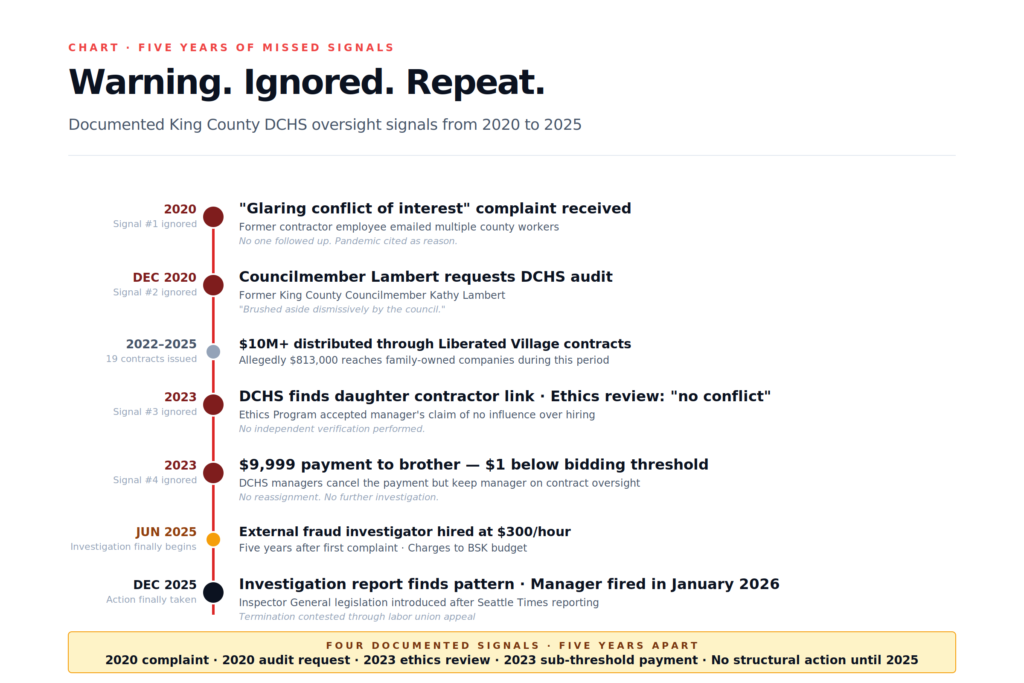
In 2020, a former contractor employee emailed multiple King County workers accusing McGhee of a “glaring conflict of interest” involving her daughter’s work in the program. No one followed up. Furthermore, health department staff later told investigators that the COVID-19 pandemic had made the department too chaotic to act on the complaint.
That explanation matters — and it does not. Specifically, the pandemic strained government operations everywhere. However, a documented allegation of grant fraud in a public-facing program does not have a statute of limitations on departmental attention.
The 2023 Discovery
Three years later, in 2023, DCHS leaders independently discovered a contractor link to McGhee’s daughter and brought it to the King County Ethics Program. Furthermore, the Ethics Program reviewed the situation and concluded it was not a conflict of interest. The reasoning: McGhee told them she had no influence over her daughter’s hiring.
That conclusion is striking. Specifically, ethics review processes typically require independent verification of claims, not deference to the staff member’s own characterization. Furthermore, the Ethics Program at the time was operating with significantly reduced capacity (more on that below).
The $9,999 Payment
One month after the 2023 ethics review concluded “no conflict,” DCHS managers found that McGhee had submitted a payment of $9,999 for one of her brothers. Specifically, that figure is one dollar below the threshold that triggers competitive bidding under King County procurement rules.
Therefore, when managers found the payment, they:
- Canceled the payment
- Did not reassign McGhee’s contract oversight work
- Did not investigate further
- Did not refer the matter to the Ethics Program for re-examination
In other words, the system caught a textbook procurement red flag — and then did nothing meaningful with it.
The 2025 Investigation
The formal investigation did not begin until 2025. Furthermore, an internal communication obtained by alternative reporting (June 24, 2025) confirmed that the investigation cost was $300 per hour and that DCHS was working to identify a Best Starts for Kids budget line to charge the cost against. The full December 2025 report identified the broader pattern that earlier reviews had missed.
How the King County DCHS Ethics Infrastructure Got Hollowed Out
The King County DCHS oversight failure cannot be understood without examining what happened to the county’s ethics infrastructure over the same period. Furthermore, the contraction was severe.
The Ethics Program Decline
Specifically, the King County Ethics Program timeline:
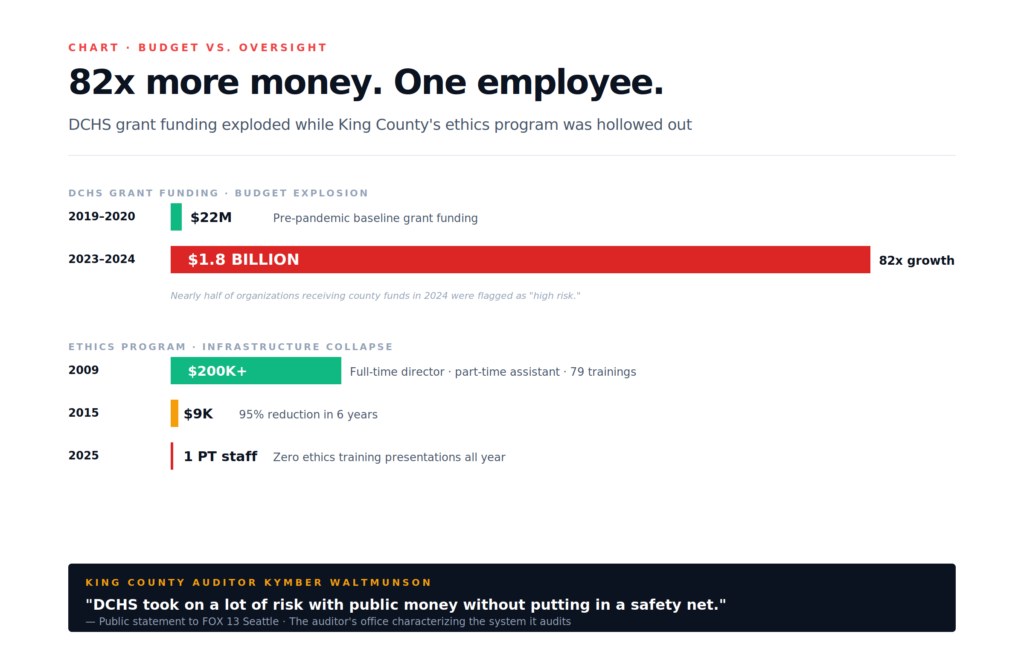
- 2009 budget: Over $200,000, with a full-time director and a part-time assistant
- 2009 training output: 79 ethics presentations and trainings
- 2015 budget: $9,000 — a 95% reduction
- 2026 staff: One part-time employee
- 2025 training output: Zero ethics training presentations
That is not a budget reduction. That is the dismantling of an entire oversight function. Furthermore, the dismantling happened during the same period when the DCHS budget grew dramatically.
The DCHS Budget Explosion
While ethics oversight contracted, DCHS spending grew:
- 2019-2020 DCHS grant funding: $22 million
- 2023-2024 DCHS grant funding: Over $1.8 billion — an 82-fold increase
- 2024 high-risk contractor flag rate: Nearly half of organizations receiving county funds
Therefore, King County was distributing 82 times more grant money through DCHS in 2023-2024 than in 2019-2020 — while simultaneously running an ethics program with a fraction of its peak capacity. Furthermore, a recent county audit found DCHS “failed to conduct basic financial and contract monitoring” during that same growth period.
What That Math Means
The King County DCHS structure created the conditions that the McGhee allegations document. Specifically:
- More money flowing through more contracts to more contractors
- Fewer ethics resources to monitor relationships and conflicts
- No standing inspector general to investigate allegations independently
- Department-internal review of departmental concerns — which carries inherent conflict
- Underfunded auditor capacity relative to the scale of spending
Therefore, when an allegation of conflict of interest came in, the system was structurally incapable of investigating it at the depth required. Furthermore, that’s not a personnel failure. That’s an architecture failure.
What Council Members Are Saying About King County DCHS
The political response to the King County DCHS allegations has been bipartisan and unusually direct. Furthermore, council members are framing this as part of a broader oversight crisis.
Dembowski: “Inexcusable. Outrageous.”
King County Councilmember Rod Dembowski, who chairs the Budget and Fiscal Management Committee, did not soften his reaction. Specifically:
“It’s just inexcusable. It’s outrageous. I just can’t believe that that was allowed to persist, particularly once it was identified. Absolutely wrong.”
Furthermore, Dembowski connected the allegations to the broader DCHS oversight gap:
“It is going to cost a little money on the inspector general to set that up, but the studies show, again, when you look at these IG offices around the country, generally, they pay for themselves. One, on the prevention side, because folks know if there’s someone watching, there’s going to be accountability — and two on the recovery part.”
That second comment matters. Specifically, Dembowski is making the case that an Inspector General is not a cost center — it is a revenue protection mechanism. Furthermore, the comparison to other jurisdictions’ IG offices is documented: independent watchdogs typically recover more in identified misspending than their operating budgets.
Dunn: “Of Course There’s Fraud”
King County Councilmember Reagan Dunn went further on the Ari Hoffman Show on Talk Radio 570 KVI. Specifically, Dunn argued that the DCHS allegations and the KCRHA $13M missing audit were predictable:
“We spent many hundreds of millions of dollars taxpayer money to this program and they just had never been able to get off the ground. Their trajectory was clearly doomed to fail.”
Dunn also called for federal involvement: “The sheriff and the federal law enforcement should be looking at this closely. Public corruption is part of the series of charges that the FBI can investigate.”
Furthermore, Dunn was part of a longer pattern of warnings that went unheeded. Former Councilmember Kathy Lambert has said publicly that she requested a DCHS audit in December 2020 that was “brushed aside dismissively by the council.” Therefore, the warnings on DCHS oversight gaps are documented going back at least five years.
The Auditor’s Position
King County Auditor Kymber Waltmunson had previously told FOX 13: “The Department of Community and Human Services took on a lot of risk with public money without putting in a safety net.”
That is the auditor’s office characterizing its own jurisdiction’s spending pattern. Specifically, the auditor is not an opposition voice — it is the institutional risk-detection function. When the auditor publicly says the department was operating without a safety net, that is a structural acknowledgment from inside the system.
The King County DCHS Inspector General Legislation
King County Councilmember Rod Dembowski is now introducing legislation to create an independent Inspector General with subpoena power. Furthermore, the legislation has the votes to pass.
The Sponsors
The Inspector General legislation has five named co-sponsors:
- Rod Dembowski (chair, Budget and Fiscal Management) — prime sponsor
- Reagan Dunn (Council Vice Chair) — co-sponsor
- Sarah Perry — co-sponsor
- Pete von Reichbauer — co-sponsor
- One additional co-sponsor signaled
Specifically, five co-sponsors on a nine-member King County Council means the legislation can pass without further negotiation. Furthermore, the political alignment crosses ideological lines — Dembowski (Democrat) and Dunn (Republican) are working together on the same accountability framework.
What the Legislation Would Do
The proposed Inspector General Division would be created within the Office of Public Complaints and would have the following authorities:
- Subpoena power to compel documents and testimony
- Independent investigative authority across all county departments
- Whistleblower protection for employees who raise concerns
- Recovery of misspent funds as a core function
- Reporting authority independent of department leadership
Therefore, the Inspector General would be structurally separate from the departments it would investigate. Furthermore, the Office of Public Complaints already exists — which means the new IG Division can be built within existing infrastructure rather than as a standalone agency.
Why Subpoena Power Matters
Subpoena authority is the core of effective inspector general work. Specifically, without subpoena power:
- Investigators cannot compel documents that subjects refuse to provide
- Investigators cannot interview witnesses who decline voluntary cooperation
- Investigators cannot enforce compliance with information requests
- Departments can effectively stonewall investigations they want to slow
Furthermore, the King County Auditor’s office has investigative authority but not full subpoena power. Therefore, when the auditor identifies risk patterns, the depth of follow-up investigation has been structurally limited.
How the King County DCHS Pattern Connects to KCRHA
The King County DCHS story is not isolated. Furthermore, it directly connects to PNW Independent’s KCRHA dissolution coverage and the broader regional governance pattern.
The Common Architecture
King County DCHS, KCRHA, Sound Transit, and other regional pass-through agencies share four structural features:
- Pass-through funding architecture — money flows from city/county budgets through the agency to contractors
- Limited ethics infrastructure — gutted ethics programs, no standing inspector general
- Heavy reliance on contracted services — most program work performed by external organizations
- Department-internal investigation of department-internal concerns — inherent conflict in oversight
Therefore, when allegations arise — whether at KCRHA ($13 million unaccounted), DCHS ($813K alleged steered to family), or other agencies — the structural response is the same: department-internal review with limited tools and limited independence.
The 200 Million Dollar Question
King County contributes roughly $80 million annually to KCRHA. The City of Seattle contributes roughly $120 million annually. Therefore, approximately $200 million per year flows through that single agency. Furthermore, DCHS distributed over $1.8 billion in 2023-2024 grant funding.
The combined regional homelessness and human services spending exceeds $2 billion annually. Therefore, the case for an Inspector General with subpoena authority is not abstract. It is a basic governance requirement at that scale of public spending.
The Federal Scrutiny Angle
DCHS is already under federal scrutiny over billions in grant money distributed with limited accountability. Furthermore, Dunn has called for additional federal law enforcement involvement specifically. Therefore, the King County DCHS scandal is not just a local political story — it has implications for federal grant compliance going forward.
What Should Happen Next on King County DCHS
The King County DCHS allegations are now in the public record. Furthermore, the political alignment for reform is in place. However, several specific actions still require attention beyond the Inspector General legislation itself.
1. Pass the Inspector General Legislation Quickly
The five-co-sponsor structure means the IG legislation can pass without further negotiation. Therefore, the council should move it on a fast track. Specifically: introduce in May, hearings in June, vote in July. Each delay means another month of the same structural gap that allowed the McGhee allegations to persist.
2. Formal Criminal Referral Decision
King County has not yet publicly announced whether the McGhee allegations will be referred to the King County Prosecutor’s Office or to federal law enforcement for criminal review. Furthermore, that decision should be made publicly with documented reasoning. Specifically: either the documentation supports criminal referral or it does not — but the decision itself is a public accountability matter.
3. Restore the Ethics Program
The Ethics Program reduction from $200,000+ to a single part-time employee is an oversight failure that pre-dates any individual scandal. Therefore, restoring the program to functional capacity should be a separate budget action. Specifically: a budget of at least $300,000 with a full-time director and assistant. The cost of preventing one McGhee-scale incident pays for the program for decades.
4. Audit All 19 Liberated Village Contracts
The 19 contracts identified in the December 2025 investigation should be subjected to a full forensic audit. Furthermore, that audit should track:
- All payments to all entities
- Documentation of services delivered
- Verification of beneficial outcomes
- Recovery options for any misspent funds
5. Whistleblower Protection for the 2020 Complainant
The former contractor employee who emailed multiple county workers in 2020 raising the conflict of interest concern should be publicly identified (with their consent) and credited. Furthermore, the council should formally acknowledge the failure to act on that complaint and establish protections for future whistleblowers.
6. Publish the Ethics Program Annual Report
King County should publish an annual ethics program report including: complaints received, complaints investigated, complaints substantiated, and outcomes. Furthermore, that report should be a permanent public record. Sunshine is the cheapest oversight tool available.
The Bottom Line on King County DCHS
The King County DCHS allegations are not the most dollar-significant scandal PNW Independent has documented. $813,000 alleged steered to family is small compared to KCRHA’s $13 million unaccounted, Sound Transit’s $34.5 billion shortfall, or the $1.8 billion annual DCHS budget that grew without commensurate oversight. However, the DCHS case matters for a different reason.
It is the case that finally generated political will to create an independent Inspector General. Furthermore, that structural reform has been needed for years. Specifically: PNW Independent’s KCRHA audit coverage called for an Inspector General as Recommendation #2. The Moody’s downgrade investigation included Inspector General reform as Recommendation #5. The KCRHA dissolution piece flagged the absence of an Inspector General as a core structural failure.
Now King County is actually creating one. Therefore, the McGhee allegations did what years of audit recommendations could not: forced political attention on the basic oversight architecture problem.
Whether the Inspector General actually delivers on its potential will depend on three things going forward. First, the legislation needs to actually pass with full subpoena authority intact. Second, the office needs to be funded at a level sufficient to investigate the scale of county spending — not at a token level that ensures failure. Third, the office’s first investigations need to demonstrate independence from the political dynamics of the council that created it.
The McGhee allegations forced the door open. What comes through that door over the next 24 months will determine whether King County’s structural oversight gap actually closes — or whether the Inspector General becomes another agency operating with the same architectural limitations as the ones it was created to investigate.
The legislation has the votes. The political will exists. The public is watching. The next chapter of the King County DCHS story is now an accountability test for the council itself.
Related Reading on PNW Independent
- KCRHA Dissolution: Legislation Introduced. Vote in August.
- KCRHA Audit: $13M Missing in Seattle’s Homeless Agency
- Moody’s Downgrade: Washington State Built This Hole
- Who Really Runs Seattle: Two Machines, One Ruling Class
External Sources
- The Seattle Times — Investigation Uncovers $800K in Payments to King County Employee’s Family Members
- FOX 13 Seattle — King County, WA floats new inspector general after $800K fraud allegations
- KUOW — Investigation points to ‘glaring conflict of interest’ in King County department
- FOX 13 Seattle — King County Council moves to dissolve KCRHA, add oversight watchdog
- KVI — “Of course there’s fraud”: Reagan Dunn blasts oversight failures amid $13M missing
- Markkula Center for Applied Ethics — Investigation Uncovers $800K in Payments to King County Employee’s Family Members
- South Seattle Emerald — The Liberated Village Arts & Education Festival (May 2023)
- King County — Department of Community and Human Services