Newsweek Navy Food Photos: A Chain of Custody Problem
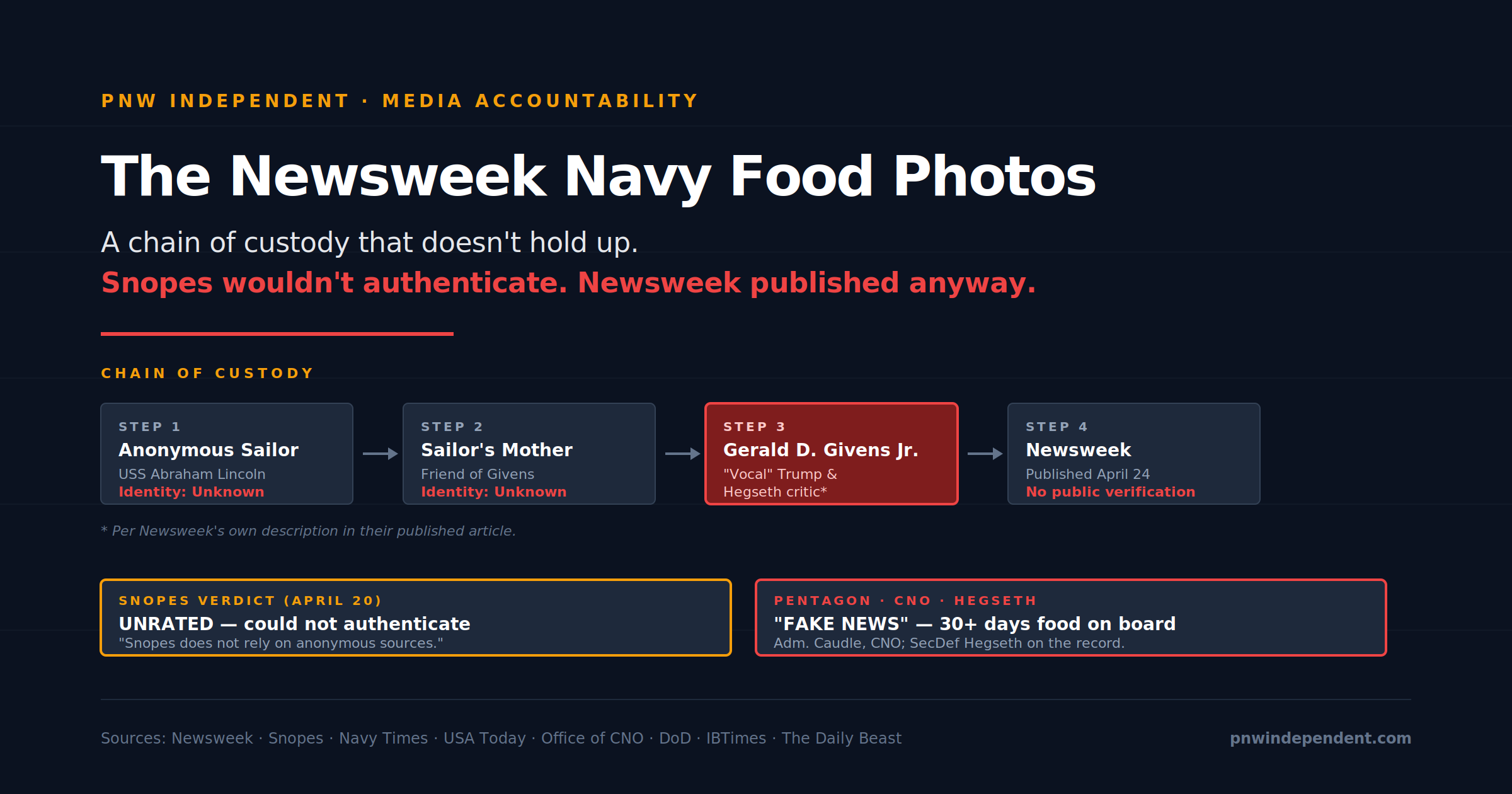
The Newsweek Navy food photos published April 24, 2026, claim to show food shortages on the USS Abraham Lincoln during active military operations against Iran. The chain of custody breaks down at every link. The original sailor is anonymous. The intermediary, Gerald D. Givens Jr., is described in Newsweek’s own copy as a vocal critic of President Donald Trump and Defense Secretary Pete Hegseth. Snopes reviewed the earlier images and explicitly left the claim unrated because the outlet “does not rely on anonymous sources” and could not view the originals. The Pentagon, Chief of Naval Operations Adm. Daryl Caudle, and Secretary Hegseth have all directly denied the story, citing 30+ days of Class I food supplies on board both ships. Despite this, Newsweek published the second batch of photos without conducting or commissioning forensic image analysis. This is a story about how the Newsweek Navy food photos got into print before basic verification questions were answered.
The Newsweek Navy Food Photos Story Timeline
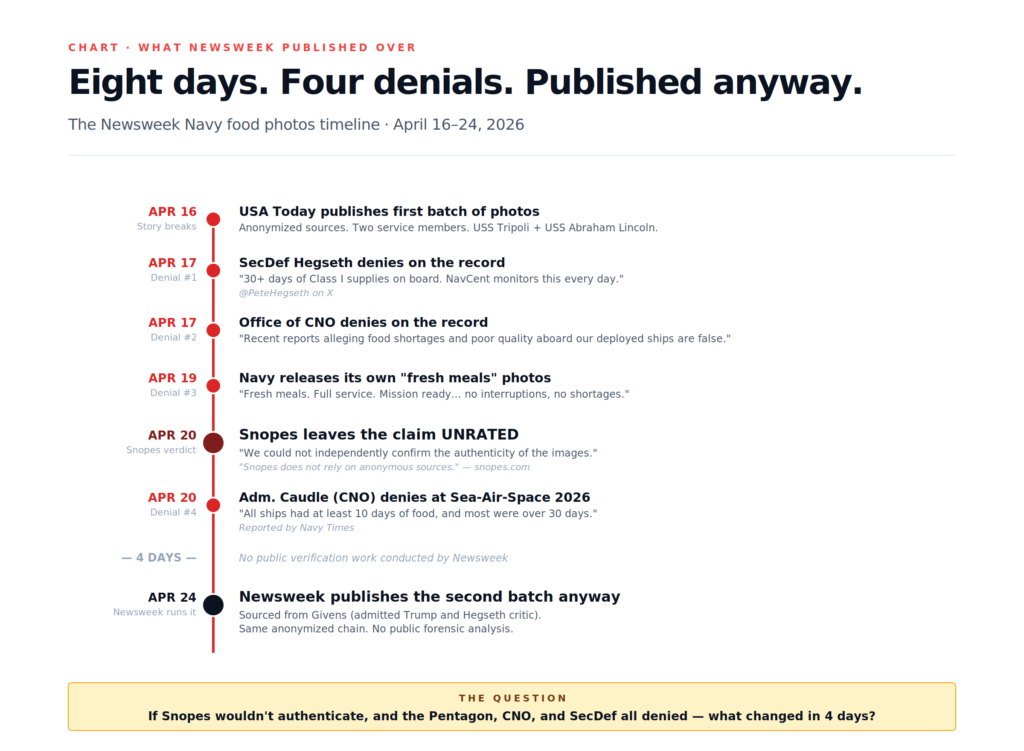
The story unfolded across two rounds of publication. The Newsweek Navy food photos that went viral on April 24, 2026, represent the second batch — the first ran in USA Today on April 16, 2026. Here is the documented sequence of events:
April 16, 2026 — USA Today publishes two photos, sourced from anonymous parents of two anonymous service members, allegedly showing meager meals aboard the USS Tripoli (one tortilla, shredded meat) and the USS Abraham Lincoln (carrots, what was described as “a gray slab of processed meat”). Both photographers are anonymized “for fear of retaliation.”
April 17, 2026 — Defense Secretary Pete Hegseth posts on X: “My team confirmed the logistics stats for the Lincoln & Tripoli. Both have 30+ days of Class I supplies (food) on board. NavCent monitors this every day, for every ship.” The Office of the Chief of Naval Operations issues its own statement: “Recent reports alleging food shortages and poor quality aboard our deployed ships are false.”
April 19, 2026 — The U.S. Navy releases its own counter-photos showing “fresh meals” being served on both ships, captioning them: “Fresh meals. Full service. Mission ready. Sailors aboard USS Abraham Lincoln and USS Tripoli continue to receive regularly prepared meals at sea — no interruptions, no shortages.”
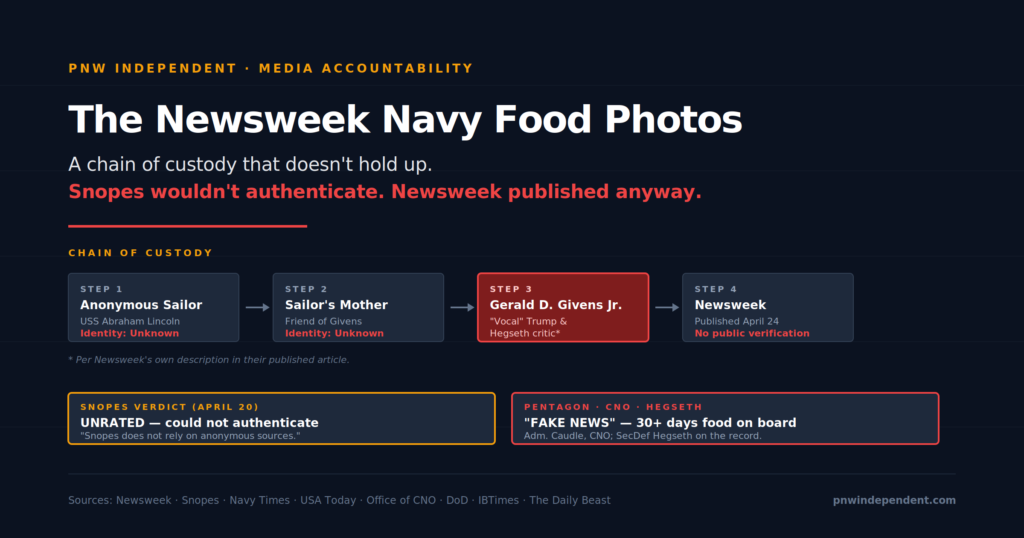
April 20, 2026 — Snopes publishes its analysis. The fact-checking organization explicitly leaves the claim “unrated” — neither true nor false — and notes: “Snopes does not rely on anonymous sources. Because we could not view the original reported images nor confirm the identities of the people who took them, we leave this claim unrated.”
April 20, 2026 — Adm. Daryl Caudle, Chief of Naval Operations, tells reporters at Sea-Air-Space 2026: “In no way, shape or form, has there been a time where in, at least in this deployment, where they’ve not met the nutritional requirements of our menu. All ships had at least 10 days of food, and most were over 30 days of food.”
April 24, 2026 — Newsweek publishes the second batch of Navy food photos, sourced from Gerald D. Givens Jr. The new images show food trays with “minimal portions” including “a single meat patty” and “a small serving of shredded meat.”
That timeline matters because the Newsweek Navy food photos were published eight days after Snopes had publicly declined to authenticate the earlier batch, and four days after the Chief of Naval Operations had directly denied the underlying claim on the record.
Who Sourced the Newsweek Navy Food Photos?
The Newsweek Navy food photos passed through three hands before publication. Each one introduces a documentable problem.
Link 1: An Anonymous Serving Officer
Newsweek’s own report describes the original photographer as a “serving officer on board the USS Abraham Lincoln” whose identity is not disclosed. The officer never spoke with Newsweek directly. The photographs were not provided with any verifiable metadata that has been made public. There is no chain of custody from the officer’s phone to the published images that any outside observer can audit.
Link 2: An Unnamed Family Member
The serving officer reportedly sent the images to his mother, who is also unnamed. Her husband — described as “a close friend and a retired veteran” — is similarly unnamed. Newsweek has not interviewed any of these family members directly. All claims about them — including the assertion that the sailor “lost 17 pounds” and that “a care package they sent in December still has not arrived” — are filtered through a third party.
Link 3: Gerald D. Givens Jr. — A Self-Described Trump and Hegseth Critic
This is where the chain becomes most troubling for journalistic standards. Givens is the founder and CEO of Raleigh Boots On The Ground, a North Carolina nonprofit. He is also, by Newsweek’s own description in its own article: “vocal about his disapproval of President Donald Trump and U.S. Secretary of Defense Pete Hegseth.”
That sentence appears in Newsweek’s published copy. It is not a partisan smear. It is a fact that Newsweek itself stipulated, and then proceeded to use Givens as the principal spokesperson and chain-of-custody intermediary for an explosive national-security story implicating the very administration Givens has publicly opposed.
Furthermore, Givens has no documented expertise in image authentication, no public role with the U.S. Navy, and no independent access to the USS Abraham Lincoln. His value to the story is, by his own account, that a friend’s son sent his mother some pictures, and that Givens chose to forward them on. A more prudent editorial decision would have been to ask why this particular intermediary — and not, say, the Navy ombudsman, a member of Congress, or a military advocacy organization without a stated political position — became the story’s primary source.
Link 4: Newsweek
Newsweek published the photographs on April 24, 2026, with no public indication that the outlet conducted independent forensic image analysis, contacted the original photographer directly, examined image metadata, ran reverse-image searches, or commissioned an outside expert to authenticate the images. The story was published despite Snopes having already declined to authenticate the earlier batch on the same chain-of-custody grounds.
What Snopes Said About the Earlier Newsweek Navy Food Photos Story
Snopes’ April 20 analysis of the original USA Today images is the document most directly relevant to the Newsweek Navy food photos. The fact-checking organization could not authenticate the images. Specifically, Snopes wrote:
“We could not independently confirm the authenticity of the images. USA Today’s report anonymized the names of the people who took the images and the people who shared them with the outlet because those people were reportedly worried they would be punished for their actions.”
And:
“Snopes does not rely on anonymous sources. Because we could not view the original reported images nor confirm the identities of the people who took them, we leave this claim unrated.”
Snopes also reached out to USA Today’s reporter, Cybele Mayes-Osterman, asking how the outlet had verified the images. Snopes was awaiting a reply at the time of its publication. As of this writing, no public response from USA Today’s verification process has been documented.
When a major fact-checking organization explicitly notes its inability to authenticate a claim, and a major news outlet then publishes an even more sensational version of the same claim — sourced through the same anonymized chain — the question is not whether the second outlet did its homework. The question is whether the second outlet did its homework at all.
The Pentagon’s Position Is Explicit and Specific
Critics of the Trump administration may be inclined to discount the Pentagon’s denials as defensive spin. That posture is fair when the denials are vague. They are not vague. The denials are specific, sourced, and offered by named officials with operational authority over the ships in question.
Defense Secretary Pete Hegseth posted on X on April 17: “My team confirmed the logistics stats for the Lincoln & Tripoli. Both have 30+ days of Class I supplies (food) on board. NavCent monitors this every day, for every ship.” Class I supplies, in Department of Defense terminology, refer specifically to subsistence — food and water for personnel.
Adm. Daryl Caudle, Chief of Naval Operations, told reporters at Sea-Air-Space 2026 on April 20: “In no way, shape or form, has there been a time where in, at least in this deployment, where they’ve not met the nutritional requirements of our menu. All ships had at least 10 days of food, and most were over 30 days of food.”
The Office of the Chief of Naval Operations posted on X: “Recent reports alleging food shortages and poor quality aboard our deployed ships are false.”
The U.S. Navy released its own photographs on April 19, captioned: “Fresh meals. Full service. Mission ready. Sailors aboard USS Abraham Lincoln and USS Tripoli continue to receive regularly prepared meals at sea — no interruptions, no shortages.”
To dismiss those denials, an outlet would need to argue that Hegseth, Caudle, the entire Office of CNO, and the Navy public-affairs apparatus are coordinated in a public lie about deployed warships during an active military operation. That is a serious accusation. It deserves serious evidence. The Newsweek Navy food photos, sourced through anonymous links and an admitted Trump critic, are not that evidence.
The Visual Questions Newsweek Did Not Address
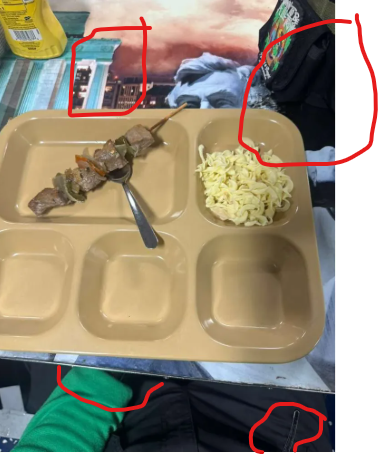
Setting aside the chain of custody for a moment, the published Newsweek Navy food photos contain compositional features that observers have flagged as inconsistent with a single, unedited photograph taken in a working military galley:
- The wall behind the food tray transitions from what reads as a printed mural (skyline, Lincoln imagery, dramatic red-tinted clouds) into what appears to be a three-dimensional bag in the foreground, with the painted cloud pattern continuing across the surface of the bag itself. A real painted mural cannot wrap onto a separate three-dimensional object in the foreground.
- The table edge does not consistently terminate where it should. In the upper-left of the image, the surface holding the mustard bottle does not have a clear structural connection to the food tray’s surface.
- The clothing of a person seated at the table includes a drawstring or pull-tab that does not terminate at any visible anchor point. The fabric of the person’s lap, the table edge, and the floor blend into one another without clean object boundaries.
- The image carries a visible “Smash JT” watermark in the lower-right corner — suggesting it was processed or republished by a social-media commentator before reaching Newsweek’s editorial pipeline.
None of these observations, individually or in combination, prove anything. They are visual questions. Visual questions are precisely what forensic image analysis is designed to answer. As of publication of the Newsweek Navy food photos, no major outlet has publicly conducted or commissioned such analysis. Not Newsweek. Not USA Today. Not Snopes — which explicitly noted it could not view the originals. Not IBTimes UK. Not MSN. Not the Daily Beast.
In the absence of forensic analysis, the only thing readers can rely on is the chain of custody. The chain of custody, as documented above, does not hold up.
What Should Have Happened Before the Newsweek Navy Food Photos Were Published
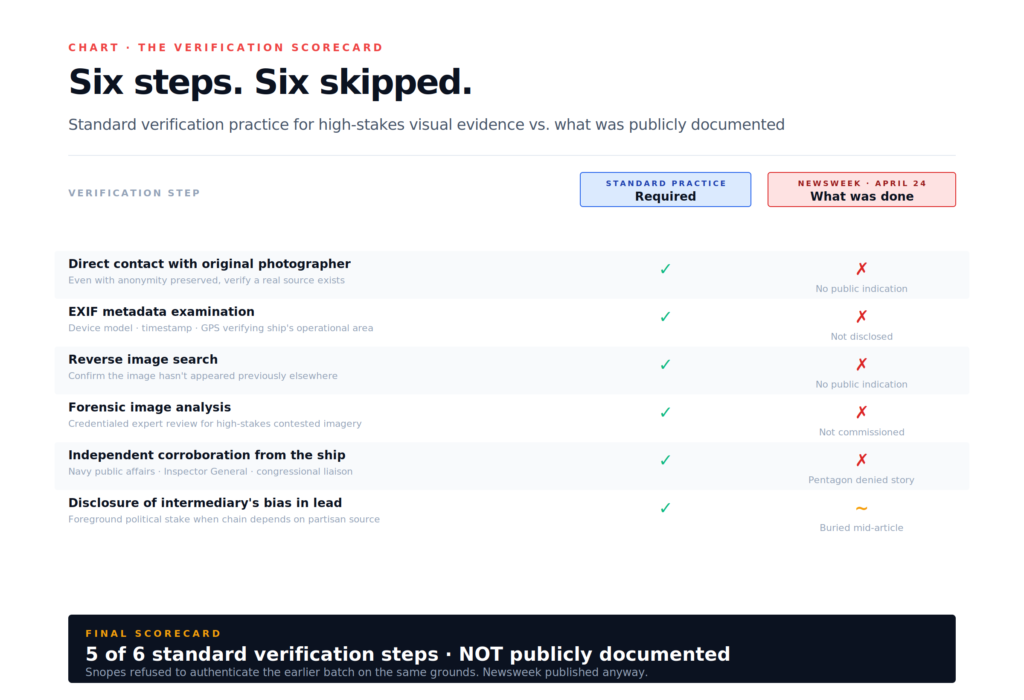
Standard journalism practice for a national-security story of this magnitude includes verification steps that, based on public record, were not taken before the Newsweek Navy food photos went to print:
1. Direct contact with the original photographer. Even if anonymity is preserved in the published article, the outlet should be able to verify that a real serving officer exists and is the source of the images. Newsweek’s published account does not indicate any such direct contact occurred.
2. EXIF metadata examination. Modern smartphones embed metadata in photographs including device model, timestamp, and (often) GPS coordinates. A real photograph from the USS Abraham Lincoln would carry metadata consistent with a Navy ship’s operational area. Generated or altered images typically lack such metadata or carry inconsistent metadata. There is no public indication that Newsweek examined or verified EXIF data.
3. Reverse image search. Before publishing any visual evidence, mainstream outlets routinely run reverse image searches to confirm the image has not appeared elsewhere previously. There is no indication this was done.
4. Forensic image analysis. For high-stakes images contradicting official government statements, forensic analysis by a credentialed expert is standard. There is no indication this was commissioned.
5. Independent corroboration from the ship. Rear-channel contact with personnel aboard the USS Abraham Lincoln, through Navy public affairs, congressional liaison, or the Inspector General’s office, would corroborate or contradict the food-shortage claim. The Pentagon’s direct denial is corroboration in the opposite direction.
6. Disclosure of the intermediary’s bias in the lead, not buried. Newsweek’s article does include the line that Givens has been “vocal about his disapproval” of Trump and Hegseth. That disclosure appears in the body of the article, not in the headline or lead, and is not flagged as relevant to the story’s central claim. A story whose chain-of-custody depends on a politically-motivated intermediary should foreground that fact, not bury it.
What This Tells Us About the Newsweek Navy Food Photos
The Newsweek Navy food photos may be authentic. They may also be inauthentic. That question has not been publicly answered. And the failure to publicly answer it before publication is itself the story.
Major outlets have a process for handling potentially explosive visual evidence that contradicts official government statements during an active military operation. That process exists for a reason. The reason is the long historical record of major journalism failures — Rathergate, the Rolling Stone UVA gang-rape story, the NBC News George Zimmerman 911-call edit, the Stephen Glass fabrications — that have damaged public trust in journalism. Each of those failures shared common features: an editorially convenient narrative, a single chain of custody that ran through an interested intermediary, and verification corners that were cut because the story “felt true.”
The Newsweek Navy food photos check every box on that historical list. The narrative is editorially convenient for outlets critical of the Trump administration’s handling of Operation Epic Fury. The chain of custody runs through a single intermediary who has publicly stated his opposition to the administration. And the verification corners — direct source contact, metadata analysis, forensic review, reverse-image search — appear, based on the published record, not to have been turned.
If the Newsweek Navy food photos are real, the story is a genuine national-security crisis: deployed sailors in active operations are not being fed adequately. That story would deserve front-page coverage, congressional inquiry, and immediate resolution. It would also survive forensic scrutiny, because real photographs do.
If the Newsweek Navy food photos are not real, the story is a media-accountability crisis: a major national outlet published unverified imagery sourced through an admitted political critic, contradicting on-record statements from named senior military officials, in the middle of active combat operations. That story would deserve a retraction, an editor’s note, and a public accounting of the editorial process.
Either way, readers and military families deserve to know which one it is. The Pentagon, the Chief of Naval Operations, and the Secretary of Defense have all stated their position on the record, in their own names. Newsweek published anonymous photographs through a partisan intermediary, with no public verification, and has not yet publicly addressed the chain-of-custody questions raised by Snopes.
The Bottom Line on the Newsweek Navy Food Photos
This article does not assert that the Newsweek Navy food photos are fabricated. It cannot make that assertion, because the forensic analysis required to support it has not been conducted. What it can assert, because the public record supports it, is that the photos were published under conditions that should not have permitted publication: anonymous originator, partisan intermediary, no metadata disclosure, no forensic review, no reverse-image search, and no engagement with the contradictory official record.
Snopes — an organization whose entire mission is the verification of contested claims — examined the earlier batch of these images and could not authenticate them. Newsweek, a larger outlet with greater resources, then published the next batch without addressing the verification problems Snopes had already publicly identified.
That is the story. Not what the photos show. What Newsweek did before they showed it.
The forensic analysis remains pending. If and when it is conducted — by Newsweek, by an independent verification organization, or by the Department of Defense in response to congressional inquiry — this story will be updated. Until then, the Newsweek Navy food photos sit in an unrated category of their own: unverified, unretraced, and uncorroborated, but published as if they were settled fact.
That is not journalism. That is publication. And the difference matters.
Related Reading on PNW Independent
- Who Really Runs Seattle: Two Machines, One Ruling Class
- Sound Transit Failure: $185B Boondoggle Run by Insiders
- The Portland Homeless Industrial Complex: Inside the $700M Machine
External Sources
- Newsweek — More Photos Emerge of Meals on Navy Ships As Pentagon Denies Shortages (April 24, 2026)
- Snopes — Inspecting photos allegedly showing ‘dismal’ meals on US military ships in Middle East (April 20, 2026)
- Navy Times — CNO denies reports of poor food service aboard Navy vessels (April 20, 2026)
- Fox News — US Navy releases photos of ‘fresh meals,’ pushes back on reports of food shortages
- IBTimes UK — More Shocking Photos From USS Lincoln Reveal Single Meat Patties and Sparse Trays
- The Daily Beast — Pentagon Pete Hegseth’s Bid to Ease Navy Food Panic Backfires
- Office of the Chief of Naval Operations — official Navy statement on X (April 19, 2026)