
Moody’s Downgrade: Washington State Built This Hole
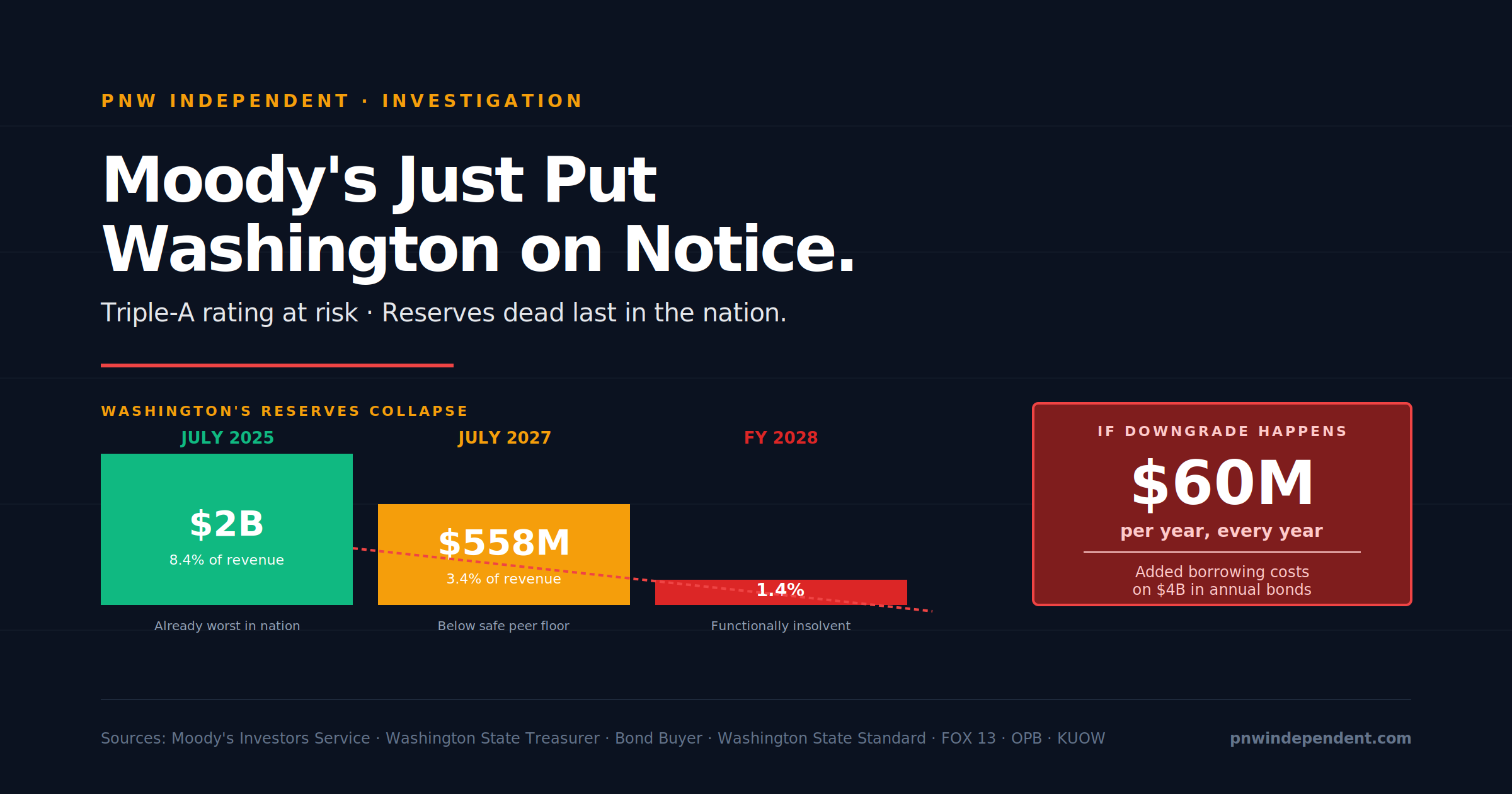
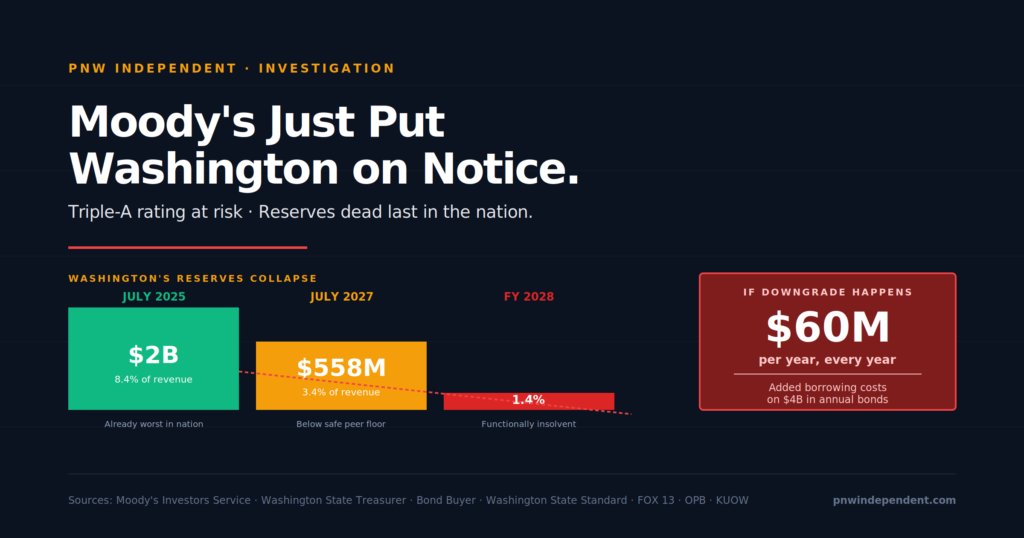
The downgrade announced April 23, 2026 revised Washington State’s bond outlook from stable to negative. Washington still holds its Aaa (Triple-A) rating — for now. However, the state ranks dead last in the nation for financial reserves at just 8.4% of tax revenues. Reserves are projected to crash to 1.4% by 2028. A formal credit downgrade would cost taxpayers $60 million per year in additional borrowing costs. Furthermore, the downgrade arrived in the same week as the KCRHA $13M-missing audit, and three weeks after Sound Transit’s $34.5 billion shortfall briefing. The pattern is not coincidence. Washington built this hole on purpose.
What the Moody’s Downgrade Actually Says
The downgrade is technically not a downgrade. Specifically, it is a revision of Washington’s bond outlook from stable to negative. The state retains its Aaa credit rating. However, Moody’s is now formally signaling that an actual rating downgrade could come within 12 to 18 months unless lawmakers fix the underlying problem.
The agency’s lead analyst, Xing Chen Zhu, was specific in the April 23 report:
“The negative outlook reflects the increased likelihood the state will rely on sizable one-time budget-balancing measures over the next 12 to 18 months, continuing a trend of general fund expenditures outpacing recurring revenues.”
In plain English: Washington keeps spending more than it brings in. Therefore, the state has been plugging the gap with reserves and accounting maneuvers. Consequently, the rainy-day fund is nearly empty.
The Three Concerns Moody’s Cited
The downgrade pointed to three specific problems:
- Continued reliance on one-time budget solutions to support General Fund spending
- Projected narrowing of budgetary reserves
- Ongoing legal challenges to new revenues — specifically the millionaire’s tax — meant to restore budget balance
Each of these is documentable. Each represents a deliberate policy choice. None happened by accident.
The Numbers Behind the Moody’s Downgrade
The downgrade comes wrapped in a single damning statistic. Washington has the worst financial reserves of any state in the nation.
Dead Last in America
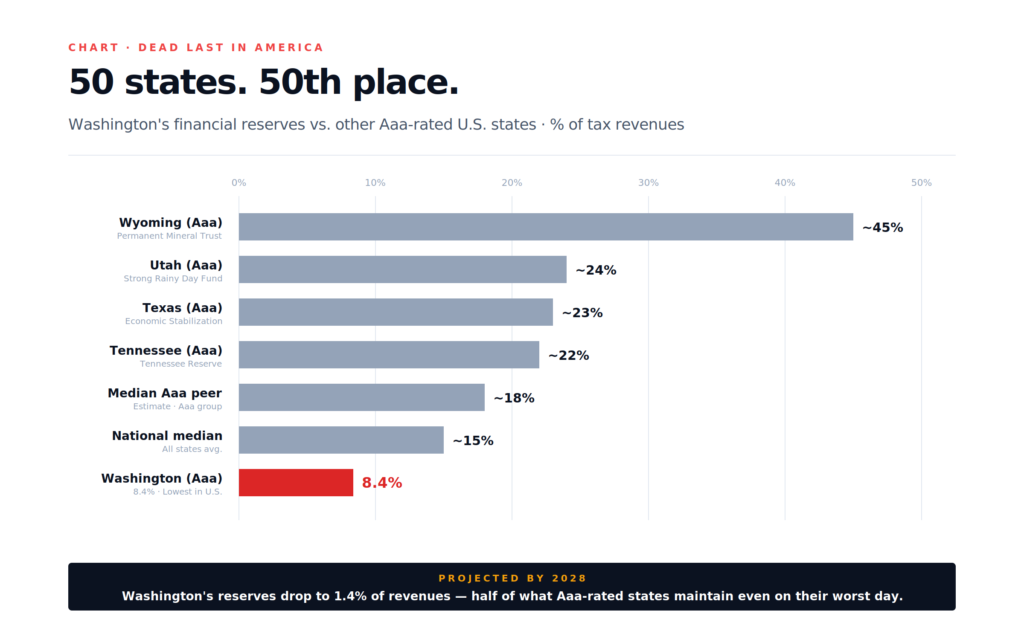
Washington’s reserves currently sit at 8.4% of tax revenues. According to the state treasurer’s office, that figure is projected to collapse to 1.4% by 2028 if current trends continue. Furthermore, total reserves are declining from $2 billion in July 2025 to a projected $558 million in July 2027.
Meanwhile, Aaa-rated peer states maintain reserves typically between 15% and 25%. Washington is operating at roughly half the lower bound of its credit-rating peer group. As Moody’s noted, this leaves Washington “less able to absorb unexpected revenue or expenditure shocks.”
What a Downgrade Costs
A one-step downgrade from Aaa to Aa1 would raise borrowing costs by an estimated 0.1% on every state bond issuance. Washington issues roughly $4 billion in bonds annually. Therefore, the math is unambiguous:
- $60 million per year in additional debt service
- Paid out of the same general fund already running structural deficits
- Compounded over the life of every bond — typically 20 to 30 years
In other words, the downgrade will not just be embarrassing. It will be expensive.
The Reserves Math Is Worse Than the Headline
Beyond direct borrowing costs, the state currently earns $30 million to $40 million per billion dollars of reserves invested. Therefore, draining reserves doesn’t just leave the state vulnerable. Additionally, it forfeits the investment income those reserves would have generated. Every dollar pulled from the rainy-day fund costs the state twice: once when it’s spent, again in lost investment returns.
How Washington Got Here
The downgrade did not emerge from a single bad year. Rather, it reflects a documented pattern across three legislative sessions.
The 2025 Budget
In 2025, Democratic lawmakers passed a $77.8 billion two-year budget covering July 1, 2025, through June 30, 2027. The budget was structurally imbalanced from day one — meaning recurring spending exceeded recurring revenue. Lawmakers knew this. The treasurer’s office said so publicly.
The 2026 Supplemental
In March 2026, Governor Bob Ferguson signed a $79.4 billion supplemental adjustment to that same budget. To make the math work, lawmakers:
- Siphoned $880 million from the state’s rainy day reserves
- Transferred $375 million from the Public Works Assistance Account
- Increased spending by approximately $1.5 billion
The Public Works Assistance Account exists specifically to provide low-interest loans and grants to local governments for infrastructure projects. It was raided to plug a state-level operating gap.
The Millionaire’s Tax Bet
The downgrade also flagged Washington’s reliance on a tax that may not survive court challenge. On March 30, 2026, Ferguson signed the so-called millionaire’s tax — a levy on annual incomes above $1 million. Democrats are counting on it to provide stable recurring revenue.
However, three problems exist:
- Collections won’t begin for three years. The tax does not solve the immediate cash problem.
- Litigation is already underway. Former Washington Supreme Court Justice Phil Talmadge is part of a lawsuit arguing the tax is unconstitutional under Washington’s uniformity clause.
- Court precedent is against it. Talmadge has been blunt: “Case after case after case where this issue has come up, saying graduated net income tax — can’t do it.”
If the courts strike down the tax, the entire fiscal premise of the next biennial budget collapses. Moody’s noticed.
What State Leaders Are Saying About the Moody’s Downgrade
The political reaction broke along predictable partisan lines. However, some of the criticism came from inside the building.
Treasurer Pellicciotti: A Democratic Warning
Democratic State Treasurer Mike Pellicciotti has been delivering this message to Ferguson and Democratic lawmakers across two legislative sessions. Pellicciotti’s position post-downgrade:
“Our credit rating determines what we pay on the interest to pay that money back. There is still time to fix this immediate issue next session before the costs of a potential credit downgrade start piling on.”
Pellicciotti characterized the strategy of pulling $880 million from reserves as “definitely risky” — said publicly and privately during the session.
When the Democratic state treasurer is publicly disagreeing with Democratic legislators about basic budget responsibility, that’s not partisan messaging. That’s a specific institutional warning.
Governor Ferguson’s Response
Ferguson’s office issued a brief statement to FOX 13 Seattle: “Washington has the highest bond rating in the country, and we’re working hard to keep it.”
Notice what that statement does not address. It does not engage with the structural deficit. Furthermore, it does not address the reserves collapse. Additionally, it does not respond to Moody’s specific concerns about one-time budget solutions or the millionaire’s tax legal challenge.
The Republican Position
Republicans have called this for over a year. Senator Chris Gildon of Puyallup, the Senate GOP budget lead, called the spending plan an “$80 billion House of Cards that’s built on a very shaky foundation.” House Republican budget leader Travis Couture issued a statement saying: “Moody’s has confirmed what we have been saying for months: the math in Olympia does not add up.”
The Pattern the Moody’s Downgrade Confirms
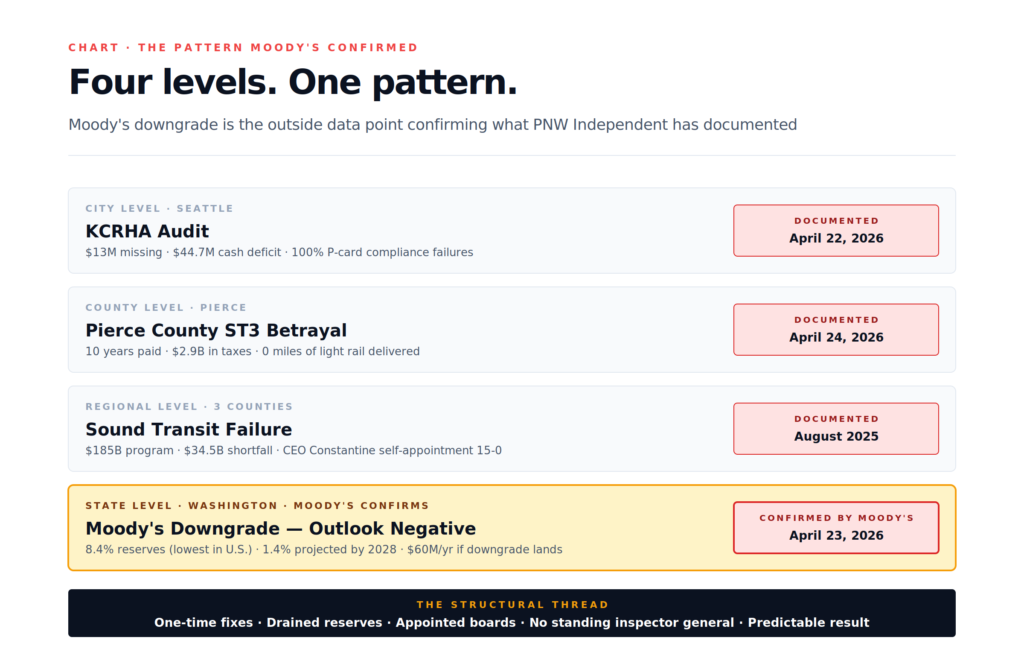
The downgrade matters most because of what it confirms about the broader pattern. PNW Independent has documented four regional governance failures in the past month. The downgrade is the outside data point that proves the pattern is real.
KCRHA: $13 Million Missing, $44.7 Million Cash Hole
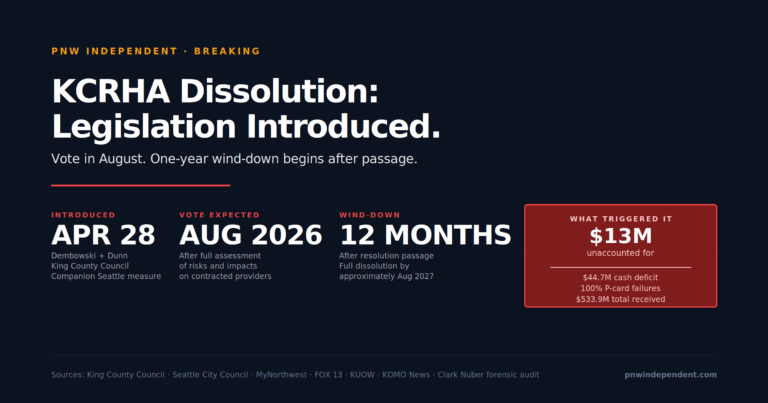
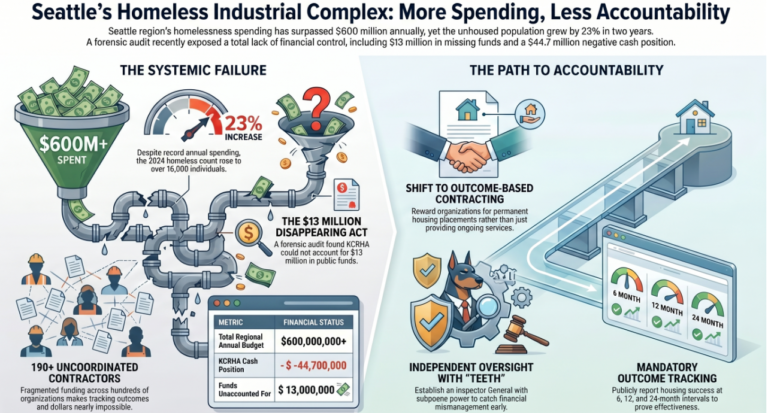
PNW Independent’s KCRHA audit investigation documented $13 million in unaccounted-for public funds at the King County Regional Homelessness Authority, plus a $44.7 million negative cash position. Auditors found no evidence of fraud — but said they could not rule it out. The agency operated for years with no formal monthly accounting close process.
Sound Transit: $34.5 Billion Funding Shortfall
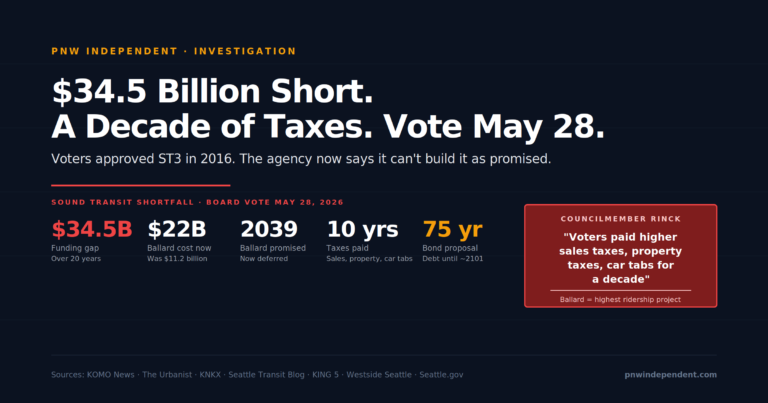
The Sound Transit failure investigation documented a $35 billion cost overrun on the ST3 program voters approved at $54 billion. Furthermore, former King County Executive Dow Constantine appointed half of Sound Transit’s 18-member board. Subsequently, that board hired Constantine as CEO at $450,000-plus base salary in a 15-0 vote.
Pierce County: 10 Years Paid, Possibly No Train
The Pierce County ST3 betrayal piece documented that Pierce County voters rejected ST3 in 2016, paid the tax for a decade anyway, and may now lose the promised Tacoma Dome Link Extension. Sound Transit is considering terminating the line at Fife instead.
The Common Thread
These are not isolated stories. Instead, they are different views of the same underlying problem: regional pass-through agencies and state-level entities operating without structural accountability. Specifically:
- KCRHA distributes hundreds of millions per year through nonprofit contractors with no inspector general
- Sound Transit’s appointed board has zero directly elected members
- The state legislature drains reserves while passing legally vulnerable taxes to plug the gap
- Each agency, in turn, blames “startup conditions” or “complex funding models” for failures that share the same architecture
Moody’s just put a price tag on the broader pattern. $60 million a year, every year, until the structural problems are fixed.
What Should Happen Before the Moody’s Downgrade Becomes a Real Downgrade
The downgrade timeline gives Washington 12 to 18 months to act. Here is what real reform would look like.
1. Statutory Reserve Floor
Washington should enact a statutory floor requiring the rainy-day fund to remain above 10% of general fund revenues. Below that floor, automatic spending restraints kick in. Furthermore, this rule already exists in stronger-rated peer states. It works.
2. End the Public Works Account Raid
The $375 million transfer from the Public Works Assistance Account was a one-time accounting maneuver that hurts local infrastructure for state operating relief. Therefore, this transfer should be repaid in the next biennium, with prospective rules forbidding similar raids.
3. Pre-Litigation Revenue Forecasting
The state cannot rely on the millionaire’s tax for budget balance until courts have actually upheld it. Specifically, budget projections should assume contingent revenues are zero until cleared. This is basic prudent forecasting, and Washington isn’t doing it.
4. Mandatory State Performance Audits
Every regional pass-through agency that receives state funds — KCRHA, Sound Transit, the regional housing authorities — should face mandatory state performance audits on a five-year cycle. The Clark Nuber forensic audit of KCRHA cost $600,000 and was commissioned only after years of warning signs. Standing performance audits would catch problems years earlier, at a fraction of the cost.
5. Independent Inspector General for State Government
Washington has a State Auditor’s Office. However, it lacks an independent Inspector General with subpoena authority covering executive-branch spending. Other Aaa-rated states have such an office. Washington should too.
6. Sunset on One-Time Budget Solutions
Statutory rules should cap how much of any biennial budget can rely on one-time revenue or reserve drawdowns. Furthermore, the cap could ratchet down across cycles. This is the single most important structural reform — and exactly the reform Moody’s specifically called out as missing.
The Bottom Line on the Moody’s Downgrade
The downgrade is not a surprise. It is the predictable, signaled, telegraphed response to a structural budget pattern that the state treasurer has been warning about for two years. Washington didn’t get here by accident. Lawmakers chose to spend more than the state takes in. They chose to drain reserves rather than match recurring spending to recurring revenue. They chose to bet on a tax that may not survive court review.
Now Moody’s has chosen to put the state on notice. The cost of that warning is roughly $60 million a year if it becomes a real downgrade. That money will not come from Olympia. It will come from every Washington taxpayer in the form of higher debt service costs, reduced infrastructure investment, and forgone investment returns on reserves the state no longer holds.
Furthermore, the downgrade arriving in the same month as the KCRHA $13 million missing audit, the Sound Transit $34.5 billion shortfall, and the Pierce County betrayal is not a coincidence. It is the same pattern at different levels of government, all pointing the same direction: regional and state governance in Washington has been operating beyond its means, with thin accountability, for years.
The 12-to-18-month window Moody’s has given Washington is not a courtesy. It is a final warning. Either the state addresses the structural deficit in the next session, or Washington taxpayers pay for the failure indefinitely.
The math doesn’t care which party fixes it. The math just keeps adding up.
Related Reading on PNW Independent
- KCRHA Audit: $13M Missing in Seattle’s Homeless Agency
- Sound Transit Failure: $185B Boondoggle Run by Insiders
- Pierce County Voted No on ST3. Now They Lose the Train.
- Who Really Runs Seattle: Two Machines, One Ruling Class
External Sources
- Bond Buyer — Moody’s revises Washington state’s outlook to negative (April 24, 2026)
- Washington State Standard — Top credit rating agency puts Washington on notice (April 24, 2026)
- FOX 13 Seattle — Moody’s shifts Washington financial outlook to negative
- KUOW — Top credit rating agency puts Washington on notice
- OPB — Top credit rating agency puts Washington on notice
- MyNorthwest — Moody’s warns of possible Washington credit downgrade
- The Columbian — Top credit rating agency puts Washington on notice
- 570 KVI — Washington faces potential credit downgrade as Moody’s flags spending
- Washington State Treasurer’s Office
11 Comments