
KCRHA Dissolution: Legislation Introduced. Vote in August.
The dissolution moved from rhetoric to reality on Tuesday, April 28, 2026. King County Councilmember Rod Dembowski formally introduced legislation to end the county’s participation in the King County Regional Homelessness Authority. Vice Chair Reagan Dunn co-sponsored. A companion Seattle measure from Councilmember Maritza Rivera is moving in parallel. The plan: a formal council vote in August, after an assessment is complete. If approved, the resolutions trigger a one-year process to wind down the agency. KCRHA received $533.9 million in public funding from its 2021 inception through July 2025. Auditors flagged $13 million as unaccounted for, and a $44.7 million negative cash position. Mayor Katie Wilson is already bypassing the agency for her 1,000-unit shelter expansion. The dissolution is no longer hypothetical.

What the KCRHA Dissolution Legislation Actually Does
The dissolution is moving forward through two parallel tracks. Furthermore, both tracks are required because of how the agency was originally created.
The Interlocal Agreement
KCRHA was established through an Interlocal Agreement (ILA) between Seattle and King County in 2021. Under the terms of that agreement, either party may terminate participation by passing an authorizing resolution or motion through its legislative body. Therefore, both councils must act for full dissolution. However, either action alone is sufficient to begin unwinding the agency.
Dembowski’s Tuesday Legislation
On Tuesday, April 28, 2026, King County Councilmember Rod Dembowski formally introduced legislation to end King County’s participation in KCRHA. The legislation is co-sponsored by Council Vice Chair Reagan Dunn. Both have been publicly critical of the agency’s performance for months. Specifically, Dembowski opposed KCRHA’s creation in 2021, and successfully amended the original authorizing legislation to keep elected oversight of the agency’s budgets — and to allow shutdown if it failed.
In his statement following the audit release:
“I was a skeptic of establishing the Regional Homelessness Authority from the beginning and successfully fought to amend the authorizing legislation to ensure that elected officials would remain in control and would oversee its budgets, and that it could be shut down if it failed. It’s now time for elected officials to bring this failed experiment to an end.”
Rivera’s Seattle Companion Resolution
Seattle Councilmember Maritza Rivera (District 4) introduced a parallel resolution at Seattle City Hall, alongside Dembowski’s announcement. Specifically, Rivera characterized the audit findings as “egregious mismanagement of funds” and said the agency had been “given ample opportunity to get their financial house in order.”
Rivera’s framing of the broader question:
“We’ll continue to allocate funds for homelessness. The question is whether we do it in-house at the city and the county or continue this regional approach.”
The August Vote
Both councilmembers signaled that the formal vote on KCRHA dissolution would not happen immediately. Furthermore, they want time for an assessment of operational impacts, contractor relationships, and federal funding implications. Therefore, the working timeline targets August 2026 for the formal council vote — about three months after the audit findings dropped.
In a joint statement, the councilmembers wrote:
“We need to take time to assess the issues, risks, and impacts of any changes to KCRHA and make an informed decision about the future of the agency. We must be responsible for our taxpayer dollars, but we must also be responsible for the people of King County who rely on these programs.”
What Happens If the Resolutions Pass
If passage occurs in August, the resolutions activate a one-year process to dissolve the regional agency. During that year, the city and county must:
- Transition existing contracts to alternative administrators
- Determine where federal pass-through grants will land
- Negotiate continuity of service for nonprofit providers
- Establish a replacement structure — either in-house at city and county, or through a new collaborative model
- Manage personnel transitions for KCRHA staff
That timeline puts full dissolution at approximately August 2027 — six years after the agency was founded.
How the KCRHA Dissolution Conversation Got Here
The dissolution did not come out of nowhere. As we documented in PNW Independent’s KCRHA audit investigation, the agency had been signaling structural problems for years. The audit was the breaking point.
The Numbers in the Audit
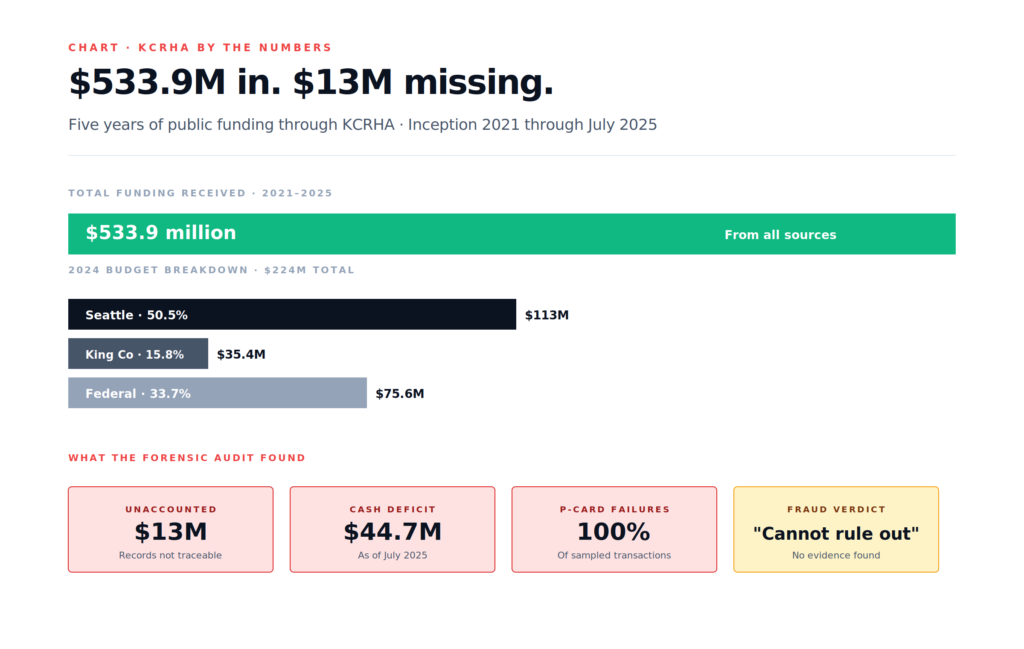
The Clark Nuber forensic audit, released April 22, 2026, identified:
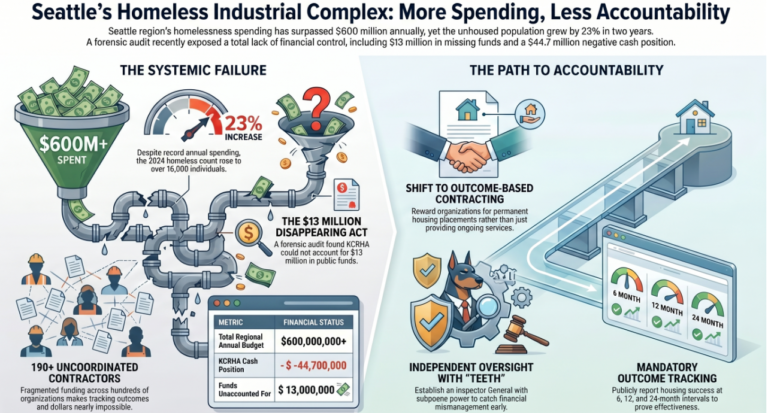
- $13 million in unaccounted-for funds
- $44.7 million negative cash position as of July 2025
- $48 million in the red at the audit’s conclusion (per KUOW reporting)
- $533.9 million in total public funding received from inception through July 2025
- 100% of sampled P-card transactions had compliance exceptions
- No formal monthly accounting close process
- No documented internal control framework
- 57% of King County invoices submitted more than 30 days late
Furthermore, auditors found no evidence of fraud — but stated they could not rule it out due to the weakness of the underlying records.
The KCRHA Budget Picture
KCRHA’s 2024 budget was $224 million. The funding split:
- Seattle: 50.5% ($113 million)
- King County: 15.8% ($35.4 million)
- Federal sources: 33.7% (approximately $75.6 million)
Therefore, dissolution requires careful management of the federal portion — funds that flow through KCRHA but are subject to U.S. Department of Housing and Urban Development (HUD) requirements. Specifically, the agency itself has been monitoring HUD’s FY2025 Notice of Funding Opportunity for any rule changes that might affect a transition.
The Wilson Workaround
There is a detail in the dissolution conversation that has gotten less coverage. Mayor Katie Wilson is already bypassing KCRHA. Her administration’s plan to add 1,000 new shelter and emergency housing units by end of 2026 is being managed through the Seattle Human Services Department — not through KCRHA.
A spokesperson for Wilson’s office told KOMO News that “the issues at KCRHA are not expected to affect the city’s goal of adding 1,000 new shelter units by the end of 2026.” That’s because Wilson never put those units through KCRHA in the first place.
In other words, the city’s largest homelessness initiative under the new mayor is already operating outside the agency that’s now being dissolved. The dissolution legislation is, in some respects, formalizing what has already happened operationally.
Where Other Stakeholders Stand on the KCRHA Dissolution
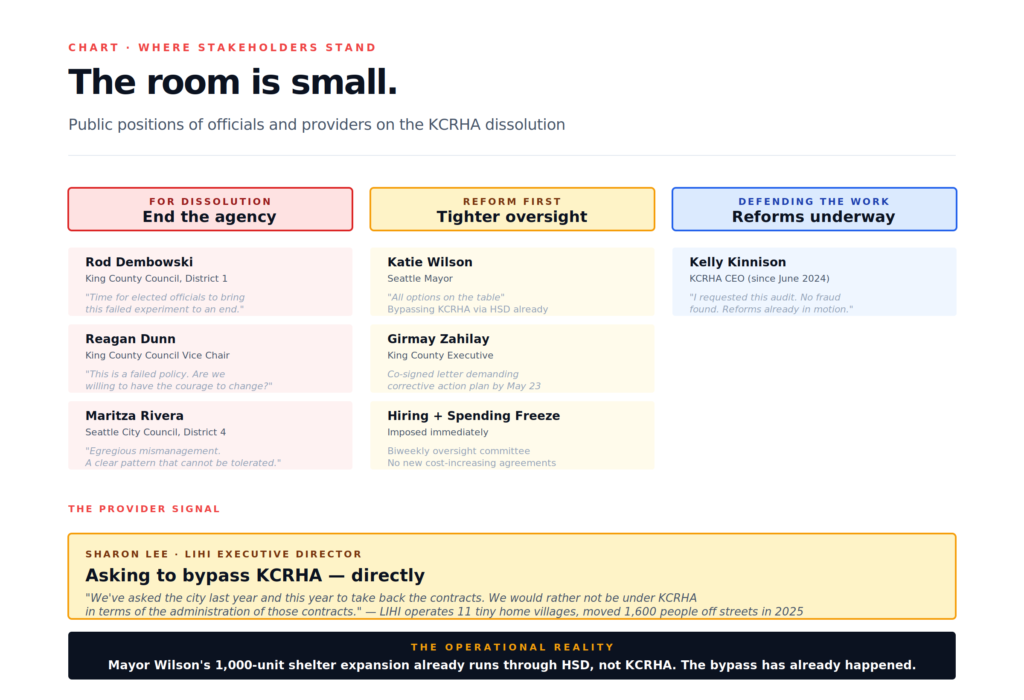
The dissolution conversation has produced public statements from nearly every major regional player. Furthermore, the alignment is striking — even officials defending the agency are largely defending its mission, not its current structure.
CEO Kinnison: “I Requested This Audit”
KCRHA CEO Kelly Kinnison, hired in June 2024, said in a letter to her board that she requested the audit and has already been working to address the conditions it flagged. Kinnison emphasized that the audit did not find fraud or misuse of funds.
Her position, summarized: “Concerns related to our financial systems” were evident from the agency’s formation, and she was hired to strengthen those systems. That is what she has been doing.
However, that defense has not stopped the dissolution legislation from advancing. In fact, the dissolution may proceed regardless of whether Kinnison’s reforms work — because the structural problems Dembowski has flagged are about the agency’s design, not its current management.
Mayor Wilson and Executive Zahilay: Tighter Oversight
Seattle Mayor Katie Wilson and King County Executive Girmay Zahilay co-signed a letter to KCRHA’s board calling for much tighter oversight with corrective actions required in the coming weeks. Specifically, they demanded:
- Written response by May 8, 2026 addressing audit’s “high-risk” findings
- Full corrective action plan by May 23, 2026
- Immediate hiring freeze
- Immediate spending freeze
- New financial oversight committee meeting biweekly
Therefore, even officials not endorsing the dissolution outright are imposing emergency measures that suggest agency-as-currently-structured is not viable.
LIHI: Provider Backs Direct City Contracting
The Low Income Housing Institute (LIHI), which operates 11 tiny home villages in Seattle and moved approximately 1,600 people off the streets in 2025, has publicly supported moving to direct city contracting.
LIHI Executive Director Sharon Lee told KOMO News:
“I think the situation would be much better. We’ve asked the city last year and this year to take back the contracts, and we would rather not be under KCRHA in terms of the administration of those contracts.”
That endorsement matters. LIHI is one of KCRHA’s largest contractors. Furthermore, the organization is publicly stating it would prefer to bypass the agency. When a major contractor is asking to be removed from your agency’s administration, that is operational vote-of-no-confidence.
The Council Vice Chair: “I Appreciate Dembowski’s Leadership”
King County Council Vice Chair Reagan Dunn co-sponsored the dissolution legislation and called the audit findings predictable. “This is a failed policy, but the question is, are we willing to have the courage to change it?” he asked.
Dunn’s framing — that the system, the policy, AND the structure all need to change — is broader than Dembowski’s. However, both arrive at the same place: dissolution.
The KCRHA Dissolution Pattern: Los Angeles Did It Last Year
The dissolution would not be unprecedented. Furthermore, it would not even be the first such move in 2025. Los Angeles County backed out of a similar regional homelessness effort last year, choosing to create a new county-level department instead.
That parallel matters because Los Angeles is significantly larger and arguably more complex than the Seattle-King County region. If LA could disentangle from a regional homelessness authority and replace it with direct county service delivery, the question is not whether King County and Seattle can do the same. The question is whether they will.
What LA Did
The Los Angeles model that emerged after the regional dissolution:
- County brought homelessness services in-house under a new department
- City and county maintained collaboration but on a contractual basis, not through a separate authority
- Service contractors transitioned to direct city or county relationships
- Federal funding continuity was maintained through coordinated grant administration
- Single chain of accountability was restored — voters can hold elected officials directly responsible for outcomes
That last point is critical. Under the regional authority model, the chain of accountability runs through an appointed governing board that no voter can directly remove. Therefore, when things go wrong — as they have at KCRHA — there is no electoral mechanism to drive change.
What Seattle and King County Could Do
Several models are available beyond the LA approach:
Option 1: Full in-house split. Seattle handles its homelessness response through HSD (which is already doing this for Wilson’s 1,000-unit expansion). King County handles its response through a new department.
Option 2: Joint Powers Authority with elected oversight. Replace KCRHA with a new structure where the governing board is composed of directly elected officials only — no community representatives without voting power.
Option 3: Performance-contracted services. Both jurisdictions contract directly with providers using performance-based contracts with specific outcomes tied to payment.
Option 4: Hybrid model. Some functions (data, federal grant administration) remain regional; service delivery returns to direct city and county management.
The August timeline gives the councils time to evaluate these options before the dissolution vote. Furthermore, that timeline is a feature, not a bug.
What KCRHA Dissolution Would Mean for Service Providers
The dissolution conversation includes one practical concern that deserves direct attention. What happens to the nonprofit service providers and the people they serve during the transition?
Tiny House Village Operators
LIHI operates 11 tiny home villages with KCRHA contracts. A new village is opening on Tukwila International Boulevard hosted by Church by the Side of the Road. Furthermore, multiple other providers depend on KCRHA contract administration for predictable revenue.
If the dissolution proceeds, these providers face a year of administrative uncertainty. Therefore, the councilmembers’ joint statement explicitly addressed continuity:
“We want to be clear: our goal is to ensure stability and continuity for those providers and the people they serve as we work through next steps.”
Whether stability is actually maintained will depend on how the transition is structured. Specifically, contract assumption, payment timeline continuity, and renegotiation processes will all matter.
Federal HUD Funding Continuity
KCRHA receives roughly $75 million annually in federal pass-through funding through HUD. That funding is subject to specific federal rules. Therefore, any transition structure must maintain HUD compliance to avoid a funding interruption.
One local expert on homelessness, who spoke to KUOW on condition of anonymity, characterized the conversation as delicate — stakeholders want financial accountability but don’t want to jeopardize the region’s federal funding.
What the KCRHA Dissolution Confirms About Regional Governance
PNW Independent has documented a structural failure pattern across regional pass-through agencies. The dissolution is the first time one of those agencies is being formally unwound.
The Pattern
Four agencies share the same architecture and the same failure mode:
- KCRHA — $13M missing, $44.7M deficit, dissolution legislation introduced April 28, 2026
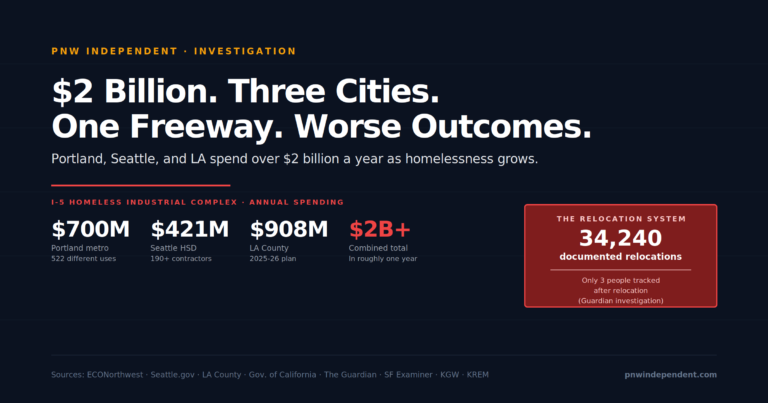
- Multnomah County’s Joint Office of Homeless Services — ~$700M/year, outcomes worsening, no dissolution conversation yet
- Seattle Human Services Department — ~$400M/year, no state performance audit conducted
- Sound Transit — $34.5B funding shortfall, CEO Constantine self-appointment 15-0
Why KCRHA Cracked First
Three factors accelerated the dissolution conversation while the others have continued unchecked:
1. The interlocal agreement structure made dissolution mechanically possible. Either party can terminate. Therefore, the political action threshold was lower than for state agencies or transit boards.
2. The dollar amounts are concentrated and clearly missing. $13 million unaccounted for is a specific, audit-confirmed number. Compared to “ongoing cost overruns” at Sound Transit or “thin oversight” at HSD, this kind of specific damage is easier to act on.
3. Voter pressure is high. Homelessness is the most visible public-policy failure in Seattle. Voters can see the outcomes daily on the streets. Therefore, the political cost of inaction was higher than for less-visible governance failures.
The pattern is the story. KCRHA dissolution is the first chapter of what may become a broader unwinding of regional pass-through agencies in Washington. Or it may stay isolated — the only one of the four agencies to face actual restructuring. Furthermore, the next 12 months will determine which.
What Should Happen Next on KCRHA Dissolution
The dissolution legislation is moving. However, several decisions still require attention.
1. Independent State Auditor Performance Review
The Washington State Auditor’s Office should conduct a parallel performance audit. Clark Nuber is a private firm hired by the city and county that fund the agency. An independent state-level audit would provide the kind of long-term documentation needed to evaluate whether the dissolution achieves its goals — and whether similar problems exist at other regional pass-through agencies.
2. Criminal Referral Decision
Auditors said they found no evidence of fraud but could not rule it out. The City of Seattle and King County Prosecutor’s Office should formally decide whether the audit’s underlying documentation rises to the level of criminal referral. Furthermore, that decision should be made publicly, with documented reasoning either way.
3. Lived Experience Coalition Audit
The $360,000 in P-card payments to the Lived Experience Coalition for an “ill-fated hotel program” deserves its own forensic review. Specifically, where did the money go, what services were delivered, and why was P-card use deemed appropriate for an arrangement of that size?
4. Provider Transition Planning Now
Service providers cannot wait until August to know what happens to their contracts. Therefore, the city and county should begin transition planning immediately, in parallel with the assessment that precedes the formal vote.
5. Replacement Structure Decision
Whether the replacement is full in-house, hybrid, or a new joint authority, the decision should be made before the dissolution vote — not after. Furthermore, voters deserve to know what they are getting before they get the dissolution.
The Bottom Line on KCRHA Dissolution
The dissolution is no longer a hypothetical. Legislation has been introduced. The vote is scheduled for August. The one-year wind-down begins after passage. Mayor Wilson is already routing her largest homelessness initiative around the agency. Major service providers are publicly asking to be removed from the agency’s administration. Furthermore, the agency’s own CEO is defending her tenure but not the agency’s underlying structure.
Whether the August vote actually happens, and whether dissolution actually proceeds, depends on a chain of political decisions over the next 90 days. However, the trajectory is clear. Regional agencies that operate without strong financial controls, without elected accountability, and without measurable outcomes do not survive forever. KCRHA appears to be the first such agency in Washington to face its reckoning.
The next 90 days will determine whether the dissolution becomes a model for accountability — or another political process that ultimately changes nothing.
The clock is running. The first vote is in August.
Related Reading on PNW Independent
- KCRHA Audit: $13M Missing in Seattle’s Homeless Agency
- Moody’s Downgrade: Washington State Built This Hole
- Who Really Runs Seattle: Two Machines, One Ruling Class
- The Portland Homeless Industrial Complex: Inside the $700M Machine
External Sources
- MyNorthwest — Lawmakers move to dissolve King County homeless agency (April 28, 2026)
- FOX 13 Seattle — King County Council votes to dissolve homeless authority (April 28, 2026)
- KUOW — Citing audit as ‘last straw,’ officials seek to dissolve KCRHA
- KOMO News — City, county councilmembers move to dissolve KCRHA
- Seattle City Council — Rivera and Dembowski companion resolutions
- King County Council — Dembowski statement on KCRHA dissolution
- KOMO News — Tiny home villages fear funding delays as KCRHA shake-up looms
- KING 5 — KCRHA faces calls to shut down after $13M goes unaccounted
- KCRHA Official Website