
How Portland’s Homeless Industrial Complex Betrays the Poor
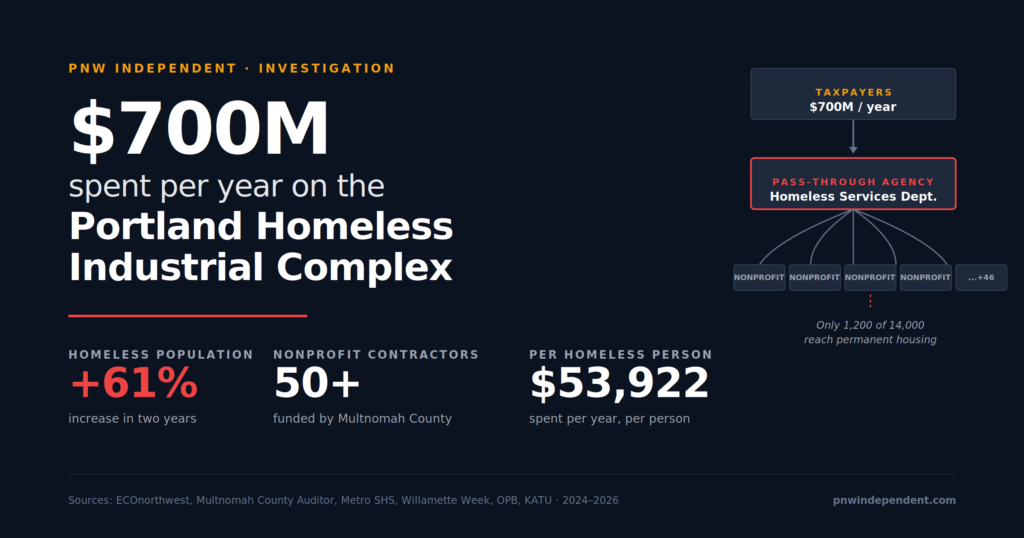
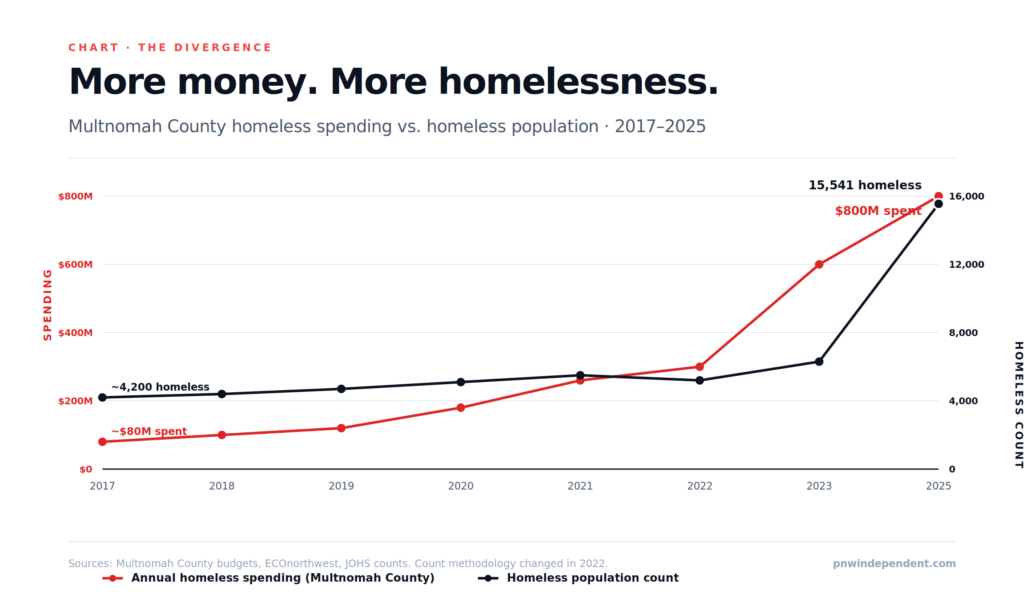
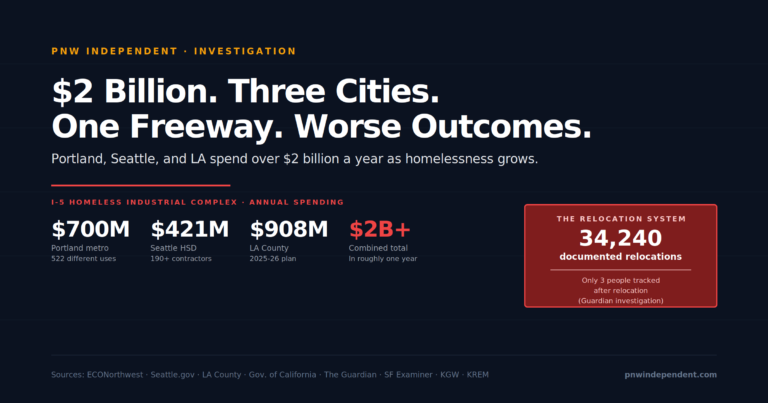
TL;DR: The Portland homeless industrial complex spends more than $700 million a year. That is roughly 10 times what Portland and Multnomah County spent in 2017. Yet the metro area’s homeless count has climbed 61 percent in two years. The Portland homeless industrial complex funnels that money through a tangle of 50-plus nonprofits. Lobbying rules barely exist. Overbilling scandals keep surfacing. Executives rotate between contractors. Meanwhile, the people these agencies were hired to help still sleep on sidewalks. This is a story about a machine that profits from the crisis it was built to end.
What Is the Portland Homeless Industrial Complex?
The Portland homeless industrial complex is a closed-loop funding system. First, government money enters at the top. Then dozens of politically connected nonprofits collect it at the bottom. In between sits a pass-through agency — now called the Multnomah County Homeless Services Department (HSD). That agency writes the checks. However, it does not deliver the services.
Here is how the structure works in four steps. First, tax dollars flow into the agency. Second, the agency contracts with more than 50 nonprofits. Third, those nonprofits depend on government contracts for most of their revenue. Finally, oversight happens only after the money is gone.
A national report published in October 2025 by the Capital Research Center documented the scale. Nonprofits that filed amicus briefs in Grants Pass v. Johnson reported $9.1 billion in combined revenue. Additionally, they took in at least $2.9 billion in government grants — about 32 percent of total revenue. Portland shows exactly how this plays out in one city.
The Numbers Behind the Portland Homeless Industrial Complex
Start with the spending. Then compare the results.
In 2024, ECOnorthwest produced a study commissioned to track every public and private dollar flowing into the region’s homeless response. The study identified more than $700 million spent in a single year across 522 different uses. This money flowed through the tri-county area, more than 50 nonprofits, and a stack of funding streams.
Multnomah County alone budgeted $354 million for homelessness in fiscal year 2025. Meanwhile, Portland Mayor Keith Wilson confirmed in May 2025 that combined city and county spending is roughly 10 times what it was in 2017. On top of that, Governor Tina Kotek’s state-level budget dedicates another $700 million-plus to homelessness and housing across Oregon.
The Results Are Going the Wrong Direction
Despite this massive spending, the Portland homeless industrial complex is losing ground. Consider the numbers:
- The tri-county homeless count jumped 61 percent in two years. It reached more than 12,000 people by early 2025.
- Nearly half of those people are completely unsheltered — in tents, cars, or on the sidewalk.
- In 2023, 456 people died unsheltered in Multnomah County. That is a 477 percent increase since 2017.
- Last fiscal year, 14,000 people cycled through shelter. Only about 1,200 adults exited to permanent housing.
- Roughly 1,400 people fall into homelessness each month in Multnomah County. Only 1,100 exit.
Even Portland District 4 City Councilor Olivia Clark said it out loud in a May 2025 joint budget meeting. She called the spending pattern “an existential moment.” She added, “Just the astounding amount of money being spent here, with the trend line going down.”
How Money Flows Through the Portland Homeless Industrial Complex
The Metro Supportive Housing Services (SHS) Tax
In May 2020, tri-county voters approved Measure 26-210. This created two new taxes to fund homeless services:
- A 1 percent personal income tax on income above $125,000 for single filers or $200,000 for joint filers.
- A 1 percent business income tax on companies with gross receipts above $5 million.
Metro, the regional government, projected collections of about $250 million a year through 2031. Instead, collections blew past forecasts. By 2023, OPB reported the tax was on pace to bring in nearly $1 billion more than expected by 2029. Projections now sit around $437 million annually rather than the original $250 million. Furthermore, Multnomah County’s share alone came in at $140.4 million in FY 2024, versus an original forecast of $96.2 million.
A tax windfall should be a gift. However, in Multnomah County, it became a liability. The county ended fiscal year 2023 with $42 million in unspent SHS dollars. Officials blamed staffing shortages and contractor wage problems. Eventually, Metro leadership had to publicly order the county to move the money.
The Joint Office Became a $342 Million Pass-Through
The Joint Office of Homeless Services was created in 2016 as a joint city-county agency. Its adopted FY 2024 budget reached $279 million. Additionally, its staff grew from 32 positions to about 100 in two years. In 2024, officials restructured the agency and renamed it the Homeless Services Department.
But the structure never changed. The agency hands out contracts. It does not provide services. Former Portland Mayor Sam Adams told Willamette Week the agency is “an incredibly large pass-through agency.”
In the fiscal year ending June 30, 2024, the Joint Office paid out $282.2 million — 82 percent of its $342.5 million operating budget — to outside contractors. Additionally, Multnomah County as a whole paid $1.2 billion to contractors in FY 2023. That total is more than a third of its $3.3 billion budget.
The Lobbying Loophole at the Heart of the Portland Homeless Industrial Complex
Here is a fact that sounds impossible. Multnomah County has no lobbying registration or disclosure requirements for its contractors. None.
Oregon, Portland, and most large West Coast counties all require disclosure. However, Multnomah County does not. No lobbyist must register. No contractor must report hours spent pitching officials. Furthermore, no public log records who met with whom. A contractor can take an official to lunch, ask for a multi-million-dollar contract, receive it, and leave no paper trail.
Willamette Week reported in February 2025 that Do Good Multnomah, a nonprofit shelter operator, received at least $5.7 million in contracts from JOHS in one fiscal year. Multiple sources told WW that CEO Daniel Hovanas told staff a major part of his job was having drinks with county officials and asking for money. Hovanas denied the drinks part. Instead, he said he met with Joint Office leadership “over lunch a few times a year.”
The point is not whether Hovanas did anything wrong. Rather, the point is that nobody can know. The disclosure rules simply do not exist. Former Portland City Councilor Erik Sten put it plainly. He said, “The absence of graft is not an argument for no disclosure.”
Meanwhile, WW asked County Chair Jessica Vega Pederson whether the public should demand lobbying transparency. She defended the current system. She said, “Our board makes funding decisions, but not decisions about who receives funding.” That answer dodges the actual question. Somebody decides who receives funding. Yet in Multnomah County, the public cannot find out how.
Case Study: Sunstone Way Exposes the Portland Homeless Industrial Complex
If you want to understand how the Portland homeless industrial complex fails, start with Sunstone Way. The nonprofit was Multnomah County’s 11th-largest contractor in FY 2024. It pulled in $13.3 million in annual revenue. Today, it operates Weidler Village and the 70-bed Delta Park Motel Shelter — a former Motel 6 converted in June 2025.
The Whistleblower Lawsuit
Show Image
In February 2026, former Sunstone Way finance director Kate Fulton filed a $4.5 million whistleblower lawsuit in Multnomah County Circuit Court. The allegations, as reported by KATU and Willamette Week, read like a how-to guide for contractor abuse:
- In 2022, a county auditor hotline tip found the organization had overbilled the county by $525,228. That figure includes $193,675 in inappropriate administrative overhead. County Auditor Jennifer McGuirk documented $330,000 in duplicated payroll expenses — the same pay period billed twice in separate invoices.
- CEO Andy Goebel allegedly moved Sunstone’s offices to more expensive space on SW Naito Parkway. However, he did this while still paying rent on the old lease. Consequently, the double rent cost the organization roughly $226,000.
- Additionally, Sunstone nearly missed payroll in July 2024, just one month into its fiscal year.
- Goebel allegedly paid a close personal friend, Chris Aiosa, roughly $30,000 through Aiosa’s side consulting firms. At the time, Aiosa was employed by HUD at the Housing Authority of Clackamas County. Those side firms were “Affordable Housing Initiative” and “Narwhal Nonprofit Consulting.” Furthermore, Affordable Housing Initiative was registered at Aiosa’s apartment.
- A vendor, Our Streets PDX, allegedly overbilled Sunstone by $210,000. Fulton’s complaint says Goebel told her not to demand a refund or alert JOHS. Instead, he allegedly said he had “made a deal” with Our Streets. Moreover, Goebel was allegedly personal friends with its leaders.
- On December 10, 2024 — just weeks after Aiosa’s visit — Sunstone Way received a new contract to manage a shelter program in Clackamas County.
- Soon after, Fulton was fired. She had just begun working with the county on another audit.
The Web of Connected Insiders
The web gets tighter. Alicia Hovanas, Sunstone’s chief operating officer, is married to Daniel Hovanas, the CEO of Do Good Multnomah. Additionally, Goebel previously worked at Do Good Multnomah alongside Aiosa. Clearly, the same small group of executives keeps rotating through the largest contractors in the Portland homeless industrial complex.
Furthermore, Sunstone Way spent public money on staff retreats to Bend. The complaint also describes “bloated contracts with related organizations.” A Sunstone spokeswoman did not respond to WW’s request for comment. Meanwhile, Multnomah County’s press office declined to comment on pending litigation.
Case Study: Rockwood CDC and the Project Turnkey Boondoggle
The Portland homeless industrial complex also shows its flaws through Rockwood CDC. In 2021, the Oregon Community Foundation distributed the state’s $125 million Project Turnkey program. As part of that rollout, it awarded Brad Ketch’s Rockwood Community Development Corporation a $6.8 million grant. The money went to buy a tattered Best Western on NE 181st Avenue in Gresham. The goal was to convert it into a family shelter. The building became Rockwood Tower. At one point, it accounted for roughly half of all family shelter rooms in Multnomah County.
Red Flags Nobody Heeded
Then-State Senator Betsy Johnson publicly warned in 2020 that Project Turnkey was moving too fast. Specifically, she said there was too little oversight. She called it “Project Turkey.” As it turned out, she was right.
By 2025, Multnomah County had built a long list of allegations against Ketch’s operation. Specifically, the county said Rockwood CDC had:
- Double-counted costs.
- Billed for rooms that were closed for repairs.
- Charged for excessive maintenance.
- Hired a contracting firm owned by one of its own employees.
- Fed residents frozen TV dinners and corn dogs. In June 2024, Rockwood Tower replaced its kitchen stoves with refrigerators. Additionally, air fryers were banned.
Former resident Denise Job-Williams told WW that heavy rain leaked through the roof for three straight days when she moved in. The leaks set off fire alarms.
The Ketch Family Business
Ketch’s compensation, per federal tax filings: $228,223 in 2023. Additionally, his wife Lynn, the executive director, made $143,440. Their son also works there.
Ketch’s previous business career is worth noting. Specifically, he ran Rim Semiconductor. That company burned through more than $50 million of investor money before closing in 2008 without selling a product. Its only revenue came from producing Step Into Liquid, a surfing documentary.
The Collapse
The aftermath played out in 2025 and early 2026. First, Multnomah County terminated contracts totaling $1.3 million in July 2025. Then, WaFD Bank foreclosed on Rockwood Tower in early 2026. The bank cited “financial strain” on East County Housing LLC — Ketch’s affiliated entity — after it lost the county contract. Consequently, families had to be relocated. Furthermore, the Days Inn & Suites the county tried to convert as a replacement fell through due to “unforeseen financing challenges.”
To his credit, Ketch gave Willamette Week the most honest quote of the entire affair. He asked, “What if standing here with Oregon’s most dysfunctional government and having a train wreck is a necessary step to this community being transformed?” Granted, it’s a fair question. So far, however, the answer is no.
The Shocking Math of the Portland Homeless Industrial Complex
Step back from the individual scandals. Then do the math.
Total estimated direct homelessness spending in Multnomah County for 2024 topped $800 million. That figure comes from PDX Voice analysis compiling city, county, state, and federal sources. Meanwhile, the April 2025 homeless count in Multnomah County stood at 15,541 individuals.
Divide one number by the other. Spending per homeless individual per year: approximately $53,922.
For context, that is more than Oregon’s median personal income. In theory, you could hand every homeless person in Multnomah County roughly $54,000 in cash. You would still come out ahead compared to the current system.
Per-Bed Shelter Costs Confirm the Pattern
Show Image
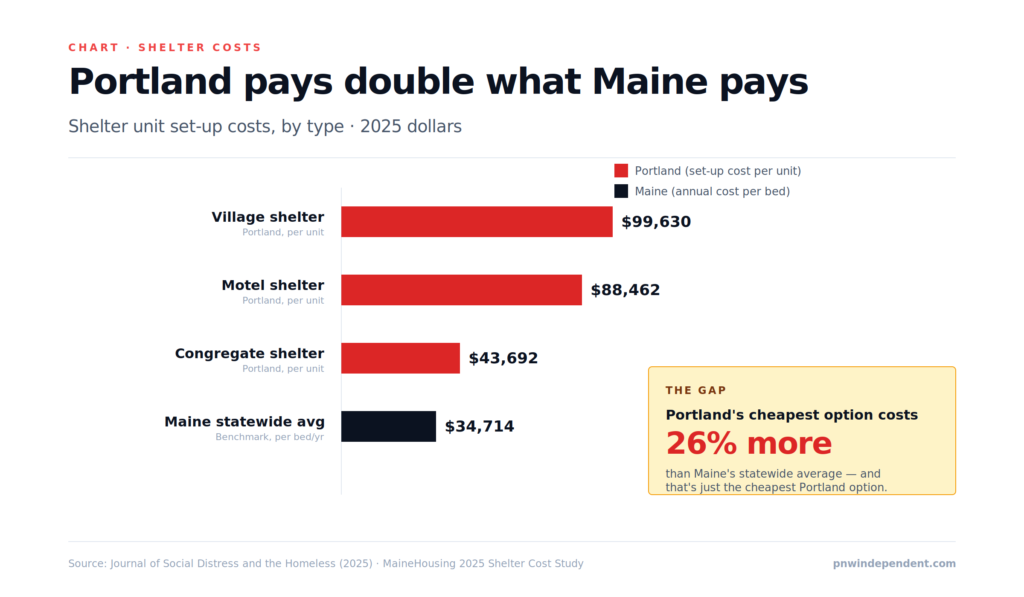
A peer-reviewed 2025 study in the Journal of Social Distress and the Homeless analyzed 22 Portland shelters. The findings:
- Village shelters: $99,630 per unit in set-up costs.
- Motel shelters: $88,462 per unit in set-up costs.
- Congregate shelters: $43,692 per unit in set-up costs.
For comparison, Maine’s statewide average cost per shelter bed is $34,714 per year. That figure works out to about $95 per bed-night. Maine has homelessness too. However, its numbers come in dramatically cheaper.
Additionally, Mayor Keith Wilson’s FY 2025-26 plan to add 1,500 overnight shelter beds carried a price tag of $15,309,000. That cost works out to roughly $10,200 per bed. The figure only covers operating costs. Furthermore, it excludes siting and conversion. Wilson also set a self-imposed deadline of December 1, 2025, to “end unsheltered homelessness” in Portland. That deadline came and went. Unsheltered homelessness did not end.
The $104 Million Hole Nobody Saw Coming
In February 2025, Multnomah County Chair Jessica Vega Pederson sent a letter to Metro and Governor Kotek. The letter announced a $104 million budget shortfall. Additionally, she asked for $55 million from the state and $30 million from Metro to fill it.
The reaction from everyone else in Oregon government was roughly: excuse me, what?
- Portland Mayor Keith Wilson said the news sent him “on his heels” and “flat-footed.”
- Metro Council President Lynn Peterson: “To me personally, it wasn’t just disappointing, it was actually quite jarring.”
- Clackamas County Commissioner Ben West: “The first inescapable fact is that Multnomah County has failed dismally, both in comparison to the other counties and, most importantly, on an absolute scale.”
- Governor Kotek said she had “outstanding questions and potential concerns” about how the county had made its cuts.
County records later told the story. Specifically, 44 percent of the Homeless Services Department’s FY 2024 spending came from one-time money. The sources included federal pandemic relief dollars (ARPA), reserves, and other non-recurring revenue. That one-time money went to fund ongoing, recurring programs. In effect, that is the municipal-finance equivalent of paying your mortgage with a credit card. When ARPA ran out, the hole appeared. Furthermore, it was predictable.
Eventually, officials reduced the shortfall to about $70 million after tapping reserves. However, the core problem was structural. The county had built a permanent spending base on temporary revenue.
The 2024 Audit Nobody Fixed
County Auditor Jennifer McGuirk has documented the rot for years. Specifically, her 2024 report on Joint Office operations found:
- Contracting policies hadn’t been updated since 2011.
- Additionally, many county employees didn’t know what those policies were.
- Furthermore, it had been five years since county staff had visited some of the nonprofits receiving county money.
- Adult and family shelters were generally full with long waitlists. However, they only sometimes moved participants into permanent housing.
- Shelter beds had tripled since 2016 — from 521 in 2015 to a budgeted 3,220 in FY 2024. Yet outcomes had not kept pace.
In response, then-Joint Office Director Dan Field (since retired) and Chair Vega Pederson did not challenge the findings. Instead, they said many recommendations were already being implemented. Additionally, they noted that 80 percent of contractor invoices were now being paid on time. In fact, officials described 80 percent on-time invoice payment as an improvement.
Where Is the Portland Homeless Industrial Complex Money Really Going?
The uncomfortable answer: a large share goes to the people administering the system. Very little, by contrast, reaches the people sleeping outside.
Consider a few data points. First, JOHS/HSD’s internal staffing tripled from 32 to about 100 in two years. Additionally, Central City Concern, the region’s largest homeless services nonprofit, has a Charity Navigator compensation ratio of 8.8. That ratio means the highest-paid executive earns 8.8 times the average staff salary.
Meanwhile, Transition Projects, Do Good Multnomah, Sunstone Way, Rockwood CDC, and dozens of smaller contractors draw most of their revenue from government contracts. The business model is not “end homelessness.” Instead, the business model is “win and retain contracts.” Clearly, those are different objectives.
Furthermore, Metro keeps 5 percent of all SHS tax receipts for its administrative fund. Higher-than-expected tax collections meant Metro had $31 million in administrative money sitting in reserve as of March 2025.
The Voters Are Catching On
The question is not whether every dollar is wasted. Plenty of line-level shelter workers are doing hard, unglamorous, genuinely compassionate work at near-poverty wages. However, the real question is whether the structure can produce a different result.
Four years into the SHS tax, a Metro-commissioned poll in 2025 found that only 53 percent of tri-county voters said they would vote to reauthorize it. Consequently, Metro Council declined to put an extension on the November 2025 ballot. Councilor Christine Lewis acknowledged what the polling reflected. Specifically, she cited voter fatigue and the growing perception that the money is not producing results.
How to Dismantle the Portland Homeless Industrial Complex
An honest report should not end without naming what a different approach could look like. Granted, reasonable people disagree on specifics. However, the cases for reform have structural overlap. Here are the pillars:
1. Mandatory Lobbying Disclosure
Multnomah County contractors should face the same disclosure rules already in place at the city, state, and most comparable West Coast counties. After all, you cannot fix a system you cannot see.
2. Performance-Based Contracting With Real Clawbacks
A contractor that bills for empty rooms, double-counts payroll, or fails to hit placement targets should lose the contract and return the money. Today, however, the consequence for mismanagement is often a renewed contract and a bail-out advance.
3. Consolidate, Don’t Proliferate
522 distinct uses across 50-plus nonprofits is not a service ecosystem. Instead, it is a billing matrix. Fewer, larger, better-audited contracts would reduce administrative bloat. Even better, they would make oversight possible.
4. Treatment Before Housing for the Chronically Homeless
Multnomah County’s own data shows roughly 2,500 homeless individuals with severe mental illness. Additionally, another 2,500 struggle with chronic substance abuse. Housing-first works for people ready for housing. For people in active psychosis or addiction, however, a bed alone is not an intervention.
5. Enforce Existing Laws
Grants Pass v. Johnson settled the legal question. Municipalities can regulate public camping. Whether to do so is a policy choice, not a constitutional bar.
6. Publish the Books
Every contract, every invoice, every outcome metric, every executive compensation disclosure — all in a single public dashboard. After all, if taxpayers are putting up $700 million a year, they deserve to see where it went.
The Bottom Line on the Portland Homeless Industrial Complex
Portland did not accidentally arrive at a 61 percent spike in homelessness. That rise came in the middle of the most expensive response in the city’s history. Rather, Portland built the system that produced the result. The Portland homeless industrial complex is not a conspiracy theory. Instead, it is a spreadsheet.
That spreadsheet contains hundreds of contracts. Additionally, it contains tens of millions in executive and administrative compensation. Furthermore, it contains overlapping boards, revolving-door hiring, and a pass-through government agency. For most of its existence, moreover, that agency didn’t even require a lobbyist to register before asking for a check.
None of this means Portland’s homeless are less deserving of help. Rather, it means the people taxpayers have trusted with that help have built a machine whose first priority is its own survival. The tragedy is clear. The two goals — helping people off the streets, and preserving the machine — have become directly opposed.
Until that changes, the trend line will keep going the wrong direction. And taxpayers will keep paying the bill.
Related Reading on PNW Independent
- Oregon’s Measure 110 Failure: How Drug Decriminalization Fueled the Homeless Crisis
- Who Really Runs Multnomah County? A Guide to the Political Machine
- Portland Business Exodus: The Companies Leaving and Why
- Grants Pass v. Johnson Explained: What the Ruling Means for the Pacific Northwest
External Sources
- ECOnorthwest regional homelessness spending analysis
- Multnomah County Auditor’s Office reports — Auditor Jennifer McGuirk
- Metro Supportive Housing Services financial reports
- Willamette Week investigations
- Oregon Public Broadcasting (OPB)
- KATU News
- Capital Research Center
- Portland Tribune
- Portland.gov — Mayor Wilson’s homelessness blueprint

3 Comments