5 Brutal Realities of the I-5 Homeless Industrial Complex
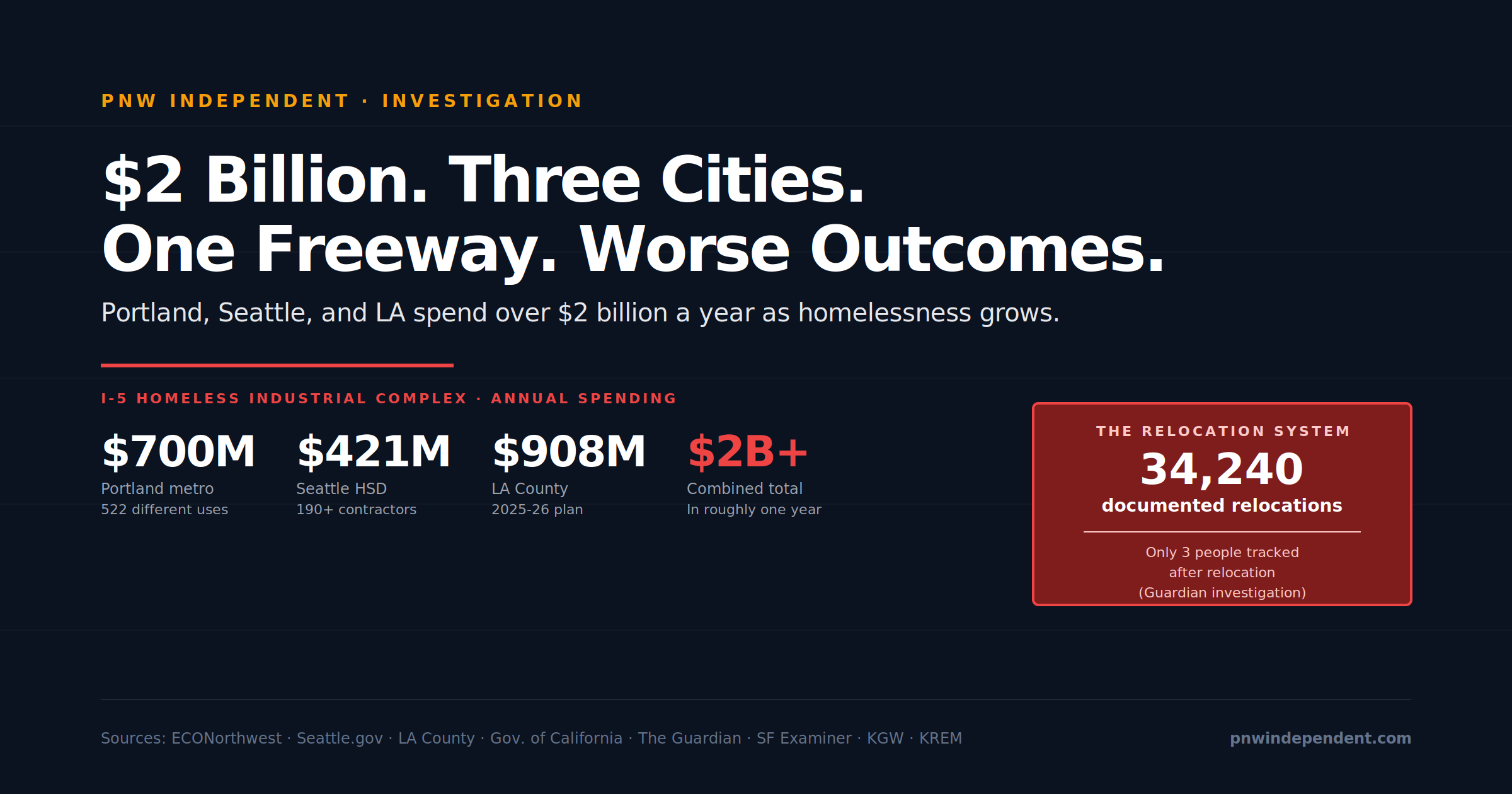
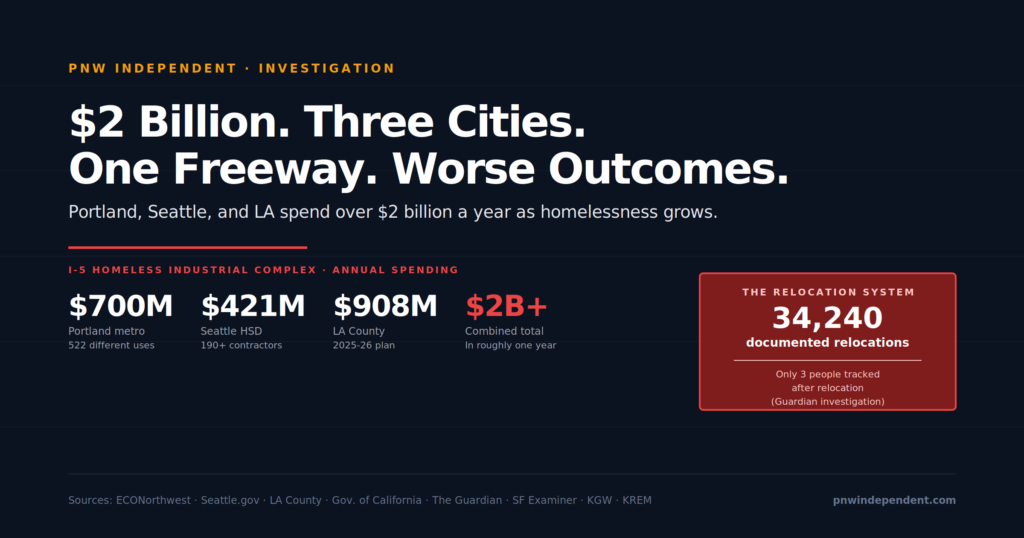
The I-5 homeless industrial complex spans three West Coast metros connected by a single freeway. Specifically, the Portland metro spent over $700 million on homelessness in a single year. Seattle’s Human Services Department runs a $421 million 2026 budget. Furthermore, Los Angeles County approved a $908 million homeless services spending plan for 2025-26. That is more than $2 billion across three cities in roughly one year.
The I-5 homeless industrial complex also includes a documented relocation system. Specifically, cities along the corridor have for years offered one-way bus tickets to move unhoused people elsewhere. Furthermore, a Guardian investigation documented 34,240 relocations nationally — and found cities could provide almost no data on outcomes. Nearly half of Portland’s relocated people lost their housing within three years. The money flows. The outcomes worsen. The structure is the story. Here is what the documents actually show.
What the I-5 Homeless Industrial Complex Actually Spends
The I-5 system is best understood through documented spending figures. Specifically, three major metros along Interstate 5 each operate large homelessness funding systems. Furthermore, those systems have grown substantially over the past decade while measured outcomes have not improved proportionally.
Portland Metro: $700 Million Per Year
The Portland tri-county area spends extraordinary sums on homelessness. Specifically, an ECONorthwest report found that more than $700 million was spent on homelessness in a single year across the region. Furthermore, that $700 million flowed to 522 different uses across the tri-county area.
That fragmentation is itself notable. Specifically, 522 separate funding streams create coordination challenges. Furthermore, fragmented funding makes outcome-tracking difficult. PNW Independent’s previous Portland Homeless Industrial Complex investigation documented how this spending fails to produce proportional results.
Seattle: $421 Million Human Services Budget
Seattle’s Human Services Department operates a $421 million adopted budget for 2026. Specifically, the department contracts with more than 190 community-based organizations. Furthermore, Seattle’s 2026 budget added a record-high $349.5 million in affordable housing investments — more than five times the 2019 amount.
That spending operates alongside the King County Regional Homelessness Authority. Specifically, PNW Independent’s KCRHA audit investigation documented $13 million in unaccounted funds at that agency. Furthermore, the combined Seattle-King County homelessness spending exceeds the Human Services Department budget alone.
Los Angeles County: $908 Million Spending Plan
Los Angeles County approved a $908 million Funding Recommendations package for homeless services in fiscal year 2025-26. Specifically, the LA County Board of Supervisors approved the plan in March 2025. Furthermore, the county launched an entirely new Department of Homeless Services and Housing on January 1, 2026.
The LA spending targets specific numbers. Specifically, the plan funds outreach teams to engage 21,000 unsheltered people, 7,200 interim housing beds, and 3,100 housing navigation slots. Furthermore, California Governor Newsom announced an additional $328.8 million in HHAP funding directed specifically to the LA region.
The Combined Total
The combined spending adds up to a staggering figure. Specifically:
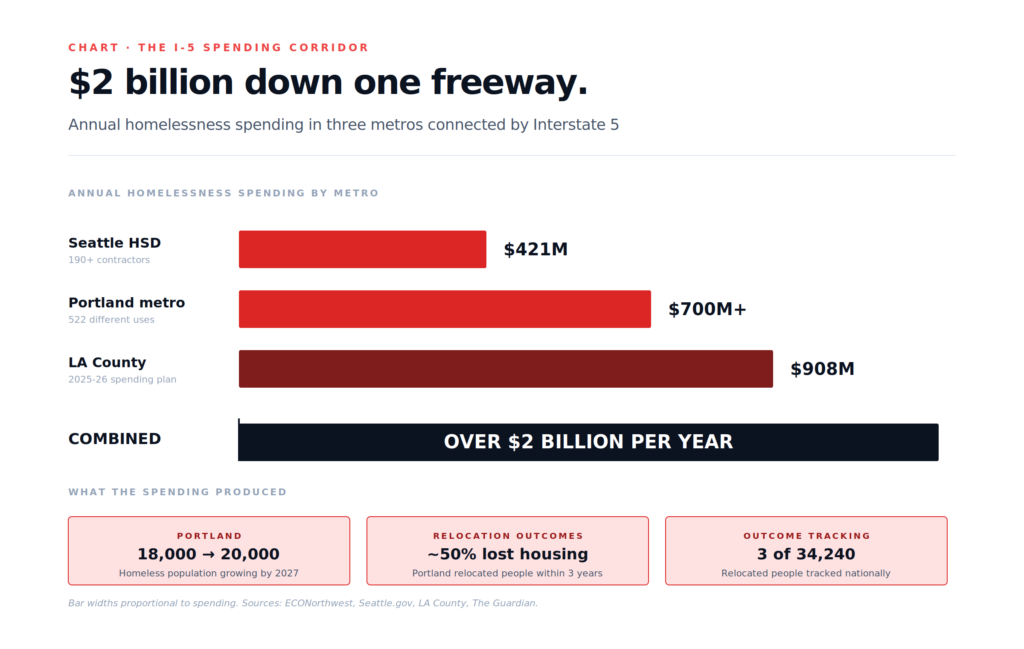
- Portland metro: $700+ million (tri-county, all sources)
- Seattle HSD: $421 million (2026 budget)
- LA County: $908 million (2025-26 plan)
- Combined: over $2 billion in roughly one year
Therefore, three cities connected by one freeway spend more than $2 billion annually on homelessness. Furthermore, that figure does not include all state and federal pass-through funding. The spending is enormous. The crisis persists.
How the I-5 Homeless Industrial Complex Moves People Between Cities
The I-5 homeless industrial complex includes a documented relocation component. Specifically, cities along the West Coast have for decades offered one-way bus tickets to relocate unhoused people. Furthermore, those programs operate up and down the I-5 corridor — and the documentation reveals troubling patterns.
San Francisco’s Homeward Bound Program
San Francisco operates the most documented relocation program. Specifically, since February 2005, the city provided nearly 10,000 homeless residents with one-way Greyhound bus tickets under its Homeward Bound program. Furthermore, recipients also received a $10 per travel day food allowance.
The numbers fluctuate annually. Specifically, the program bused between 815 and 942 people per year at various points. Furthermore, the program’s biggest documented shortcoming is the lack of outcome data. Specifically, the city could not show whether bused individuals ended up homeless again soon after arrival.
Portland as a Destination and Origin
Portland sits at the center of the I-5 homeless industrial complex relocation flows. Specifically, a Unit 8 investigation found that several cities from San Diego to San Francisco were providing one-way bus tickets directing homeless people to Portland. Furthermore, individuals reported being sent by police departments and social workers.
Portland also runs its own outbound program. Specifically, the city’s “A Ticket Home” program relocated people elsewhere. Furthermore, when officials tracked outcomes, the results were grim. Nearly half of the people who used Portland’s program over three years had lost the housing they were supposed to get after leaving the city.
The Guardian’s National Investigation
The most comprehensive documentation came from a Guardian 18-month investigation. Specifically, the investigation obtained data from 16 cities with homeless relocation programs. Furthermore, the investigation documented 34,240 total relocations across the country.
The findings were damning. Specifically, the investigation found that “almost half of the 7,000 homeless people San Francisco claims to have helped lift out of homelessness in the period of 2013-16 were simply given one-way tickets out of the city.” Furthermore, the investigation found that only three relocated people were contacted after their relocation to verify outcomes.
Why This Matters for the I-5 Homeless Industrial Complex
The relocation programs reveal a structural feature of the I-5 homeless industrial complex. Specifically, cities can report “reductions” in homelessness by relocating people rather than housing them. Furthermore, a one-way bus ticket counts as a “successful” outcome in some reporting frameworks — even when the person becomes homeless again at the destination.
Homeless advocate Ibrahim Mubarak characterized the pattern directly. Specifically, he said these programs “don’t solve the problem. They just move it from one city to the next.” Furthermore, he described the approach as “trying to sweep reality under a carpet.” Moving people is not the same as housing people.
What the I-5 Homeless Industrial Complex Produces in Outcomes
The corridor system produces measurable outcomes. Specifically, those outcomes do not match the spending. Furthermore, the gap between input and output is the central accountability question.
Portland’s Worsening Numbers
Despite the $700 million in annual spending, Portland-area homelessness has grown. Specifically, the Multnomah County homeless population has reached approximately 18,000 — and is projected to hit 20,000 by 2027. Furthermore, that growth occurred while the region poured hundreds of millions into response systems.
Therefore, the Portland component of the I-5 homeless industrial complex demonstrates the core problem. Specifically, more spending has not produced fewer homeless people. Furthermore, the population is projected to keep growing despite the spending.
Seattle’s Persistent Crisis
Seattle’s homelessness crisis persists despite massive investment. Specifically, the city estimates roughly 4,000 unsheltered individuals in need of shelter. Furthermore, Mayor Katie Wilson’s recent plan to build 500 shelter units by June 2026 faces documented delays. PNW Independent’s Seattle World Cup homeless investigation documented that the earliest realistic delivery is July 14 — after the World Cup ends.
That gap matters. Specifically, the spending is enormous and the delivery is slow. Furthermore, the combination defines the Seattle component of the I-5 homeless industrial complex.
California’s Mixed Signals
California presents a more complicated picture. Specifically, Governor Newsom announced a 9% reduction in unsheltered homelessness — the first statewide drop in over 15 years. Furthermore, that reduction came alongside billions in Proposition 1 funding and HHAP investments.
However, the California reduction must be evaluated carefully. Specifically, a 9% reduction in unsheltered homelessness does not mean a 9% reduction in total homelessness. Furthermore, people moving from unsheltered to interim housing count as reductions in unsheltered numbers even though they remain homeless. The metric matters as much as the number.
The Outcome Data Problem
The deepest issue with the I-5 homeless industrial complex is the outcome data problem. Specifically, across all three metros, outcome-tracking is weak. Furthermore, the relocation programs explicitly lack outcome data. Specifically:
- San Francisco could not show whether bused people stayed housed
- Portland found nearly half its relocated people lost housing
- The Guardian found only three of 34,240 relocated people were tracked
- The 522 Portland funding streams resist coordinated outcome measurement
Therefore, the I-5 homeless industrial complex spends over $2 billion annually with weak outcome accountability. You cannot manage what you do not measure. The system does not measure well.
How the I-5 Homeless Industrial Complex Creates Perverse Incentives
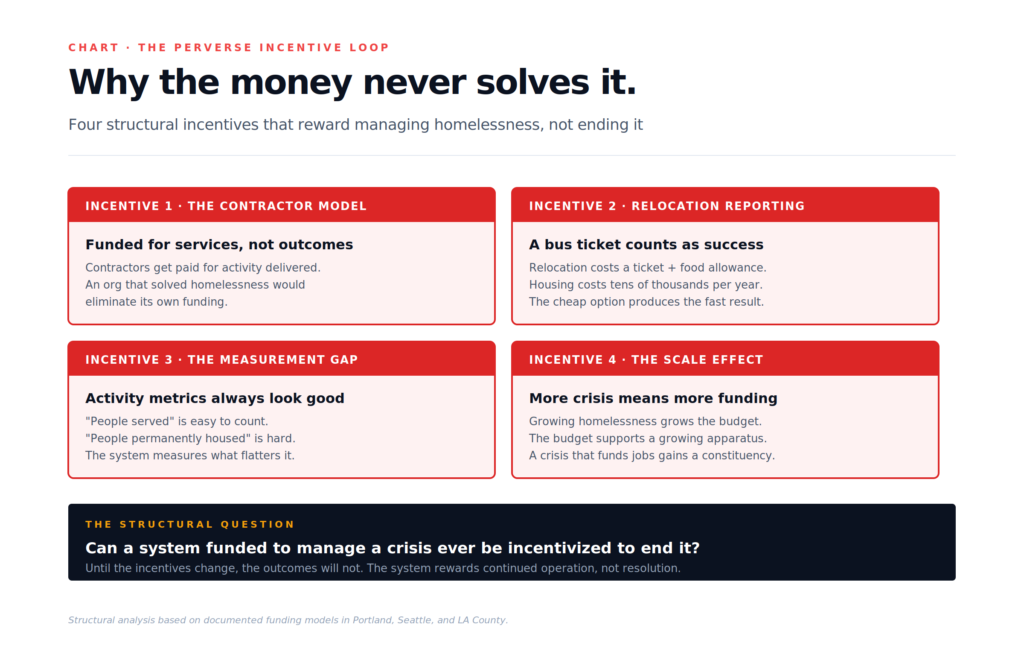
The corridor system creates documented perverse incentives. Specifically, the funding structure can reward activity over results. Furthermore, those incentives help explain why spending grows while outcomes do not improve.
The Nonprofit Contractor Model
Both Seattle and Portland rely heavily on nonprofit contractors. Specifically, Seattle’s Human Services Department contracts with more than 190 community-based organizations. Furthermore, Portland’s $700 million flows to 522 different uses.
That model creates a structural incentive. Specifically, contractors are funded based on services delivered, not outcomes achieved. Furthermore, an organization that fully solved homelessness in its service area would eliminate its own funding. Therefore, the funding model does not financially reward ending homelessness — it rewards managing it indefinitely.
That is not an accusation of bad faith. Specifically, most homelessness service workers are deeply committed to helping people. Furthermore, the structural incentive exists regardless of individual intentions. The system rewards continued operation, not resolution.
The Relocation Reporting Incentive
The relocation programs create a separate perverse incentive. Specifically, a one-way bus ticket is cheap compared to housing. Furthermore, it produces an immediate visible result — one fewer tent on the local sidewalk.
Therefore, cities have financial incentive to relocate rather than house. Specifically, relocation costs a bus ticket plus a small food allowance. Furthermore, housing costs tens of thousands of dollars per person per year. The cheaper option produces the faster visible result — even when it does not actually help the person.
The Measurement Incentive
The weak outcome-tracking creates its own incentive. Specifically, when outcomes are not rigorously measured, programs can claim success based on activity. Furthermore, “people served,” “contacts made,” and “tickets provided” are all easier to count than “people permanently housed.”
Therefore, the I-5 homeless industrial complex measurement systems favor activity metrics. Specifically, activity metrics always look positive. Furthermore, outcome metrics often look discouraging. The system measures what makes it look good, not what would prove it works.
The Scale Incentive
The final perverse incentive is scale. Specifically, as homelessness grows, so does the funding to address it. Furthermore, the growing funding supports a growing apparatus of administrators, contractors, consultants, and service providers.
That apparatus develops its own institutional interest in continued funding. Specifically, the Two Machines analysis documented how institutional players develop stakes in the systems they administer. Furthermore, the homelessness response apparatus is now a major regional employer. A crisis that funds thousands of jobs develops a constituency for its own continuation.
How the I-5 Homeless Industrial Complex Connects to Broader Accountability Patterns
The corridor system connects directly to PNW Independent’s ongoing accountability reporting. Furthermore, the connections reveal a consistent regional pattern. Specifically, the same structural features appear across multiple investigations.
Connection 1: The KCRHA Audit Gap
PNW Independent’s KCRHA audit investigation documented $13 million in unaccounted funds. Specifically, that audit found weak financial controls at the King County Regional Homelessness Authority. Furthermore, the audit pattern is exactly what the I-5 homeless industrial complex produces at scale.
Therefore, the KCRHA gap is not an isolated failure. Specifically, it is a local instance of the regional pattern. Furthermore, weak financial controls are a predictable feature of fragmented, fast-growing funding systems.
Connection 2: The Moody’s Fiscal Context
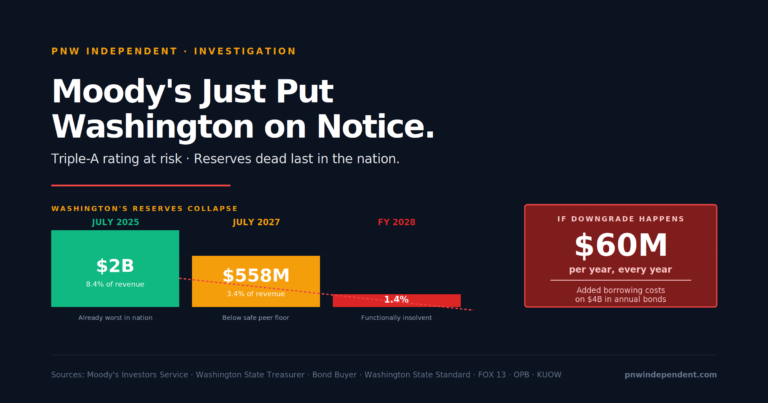
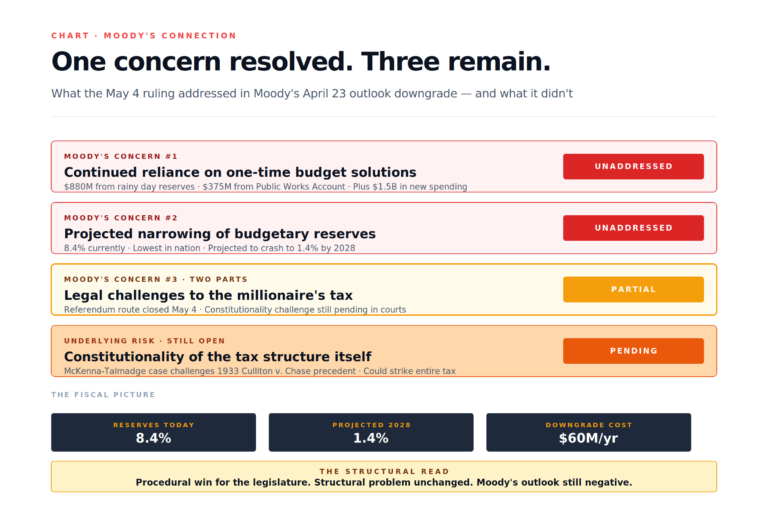
PNW Independent’s Moody’s downgrade investigation documented Washington State’s fiscal vulnerabilities. Specifically, the rating agency flagged structural budget concerns. Furthermore, homelessness spending is a significant and growing budget category.
Therefore, the I-5 homeless industrial complex has fiscal implications beyond homelessness. Specifically, $2 billion in annual regional spending affects overall fiscal trajectories. Furthermore, spending that does not produce results represents a structural fiscal risk.
Connection 3: The Portland Pattern
PNW Independent’s Portland Homeless Industrial Complex investigation documented how Portland’s spending fails the poor. Specifically, that piece is the foundational documentation of the pattern this article extends. Furthermore, the I-5 framework shows Portland is not unique — it is one node in a corridor-wide system.
Therefore, the Portland pattern is the West Coast pattern. Specifically, the same dynamics appear in Seattle and Los Angeles. Furthermore, the freeway connection is not just geographic — it is structural and financial.
The Regional Truth
The corridor pattern reveals a regional truth. Specifically, three of America’s most progressive cities spend more than $2 billion annually on homelessness. Furthermore, all three have persistent or growing homeless populations. The spending is not the solution. In some ways, the spending structure is part of the problem.
What Should Happen Next on the I-5 Homeless Industrial Complex
The corridor system requires structural reform. Furthermore, several specific changes could improve outcomes. Specifically, each addresses a documented failure point.
1. Mandatory Outcome Tracking
The single most important reform is mandatory outcome tracking. Specifically, every dollar spent should be tied to measurable outcomes. Furthermore, those outcomes should include:
- Permanent housing placement rates at 6, 12, and 24 months
- Returns to homelessness after placement
- Cost per successful permanent placement
- Outcomes for relocated individuals at their destinations
That tracking would transform accountability. Specifically, it would reveal which programs actually work. Furthermore, it would let funders shift money from ineffective to effective approaches. You cannot improve what you do not measure.
2. Relocation Program Transparency
The relocation programs need full transparency. Specifically, every city operating a bus-ticket program should publish:
- Number of people relocated annually
- Destinations of relocated individuals
- Verification that receiving parties agreed to accept them
- Outcome tracking at 30, 90, and 365 days post-relocation
Furthermore, relocations should not count as “successful outcomes” unless the person remains housed at the destination. Specifically, current reporting frameworks that count a bus ticket as success are fundamentally misleading. A bus ticket is not a home.
3. Consolidated Funding Coordination
The fragmentation problem requires consolidation. Specifically, Portland’s 522 funding uses and Seattle’s 190+ contractors create coordination failures. Furthermore, consolidation could reduce administrative overhead and improve outcome tracking.
That consolidation does not require eliminating service providers. Specifically, it requires unified outcome measurement and coordinated case management. Furthermore, a single regional outcome database would let the system identify what works.
4. Independent Audit Authority
The I-5 homeless industrial complex needs independent audit authority. Specifically, each major metro should have an empowered inspector general for homelessness spending. Furthermore, PNW Independent’s King County DCHS investigation documented the value of independent oversight.
That audit authority should have subpoena power, independent investigative capacity, and a public reporting mandate. Specifically, the federal Inspector General model works when properly resourced. Furthermore, replicating it at the regional level could catch the financial control failures the KCRHA audit revealed.
5. Outcome-Based Contracting
The contractor model needs restructuring. Specifically, contracts should reward outcomes, not activity. Furthermore, performance-based contracting could tie funding to permanent housing placements rather than services delivered.
That restructuring would change the incentive structure. Specifically, contractors would have financial reason to actually house people permanently. Furthermore, the current model that rewards continued operation would shift toward rewarding resolution.
6. Honest Public Reporting
The deepest reform is honest public reporting. Specifically, cities should stop reporting relocations as reductions. Furthermore, they should report total homelessness honestly — including people in interim housing who remain homeless.
That honesty would change the public conversation. Specifically, voters cannot evaluate policy without accurate data. Furthermore, the current reporting frameworks obscure more than they reveal. Honest numbers are the foundation of accountability.
The Bottom Line on the I-5 Homeless Industrial Complex
What the I-5 Homeless Industrial Complex Actually Is
The I-5 homeless industrial complex is a documented regional system. Specifically, three West Coast metros spend more than $2 billion annually on homelessness. Furthermore, the spending flows through hundreds of fragmented funding streams to hundreds of contractors. The money is real. The crisis persists.
That outcome is not an accident. Specifically, the funding structure rewards activity over results. Furthermore, the measurement systems favor metrics that look positive over metrics that prove effectiveness. The relocation programs let cities report reductions by moving people rather than housing them.
Why the Spending Does Not Solve the Crisis
The corridor system does not solve homelessness because its structure does not reward solving homelessness. Specifically, contractors are funded for services, not outcomes. Furthermore, cities are incentivized to relocate rather than house. The measurement systems obscure rather than reveal.
Therefore, the spending grows while the crisis persists. Specifically, Portland’s population is projected to grow despite $700 million annually. Furthermore, Seattle’s crisis persists despite a $421 million Human Services budget. More money has not meant fewer homeless people.
What This Means for West Coast Voters
The corridor system matters for every West Coast voter. Specifically, voters are funding a $2 billion annual system with weak accountability. Furthermore, that system is not producing the results its cost would imply.
The practical takeaway is clear. Specifically, voters should demand outcome data, relocation transparency, and independent audits. Furthermore, the current system will not reform itself — the institutional incentives all point toward continuation. Reform requires external pressure.
The Structural Question
The deepest issue raised by the I-5 homeless industrial complex is structural. Specifically, can a system funded to manage a crisis ever be incentivized to end it? Furthermore, that question applies beyond homelessness to many areas of public spending.
The answer requires honesty about incentives. Specifically, the current system rewards managing homelessness indefinitely. Furthermore, ending homelessness would eliminate the funding that sustains the apparatus. Until the incentives change, the outcomes will not.
For Pacific Northwest readers, the I-5 homeless industrial complex is not a distant abstraction. It is the system your tax dollars fund. It is the system that is not working. Furthermore, the documentation is now public — the spending figures, the relocation data, the outcome failures. The accountability questions write themselves.
The clock is running on the next budget cycle. Over $2 billion will be spent again next year. The structure that produced this year’s results will produce next year’s results too — unless something changes. That change starts with demanding the outcome data the system has so far failed to provide.
Related Reading on PNW Independent
- How Portland’s Homeless Industrial Complex Betrays the Poor
- Seattle World Cup Homeless: A Brutal 43% Gap
- KCRHA Audit: $13M Missing in Seattle’s Homeless Agency
- Who Really Runs Seattle: Two Machines, One Ruling Class
External Sources
- KGW — Researchers track homelessness spending in the Portland metro area: How much and where it’s going
- Seattle.gov Human Services — Budget Overview and Funding Sources
- LA County — Board of Supervisors approves $908 million homeless services spending plan
- Governor of California — Newsom announces new investments following 9% drop in unsheltered homelessness
- The Guardian — Bussed out: How America moves its homeless (18-month investigation)
- San Francisco Examiner — SF expanding program that has bused 10K homeless residents out of town
- KREM — Several cities providing homeless one-way bus tickets to Portland
- Seattle City Council — 2026 Budget Summary
- Vice — Instead of Helping Homeless People, Cities Are Bussing Them Out of Town