Seattle World Cup Homeless: A Brutal 43% Gap
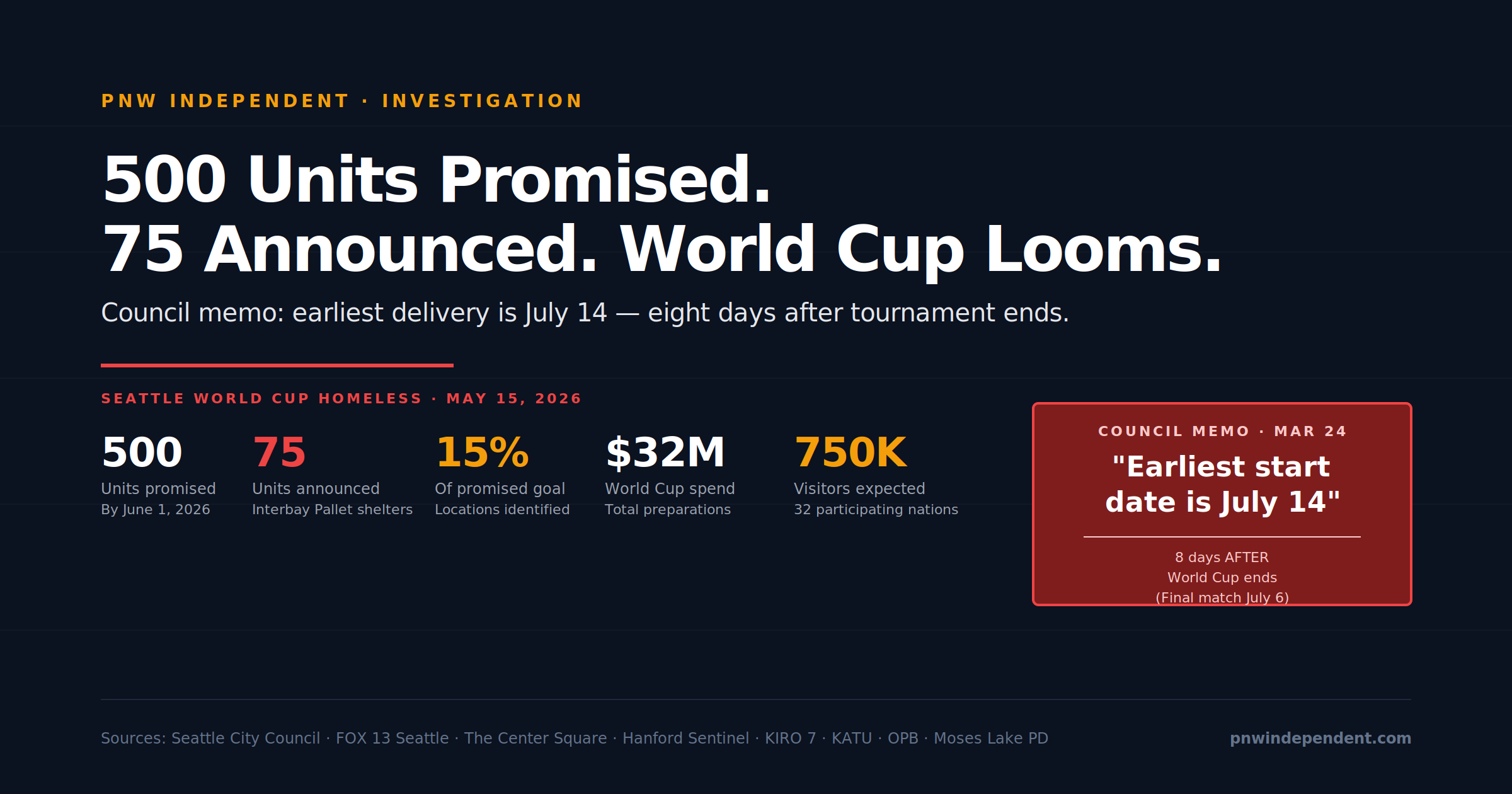
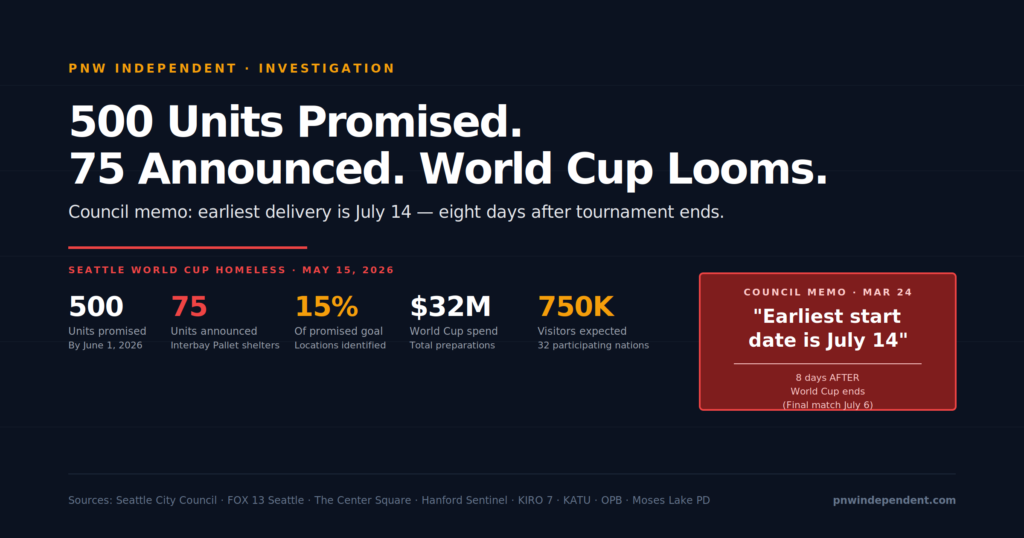
Mayor Katie Wilson promised 500 shelter units by June 1, 2026 — before Seattle’s World Cup matches begin. Specifically, a Seattle City Council staff memo concluded the earliest operations date is July 14, 2026 — eight days after the final World Cup game. Furthermore, only 75 units have been publicly identified. That puts the Seattle World Cup homeless plan at roughly 15% of the promised target with two weeks to deadline. The city has committed $32 million to World Cup preparations. Microsoft already relocated its Build 2026 developer conference to Las Vegas, citing downtown conditions.
The Seattle World Cup homeless situation drew further attention this week when rumors spread that the city was busing unhoused people to Moses Lake and Bremerton. Moses Lake PD officially denied the rumors on May 13. Furthermore, no documented busing program exists. Meanwhile, Portland’s separate homeless crisis — under a different Mayor Wilson — is producing parallel structural failures. The gap between political promises and operational delivery is the story. Here is what the documents actually show.
What the Seattle World Cup Homeless Plan Actually Promised
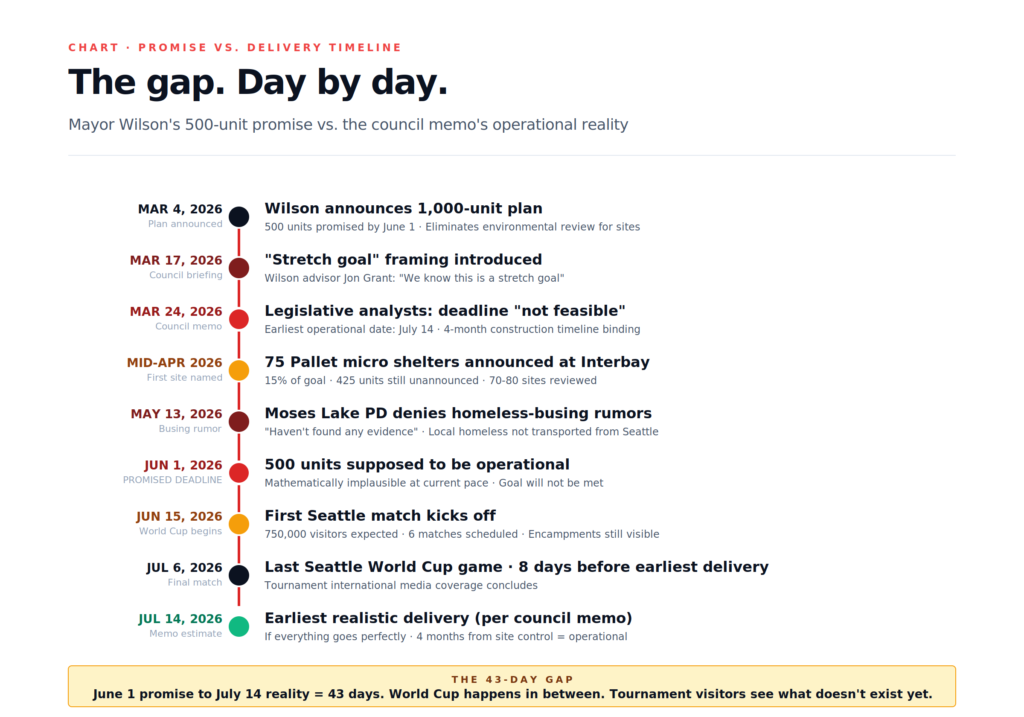
The plan was announced by Mayor Katie Wilson on March 4, 2026. Specifically, Wilson promised 1,000 shelter units by the end of 2026. Furthermore, on March 17, Wilson’s administration accelerated the timeline: 500 of those units would open before June 15 — the date of Seattle’s first World Cup match.
The Numbers Wilson Promised
Wilson’s plan included specific numerical commitments. Specifically:
- 500 units operational by June 1, 2026
- 1,000 units by end of 2026
- 4,000 units by end of Wilson’s term (campaign promise)
- $17.5 million budgeted for first 500 units start-up + operating costs
- $28,000 per unit per year low estimate
- $45,000 per unit per year higher-support estimate
Therefore, the plan was structured around a specific tournament deadline. Furthermore, the structure assumed the city could compress what is normally a multi-year shelter-development process into roughly 90 days.
Why June 1 Was the Deadline
The Seattle FIFA matches begin June 15, 2026. Furthermore, the city expects approximately 750,000 visitors across six matches scheduled for June 15, 19, 24, 26, July 1, and July 6. Specifically, Wilson set the June 1 deadline to ensure shelter capacity was operational two weeks before the international spotlight arrived.
That timing matters. Specifically, the city projects roughly $32 million in World Cup preparation costs. Furthermore, the budget covers transportation upgrades, security, signage, hospitality coordination, and visitor services. The homeless shelter expansion was supposed to be the most visible component of preparedness.
What the Plan Actually Funds
The plan involves several specific funding mechanisms. Specifically:
- $4.9 million allocated for tiny home village construction
- $17.5 million total for 500 units across 2026
- Philanthropy partnerships with Challenge Seattle (Microsoft, Mariners ownership, T-Mobile, Starbucks named)
- Regional Homelessness Authority unspent funds redirected
- Federal funding uncertainty noted but not quantified
Therefore, the funding structure relies heavily on private partnerships and unspent existing allocations. Furthermore, the unspent regional funds raise questions about why those funds were sitting unspent in the first place. PNW Independent’s previous reporting on KCRHA accountability gaps is directly relevant here.
What the Council Memo Says About Seattle World Cup Homeless Delivery
The Seattle City Council legislative analysts produced a memo dated March 24, 2026 examining Wilson’s plan. Specifically, the memo identifies a fundamental scheduling problem. Furthermore, the analysis casts substantial doubt on whether the June 1 deadline is achievable under any scenario.
The Decisive Quote
The council memo states bluntly:
“It is not at all clear that passage of this legislation would result in 500 new units of shelter by June 1, 2026, before World Cup games begin, which is the Executive’s stated goal.”
Specifically, the memo identifies a four-month construction timeline as the binding constraint. Furthermore, the memo’s math is direct: “The Executive has said that it takes 4 months from site control to have a micro-modular village become operational. Even if the Executive were able to secure leases by mid-April, that would put the earliest start date for operations is July 14.”
Therefore, the earliest possible operational date is eight days after the final World Cup game. Furthermore, that date assumes everything else goes perfectly. It does not appear to be going perfectly.
The 75 Units Announced
By mid-April 2026, Wilson had publicly announced only 75 of the promised 500 units. Specifically, those 75 units are located in Interbay along 15th Avenue. Furthermore, the units are Pallet micro shelters — composite-panel structures designed by an Everett-based company.
That means 425 of the promised 500 units have no announced location. Furthermore, the math is straightforward:
- 75 units announced (15% of goal)
- 425 units unannounced (85% of goal)
- 70-80 sites reviewed
- Fewer than 10 sites identified as having all required elements (willing landlords, buildable land, utilities)
Therefore, the Seattle World Cup homeless plan is structurally constrained by land availability, not just political will. Furthermore, the pace problem has been visible since April. The May 14 update did not improve the situation.
The “Stretch Goal” Acknowledgment
Mayor’s office staff have begun characterizing the deadline differently. Specifically, Wilson policy advisor Jon Grant told the city council:
“We’re looking to accelerate this progress with the first 500 units, with a very ambitious goal of trying to open them before the World Cup, which would be the end of May. We know this is a stretch goal.”
Furthermore, that “stretch goal” language is itself notable. Specifically, the administration is signaling expectation-management before the deadline arrives. The Seattle World Cup homeless plan is being repositioned from a deliverable into an aspirational target. The gap between promise and operational reality is now publicly acknowledged by the administration itself.
What “43% of Pace” Actually Means
Based on the timeline analysis, the Seattle World Cup homeless plan is operating at roughly 43% of the promised pace. Specifically:
- Goal: 500 units operational by June 1
- Days promised: ~90 from March 4 announcement
- Days remaining as of May 15: ~17
- Units announced: 75 (15%)
- Linear pace required: 5.5 units per day
- Actual pace: well below 1 unit per day
Therefore, even if Wilson’s team accelerated dramatically, catching up to the original goal within the remaining 17 days is mathematically implausible. Furthermore, the council memo’s July 14 estimate is consistent with this analysis.
How the Seattle World Cup Homeless Situation Sparked Busing Rumors
The crisis spawned a specific rumor cycle in early May 2026. Specifically, social media posts claimed Seattle was busing unhoused people to other Washington cities ahead of the tournament. Furthermore, the rumors targeted two specific destinations: Bremerton (via ferry) and Moses Lake (via bus).
What the Rumors Alleged
The rumors made specific claims. Specifically:
- Seattle officials were “shipping” homeless people to Bremerton via Washington State Ferries
- Buses were transporting homeless people to Moses Lake east of the Cascades
- The operations were timed to coincide with World Cup preparations
- The destinations were chosen because of distance from tournament venues
Furthermore, the rumors gained significant traction on social media. Specifically, multiple accounts shared the claims as though documented. The volume of sharing made official response necessary.
What Moses Lake PD Found
The Moses Lake Police Department issued an official statement on May 13, 2026. Specifically, the department denied the rumors:
“We haven’t found any evidence that anyone is being bused here from Seattle ahead of the World Cup.”
Furthermore, Moses Lake officers interviewed local homeless residents. Specifically, the department reported: “None of the local homeless people that we talked to have talked to anyone who was bused here from Seattle.” Therefore, the busing rumor lacks documented evidentiary support from the destination jurisdiction.
What Actually Appears to Be Happening
The Seattle World Cup homeless situation is producing visible displacement — but not through coordinated busing. Specifically, sweeps have intensified in tourist-corridor neighborhoods. Furthermore, displaced individuals often move organically rather than being transported.
A long-time Seattle street outreach worker told reporters the truth is “less tidy than the rumors” but “isn’t exactly reassuring either.” Specifically, the worker described uncertainty about where displaced individuals actually go — including ferries, deeper into wooded areas, or simply other neighborhoods. The lack of documented placement is itself a transparency issue.
Why the Rumors Mattered Anyway
The Seattle World Cup homeless busing rumors matter even though Moses Lake PD found no evidence. Specifically, the rumors reveal a structural information gap. Furthermore, when official displacement-tracking is absent, rumors fill the void. The Wilson administration has not published a public dashboard tracking what happens to people displaced from cleared encampments.
That absence is consequential. Specifically, both transparency advocates and tourism interests benefit from documented placement data. Furthermore, the absence of that data is what makes rumors plausible to share. The fastest way to end the busing rumor would be public outcome data on displacement.
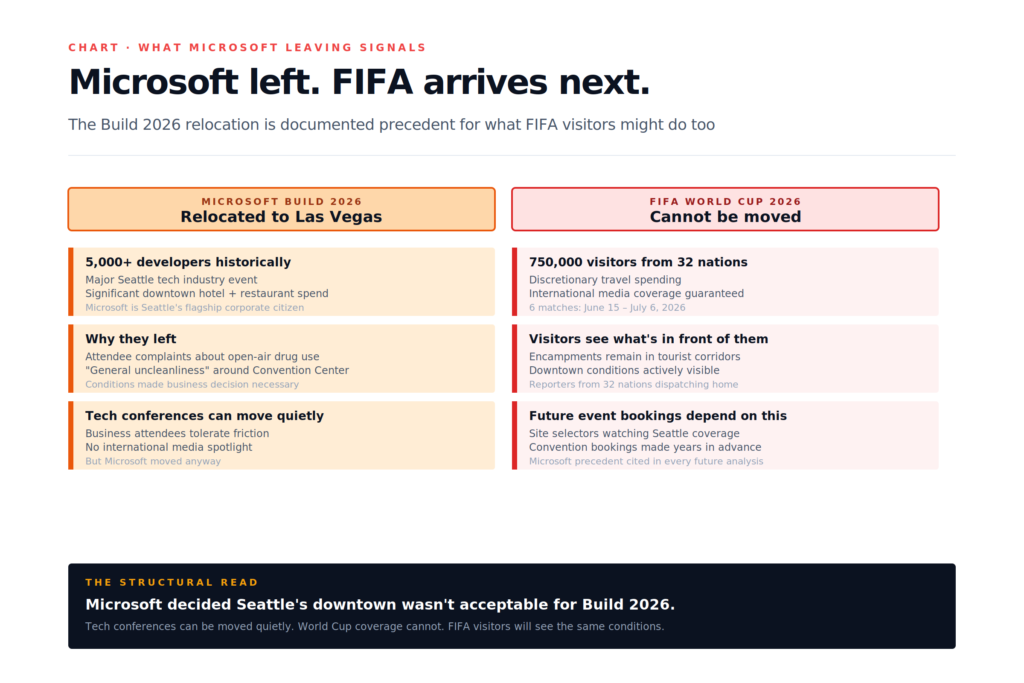
What Microsoft Build 2026 Tells Us About Seattle World Cup Homeless Stakes
The situation has produced documented economic consequences. Specifically, Microsoft relocated its Build 2026 developer conference to Las Vegas in early 2026. Furthermore, the relocation followed attendee complaints about open-air drug use and “general uncleanliness” around the Washington State Convention Center.
The Microsoft Build Significance
Microsoft Build is one of Seattle’s marquee tech industry events. Specifically, the conference typically:
- Hosts 5,000+ developers in person
- Generates significant downtown hotel + restaurant spending
- Attracts global tech press coverage
- Demonstrates Seattle’s tech industry centrality
Furthermore, Microsoft relocating the conference is significant precisely because Microsoft is Seattle’s flagship corporate citizen. Specifically, when Microsoft determines that Seattle’s downtown conditions affect its business decisions, that signals something other companies are likely to notice.
What FIFA Visitors Will See
The Microsoft Build precedent matters because FIFA visitors are not Microsoft developers. Specifically:
- Tech conference attendees have business reasons to tolerate friction
- FIFA visitors are spending discretionary travel dollars
- Tech conferences can be relocated quietly
- World Cup matches cannot be moved
Furthermore, the FIFA tournament will produce documented international media coverage. Specifically, journalists from 32 participating nations will be in Seattle. Their dispatches will shape how their home countries view the city for future travel and investment decisions.
The Stakes Beyond the Tournament
Seattle’s tourism economy depends on perception. Specifically, the city competes for events, conventions, conferences, and leisure travel against:
- Portland (the other Wilson)
- Vancouver BC (proximate competition)
- San Francisco (West Coast tech tourism)
- Las Vegas (event capacity + perception advantage)
Furthermore, each major event Seattle hosts (or loses) shapes future bookings. Microsoft Build’s relocation to Las Vegas is now part of every future event organizer’s site-selection analysis. The Seattle World Cup homeless situation will produce similar precedent — for good or bad — depending on visitor experience during the tournament.
How the Seattle World Cup Homeless Crisis Compares to Portland’s
The Seattle plan is happening alongside a separate but parallel Portland crisis. Specifically, Portland Mayor Keith Wilson (no relation to Seattle’s Katie Wilson) is facing his own structural homelessness challenges. Furthermore, the parallel timing reveals broader regional patterns.
Two Different Wilsons, Two Different Cities
The naming coincidence is worth noting:
- Seattle Mayor Katie Wilson — Elected 2025, took office January 2026, campaign focused on 4,000 shelter units
- Portland Mayor Keith Wilson — Elected November 2024, took office January 2025, focused on rapid shelter expansion
Specifically, both Mayors Wilson campaigned on aggressive homelessness response. Furthermore, both are now facing operational constraints. The two are not related and run entirely separate cities.
Portland’s Multnomah Safe Rest Village Pushback
Portland’s Mayor Keith Wilson is converting the Multnomah Safe Rest Village to a high-barrier recovery center model. Specifically, the original village operates as a low-barrier shelter — no sobriety requirements, no mandatory services. Furthermore, advocates and neighbors rallied Sunday, May 17 to oppose the conversion.
Specifically, the rally argued the conversion would displace residents not ready for substance-use treatment. Furthermore, the operator transitioning the facility — Urban Alchemy — has faced separate KATU investigation over staff drug use, distribution, and sexual harassment allegations. Several Portland city councilors have urged divesting from Urban Alchemy entirely.
Multnomah County’s Numbers
The Portland regional homeless population has grown despite massive spending. Specifically:
- Multnomah County homeless population: ~18,000
- Projected by 2027: ~20,000
- Hundreds of millions spent annually with worsening outcomes
- JOHS (Joint Office of Homeless Services) spending ~$700M/year regionally
PNW Independent’s previous Portland Homeless Industrial Complex investigation documented this pattern. Furthermore, the May 17 Multnomah Village rally reflects the structural tension between low-barrier service philosophy and recovery-oriented approaches.
What Both Cities Reveal
The Seattle World Cup homeless crisis and the Portland Multnomah Safe Rest Village conversion reveal parallel structural problems. Specifically:
- Both cities elected mayors promising aggressive homelessness response
- Both mayors are facing operational constraints months into office
- Both regions spend hundreds of millions with worsening outcomes
- Both face credibility gaps between promises and delivery
- Both have shelter operators with documented oversight issues
Therefore, the Pacific Northwest homelessness crisis is not a function of any single mayor’s policy choices. Furthermore, it is a structural feature of how regional homelessness systems have evolved. Neither Wilson can solve in 90 days what 15 years of policy decisions created.
How the Seattle World Cup Homeless Plan Connects to Broader Accountability Patterns
The plan fits PNW Independent’s ongoing structural-accountability framework. Furthermore, the connections are specific. Specifically, the case touches several accountability infrastructure questions documented in recent reporting.
Connection 1: The KCRHA Audit Gap
PNW Independent’s KCRHA audit investigation documented $13 million in unaccounted funds at the King County Regional Homelessness Authority. Specifically, that audit identified weaknesses in financial oversight that have not been fully resolved.
Furthermore, Wilson’s 500-unit plan partially relies on unspent KCRHA funds being redirected. Specifically, the question of whether those funds can be effectively deployed depends on KCRHA’s operational capacity — which is the same capacity the audit found wanting. The Seattle World Cup homeless plan is partially funded through agencies with documented accountability gaps.
Connection 2: The Moody’s Downgrade Context
PNW Independent’s Moody’s downgrade investigation documented the rating agency’s concerns about Washington State’s fiscal trajectory. Specifically, those concerns included structural budget vulnerabilities and reserve depletion.
Furthermore, Seattle’s $32 million World Cup spending occurs within that broader fiscal context. Specifically, every dollar spent on visible event preparation is a dollar not available for sustained homelessness infrastructure. Major events produce short-term fiscal stress on top of structural challenges.
Connection 3: The Two Machines Pattern
PNW Independent’s Two Machines analysis documented how Pacific Northwest urban political dynamics often produce institutional decisions favoring high-visibility events over sustained service delivery. Furthermore, the Seattle World Cup homeless plan fits the pattern.
Specifically, the 500-unit shelter goal was announced explicitly tied to World Cup visibility. Furthermore, the deadline was set by tournament timing rather than service-population need. When event-driven deadlines determine policy structure, operational delivery often suffers.
Connection 4: The Pioneer Square FIFA Plan
PNW Independent’s Pioneer Square FIFA investigation examined how Seattle is preparing the historic Pioneer Square neighborhood for World Cup visitors. Specifically, that piece focused on infrastructure and visitor-services investments. Furthermore, this piece is a structural counter-pattern. Pioneer Square got investment. The shelter plan got promises.
What Should Happen Next on Seattle World Cup Homeless
The Seattle World Cup homeless situation creates several specific decision points. Furthermore, each affects whether the next 30 days produce damage control or productive policy. Specifically, here are the actions that would meaningfully address the gap.
1. Public Dashboard on Displacement Tracking
The fastest way to end the busing rumors is transparency. Specifically, the Wilson administration should publish a public dashboard tracking:
- Number of encampments cleared by week
- Number of individuals contacted during clearings
- Number of individuals placed in shelter
- Number of individuals declining services
- Geographic disposition of cleared individuals
- Outcome tracking at 30/60/90 days
Furthermore, that dashboard would address transparency concerns and rumor amplification simultaneously. Information vacuum is what allows speculation. Transparent data is what defeats it.
2. Honest Public Recalibration
The Seattle World Cup homeless plan needs a public reset. Specifically, Wilson should:
- Publicly acknowledge the 500-unit June 1 goal will not be met
- Report current actual numbers (announced + operational)
- Provide a revised realistic timeline
- Identify specific barriers (land availability, permitting, funding)
- Commit to delivering whatever is achievable while World Cup runs
Furthermore, that honesty would preserve credibility for future commitments. Specifically, voters and partners can accept reduced delivery if the recalibration is transparent. They cannot accept ongoing claims that contradict the council memo.
3. Direct Coordination with Tournament Organizers
The crisis directly affects tournament visitor experience. Specifically, SeattleFWC26 — the local organizing committee — has detailed transportation and visitor-services plans. Furthermore, those plans need to coordinate with shelter availability.
Specifically, the city should publish a coordinated plan covering:
- Where visitors will be directed during downtown traversal
- Which routes will be monitored for visitor experience
- How encampment locations will be documented for transparency
- What outreach will be available for the unhoused population during tournament weeks
That coordination would benefit both populations. Visitors get clearer expectations. Unhoused individuals get clearer service availability.
4. Microsoft Build Lesson Application
The Microsoft Build relocation is documented precedent. Specifically, Microsoft’s decision criteria are publicly knowable. Furthermore, applying those criteria to future event-retention strategy is exactly what Seattle should do.
Specifically, Seattle should:
- Document what Microsoft Build attendees actually complained about
- Identify which conditions are tractable in the short term
- Identify which conditions require sustained investment
- Build retention strategies for other corporate events at risk
Specifically, losing Microsoft Build was a warning. The next major event relocation will be cumulative — and harder to reverse.
5. Regional Coordination Beyond Seattle
The Seattle World Cup homeless crisis affects the broader Puget Sound region. Specifically, visitors will travel through:
- Sea-Tac International Airport
- Bellevue and Eastside cities
- Tacoma and South King County
- Ferry routes to Kitsap Peninsula
Furthermore, those jurisdictions all have separate homelessness response systems. Specifically, the absence of coordination means visitors will see inconsistent conditions across the region. Tournament visitors don’t care about jurisdiction boundaries.
A coordinated regional response — even modest — would help. Specifically, the Puget Sound Regional Council has the convening authority. Furthermore, the next 30 days are the window for any coordination to produce visible results.
6. Honest Conversation About 4,000-Unit Goal
The Seattle World Cup homeless deadline crisis raises the deeper question: is the 4,000-unit campaign goal achievable? Specifically, Wilson’s term runs through 2029. Furthermore, hitting 4,000 units requires roughly 1,300 per year on average — far above current pace.
That conversation should happen publicly now. Specifically, the campaign goal was set during electoral campaigning. Furthermore, operational reality may require revising it. Setting expectations early is far better than missing them late.
The Bottom Line on Seattle World Cup Homeless
What the Seattle World Cup Homeless Plan Actually Delivered
The Seattle World Cup homeless plan ends one chapter today. Specifically, the June 1 goal will not be met. Furthermore, the council memo’s July 14 estimate is now the operationally credible date — eight days after the final tournament match. The structural gap is documented.
That outcome was foreseeable. Specifically, the council memo identified the timeline problem in March. Furthermore, the administration’s own staff acknowledged “stretch goal” language by mid-April. The gap between political promise and operational delivery has been visible for two months.
Why Microsoft Already Left
The Microsoft Build relocation matters because it demonstrates measurable cost. Specifically, when major employers determine that downtown conditions affect business decisions, the cost is not theoretical. Furthermore, every additional event relocation creates cumulative precedent.
Specifically, the cost is also not just about events. It is about the credibility of city services. When Microsoft moves a conference, it signals that other companies should also consider their options. That signal is the actual long-term cost of the Seattle World Cup homeless crisis.
What This Means for Tournament Visitors
The Seattle World Cup homeless situation will be visible to tournament visitors. Specifically:
- Encampments remain in tourist corridors despite sweeps
- Service delivery is documented as insufficient
- The promised shelter capacity is not coming
- The administration has not published displacement-tracking data
- Regional coordination remains absent
Therefore, visitors from 32 nations will see Seattle’s homelessness reality firsthand. Furthermore, their dispatches will shape how their home countries view Seattle. The narrative of the 2026 Seattle World Cup will include the homelessness crisis whether the administration wants it to or not.
The Structural Question
The deeper issue raised by the Seattle World Cup homeless plan is structural. Specifically, can American cities deliver shelter capacity at the scale the homelessness crisis requires? Furthermore, that question is bigger than any single mayor’s term.
Both Mayors Wilson — Seattle’s Katie and Portland’s Keith — campaigned on aggressive shelter expansion. Furthermore, both are now facing operational constraints. Specifically, the constraints include land availability, permitting timelines, construction capacity, funding sustainability, and service-operator capability.
Those constraints don’t disappear because a mayor wills them away. The Seattle World Cup homeless crisis is a stress test for whether American urban governance can deliver on its campaign promises. The 43% gap is the answer for this round.
For Pacific Northwest voters, the practical takeaway is clear. The Seattle World Cup homeless plan promised what could not be delivered. Furthermore, that gap is now documented. The accountability questions for the next 30 days are about whether the administration recalibrates honestly or doubles down on the original promise.
The clock is running. June 15 is the first match. July 14 is the council memo’s earliest delivery date. The gap between those two dates is the Seattle World Cup homeless story — written in real time and visible to the world.
Related Reading on PNW Independent
- KCRHA Audit: $13M Missing in Seattle’s Homeless Agency
- How Portland’s Homeless Industrial Complex Betrays the Poor
- Moody’s Downgrade: Washington State Built This Hole
- Who Really Runs Seattle: Two Machines, One Ruling Class
External Sources
- The Center Square — Wilson World Cup homeless reduction plan may not happen (April 2, 2026)
- FOX 13 Seattle — Seattle committee backs bills to boost shelter units ahead of World Cup
- Hanford Sentinel — Seattle Mayor Katie Wilson’s big shelter promise has looming deadline, few details
- Yoursourceone — Moses Lake Police Deny World Cup Homeless Relocation Rumors
- Seattle Red — Seattle homeless World Cup rumors: what’s true
- KIRO 7 — Seattle says it’s ready for 750K FIFA World Cup fans
- KATU — Multnomah Village rally opposes plan to shift Safe Rest Village to recovery-only model
- OPB — Portland could close more than 950 shelter beds under mayor’s budget
- National Today — Seattle Mayor’s World Cup Homeless Plan Faces Challenges