How It Failed: The Truth Behind Ferguson’s $100M Police Fund
The Ferguson police fund was the cornerstone of Bob Ferguson’s 2024 campaign for governor. Specifically, he vowed to secure $100 million to hire more police officers in a state that ranks dead last in officers per capita. Furthermore, he kept that promise — securing the money through House Bill 2015 in 2025.
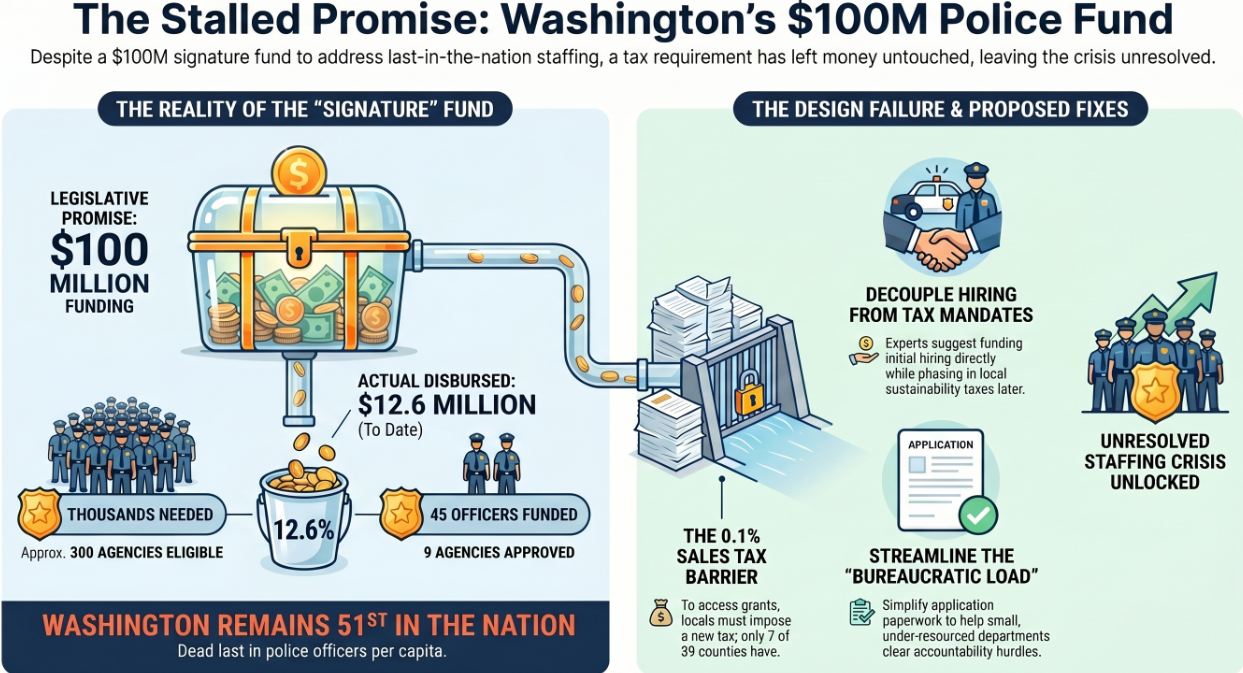
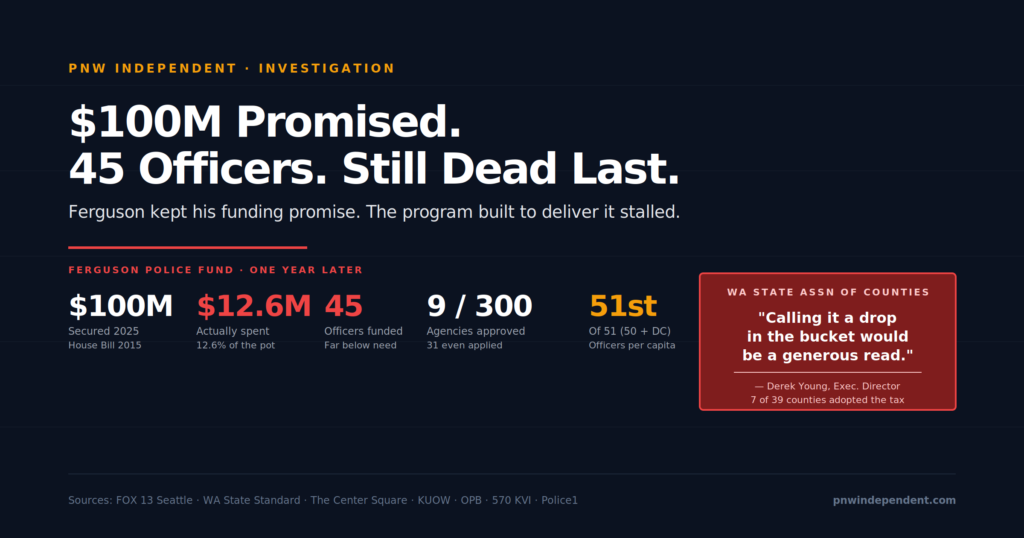
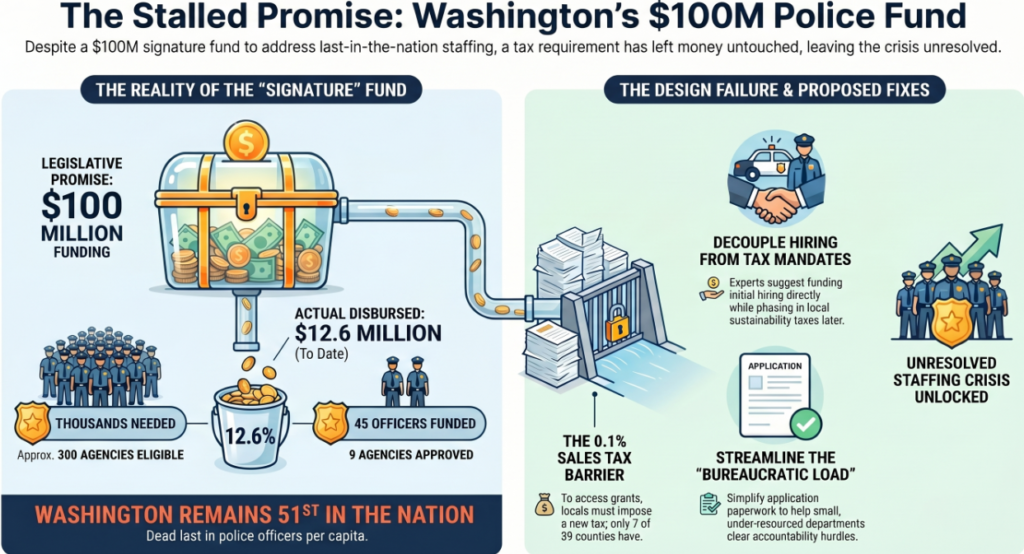
The problem is what happened next. Specifically, more than a year later, only about $12.6 million of the $100 million has been disbursed. Furthermore, just 9 of roughly 300 agencies have been approved, funding only 45 new officers out of the thousands needed. The Ferguson police fund stalled because of a single requirement: to access the grant, local governments must impose a 0.1% sales tax. Furthermore, only 7 of Washington’s 39 counties have adopted it. The money exists. The officers do not. The promise outran the design. Here is what the documents actually show.
What the Ferguson Police Fund Actually Promised
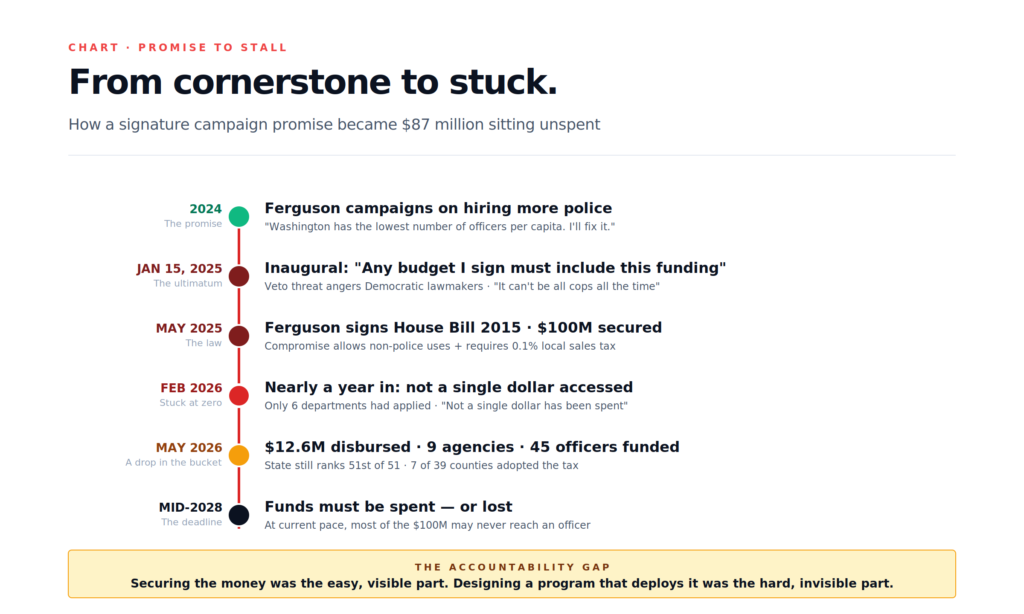
The fund began as a campaign promise. Specifically, during his 2024 run for governor, Bob Ferguson made public safety a top priority. Furthermore, he pointed to a stark statistic: Washington ranks last in the nation in police officers per capita.
The Campaign Cornerstone
Ferguson was explicit about the commitment. Specifically, in a campaign ad he said: “Washington has the lowest number of officers per capita of any state. That’s unacceptable. As governor, I’ll fix it.” Furthermore, he vowed to secure $100 million to hire more officers.
That promise became a defining feature of his campaign. Specifically, Ferguson made it a centerpiece of his 2024 run. Furthermore, he carried it directly into office. The Ferguson police fund was not a minor policy plank. It was a signature pledge.
The Inaugural Ultimatum
Ferguson reinforced the commitment on his first day in office. Specifically, in his January 15 inaugural address, he said: “That idea was a cornerstone of my campaign for governor. Any budget I sign must include this funding.” Furthermore, he vowed to veto any budget that did not include the $100 million.
That ultimatum angered many Democratic lawmakers. Specifically, progressives in his own party were skeptical of spending $100 million primarily on policing. Furthermore, the Legislative Black Caucus pushed back. Specifically, Rep. Kristine Reeves, D-Federal Way, said: “It can’t be all cops all the time.”
The Ranking That Drove It
The fund was built on a real problem. Specifically, the Washington Association of Sheriffs and Police Chiefs reports the state ranks 51st among the 50 states and the District of Columbia for officers per capita. Furthermore, that ranking is the lowest possible. Washington is genuinely last. The diagnosis was accurate even where the remedy faltered.
How the Ferguson Police Fund Became Law
The fund became law through House Bill 2015. Specifically, Rep. Debra Entenman, a Kent Democrat, sponsored the bill. Furthermore, Ferguson signed it in May 2025 after a contentious legislative session.
The Legislative Fight
The bill was a sore point all session long. Specifically, Ferguson’s veto threat forced the issue. Furthermore, the legislation evolved through many iterations as Democrats sought compromise. Specifically, the final bill passed 55-42 in the House and 30-19 in the Senate. Only five Republicans supported it.
That partisan math is notable. Specifically, the fund passed largely on Democratic votes despite Democratic skepticism. Furthermore, it embedded the grant program in a broad policy bill designed to let local and tribal governments decide how to use the dollars.
The Progressive Compromise
To win over skeptical progressives, lawmakers broadened the bill. Specifically, the money can be used for more than hiring officers. Furthermore, it can fund:
- Training for existing officers
- Mental health crisis responders
- Emergency management planning
- Community assistance programs
Therefore, the program is not strictly a police-hiring fund. Specifically, the bill allows spending “even if that means not hiring a single new cop.” Furthermore, that flexibility was the price of passage. The compromise that passed the bill also diluted its original purpose.
The Conditions Attached
The program came with significant conditions. Specifically, to access the grant, local governments must:
- Impose a 0.1% sales tax dedicated to public safety (or have an equivalent)
- Adopt model use-of-force policies
- Complete trauma-informed training for all officers
- Comply with limits on police assisting federal immigration enforcement
- Collect use-of-force data
Furthermore, those conditions reflect the progressive priorities built into the bill. Specifically, the requirements were meant to ensure accountability. However, they also created friction. Every condition added was a hurdle a small department had to clear.
Why the Ferguson Police Fund Has Barely Been Spent
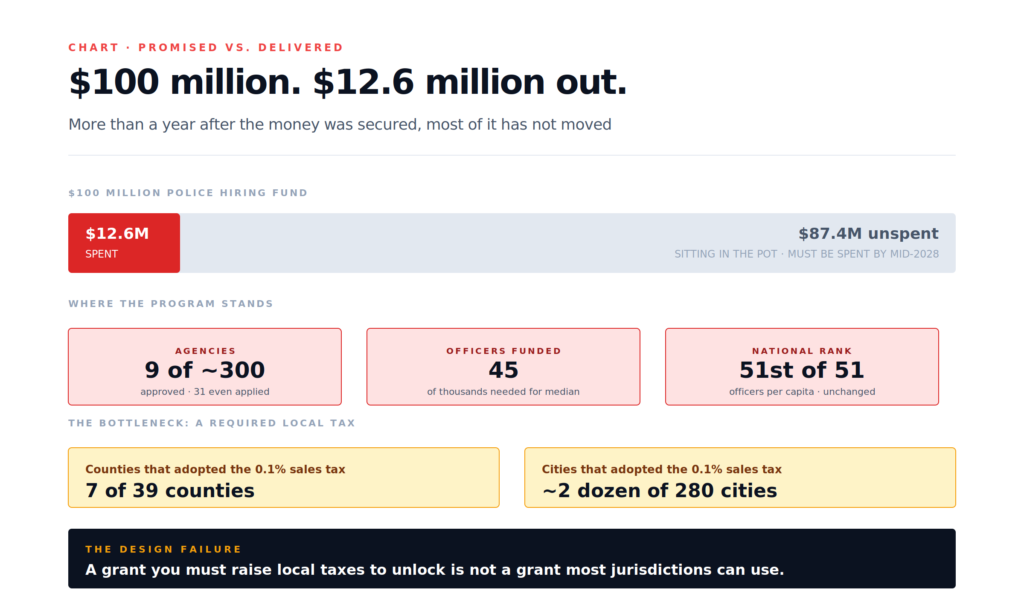
The fund has barely moved. Specifically, more than a year after the money was secured, only a fraction has reached agencies. Furthermore, the gap between the headline figure and the actual spending is stark.
The Spending Numbers
The numbers tell the story. Specifically, of the $100 million:
- $12.6 million has been disbursed so far
- 31 of roughly 300 agencies have applied
- 9 agencies have been approved
- 45 new officers funded — out of thousands needed to reach the national median
Therefore, the program has deployed roughly 12.6% of its money more than a year in. Furthermore, the officer count is a rounding error against the need. Forty-five officers does not move a state ranked 51st.
The “Drop in the Bucket”
Local officials are blunt about the shortfall. Specifically, Derek Young, Executive Director of the Washington State Association of Counties, said: “Calling it a drop in the bucket would be a generous read. It is nowhere near the level of need that our counties have just this last year.” Furthermore, Young noted many county budgets are in crisis.
That assessment matters. Specifically, the people closest to the problem say the Ferguson police fund is not meeting the need. Furthermore, the criticism comes from officials who credit Ferguson for prioritizing the issue. They support the goal. They fault the execution.
The Earlier Zero
The slow rollout was visible even earlier. Specifically, by late February 2026, not a single officer had been hired and not a single dollar accessed. Furthermore, Rep. Matt Marshall, R-Eatonville, said: “Not a single dollar has been spent of that money, despite agencies that have critical needs.” Specifically, only six departments had applied at that point. The program spent its first year stuck at zero.
How the Sales Tax Rule Broke the Ferguson Police Fund
The program stalled largely because of one requirement. Specifically, to access the grant, local governments must impose a 0.1% sales tax dedicated to public safety. Furthermore, that single condition created the central bottleneck.
The Tax Adoption Problem
The tax requirement has limited uptake dramatically. Specifically, only 7 of Washington’s 39 counties and approximately two dozen of its 280 cities have adopted the tax. Furthermore, that means the vast majority of jurisdictions cannot access the money.
That is the core design failure. Specifically, the program requires local governments to raise taxes before they can receive state money. Furthermore, many jurisdictions are unwilling or unable to do so. A grant you must raise taxes to unlock is not a grant most places can use.
The Long-Term Cost Trap
The tax requirement reflects a real fiscal concern. Specifically, the grant money is temporary, but salaries and benefits are permanent. Furthermore, local officials warned that temporary funds could help hire officers, but the long-term expense would fall on local budgets once grants expire.
Therefore, the sales tax was meant to create sustainable local funding. Specifically, it ensures jurisdictions can keep officers employed after the grant runs dry. However, it also means jurisdictions must commit to a permanent tax increase. The fix for sustainability became the barrier to access.
The Timing Problem
The tax requirement collides with broader fiscal pressure. Specifically, Derek Young noted: “That is another challenge — you have to be willing to increase taxes at a time when the legislature is increasing taxes in other places.” Furthermore, PNW Independent’s Moody’s downgrade investigation documented Washington’s fiscal strain. Asking local voters for new taxes during a statewide tax surge is a hard sell.
The Bureaucratic Load
Beyond the tax, the paperwork is heavy. Specifically, small departments struggle with the extensive training mandates and application requirements. Furthermore, both Young and law enforcement leaders credit Ferguson for prioritizing police hiring but say the strategy is “bogged down by bureaucracy.” Specifically, the conditions designed to ensure accountability also slow access. Accountability and accessibility ended up in tension.
How the Ferguson Police Fund Fits the Ferguson Accountability Pattern
The fund connects directly to PNW Independent’s ongoing Ferguson coverage. Furthermore, the connections reveal a consistent pattern. Specifically, the gap between Ferguson’s promises and their execution recurs across multiple stories.
Connection 1: The Ethics Pattern
PNW Independent’s Ferguson ethics investigation documented Ferguson’s ethics settlement and transparency concerns. Specifically, that piece established a pattern of gaps between Ferguson’s public posture and his actual conduct. Furthermore, the fund extends that pattern into policy execution. The promise was loud. The delivery was quiet.
Connection 2: The Sheriff Standards Connection
PNW Independent’s sheriff standards investigation documented the fight over law enforcement standards. Specifically, that piece dealt with who can serve as sheriff. Furthermore, the fund deals with whether there are enough officers at all. Specifically, both stories center on Washington’s law enforcement capacity. The state is fighting over standards while it cannot fill the ranks.
Connection 3: The Spending-Without-Results Pattern
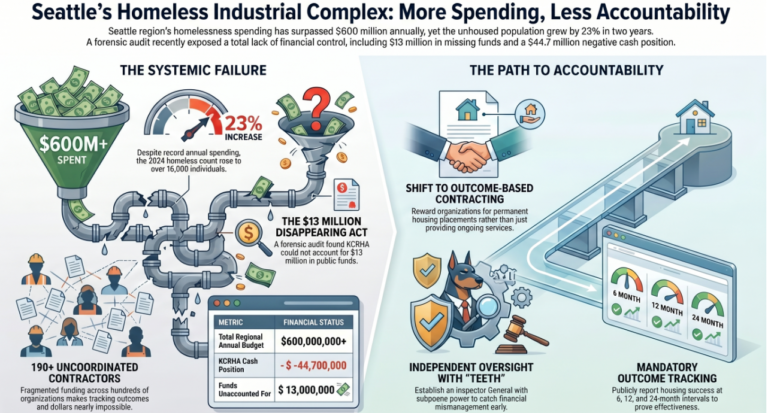
The fund mirrors a pattern across PNW Independent’s reporting. Specifically, the Seattle homeless industrial complex and Sound Transit shortfall both documented large sums failing to produce promised results. Furthermore, the fund is another instance. Money allocated is not money delivered. Results require execution, not announcements.
The Accountability Truth
The fund reveals an accountability truth. Specifically, securing funding is the easy, visible part. Furthermore, designing a program that actually deploys the funding is the hard, invisible part. Ferguson won the headline. The execution lost the plot.
What Should Happen Next on the Ferguson Police Fund
The fund requires structural fixes. Furthermore, several specific changes could unlock the money. Specifically, each addresses a documented barrier.
1. Reconsider the Sales Tax Requirement
The single biggest fix is the tax requirement. Specifically, the state should consider whether the 0.1% sales tax mandate is the right gatekeeper. Furthermore, alternatives could include a phased sustainability plan rather than an upfront tax. If only 7 of 39 counties can clear the bar, the bar is in the wrong place.
2. Streamline the Application Process
The bureaucratic load needs reduction. Specifically, small departments lack the staff to navigate extensive paperwork. Furthermore, the state could provide application assistance, simplified forms, or technical support. Specifically, the Criminal Justice Training Commission could deploy staff to help under-resourced agencies apply.
3. Provide Transparent Progress Reporting
The program needs transparent reporting. Specifically, the state should publish a public dashboard showing:
- Dollars disbursed versus dollars available
- Agencies applied, approved, and denied
- Officers actually hired
- Reasons applications fail
Furthermore, that transparency would let voters track whether the program works. You cannot fix what you do not measure.
4. Decouple Hiring From the Tax
The fund could separate hiring grants from the tax requirement. Specifically, the state could fund initial hiring directly while phasing in local sustainability funding over several years. Furthermore, that would let agencies hire now and build sustainable funding gradually.
5. Honest Public Recalibration
Ferguson should communicate honestly about the gap. Specifically, the administration should acknowledge that the rollout has fallen short of the promise. Furthermore, it should publish a realistic timeline for deploying the remaining funds. Voters can accept a slow start. They cannot accept claims that contradict the spending numbers.
6. Independent Performance Review
The program warrants independent review. Specifically, the Washington State Auditor should examine why the program stalled. Furthermore, PNW Independent’s King County DCHS investigation documented the value of independent oversight. Specifically, an audit could identify whether the barriers are fixable or fundamental.
The Bottom Line on the Ferguson Police Fund
What the Ferguson Police Fund Actually Delivered
The fund delivered a headline and a fraction of its promise. Specifically, Ferguson secured the $100 million he campaigned on. Furthermore, more than a year later, only $12.6 million has been spent and just 45 officers funded. The money was secured. The officers were not hired. The state remains dead last.
That outcome reflects a design failure, not a funding failure. Specifically, the money exists. Furthermore, the conditions attached to accessing it — especially the 0.1% sales tax — have blocked most jurisdictions from using it. The fund works on paper. It fails on the ground.
Why the Promise Outran the Design
The fund shows the gap between political promises and program design. Specifically, Ferguson made a clear, popular promise and kept the funding portion. Furthermore, the program built to deliver that promise was compromised by competing priorities and burdened by conditions.
Therefore, the headline was achieved while the goal was not. Specifically, the compromise that passed the bill — allowing non-police uses and requiring local taxes — diluted its effectiveness. A promise is a sentence. A working program is a system. The two are not the same.
What This Means for Washington Voters
The fund matters for every Washington voter. Specifically, voters were promised more officers in a state ranked dead last. Furthermore, the program meant to deliver them has barely functioned. Specifically, the accountability question is whether Ferguson will fix the design or let the money sit.
The practical takeaway is clear. Specifically, voters should demand transparent reporting, a reconsidered tax requirement, and a realistic timeline. Furthermore, the money is already allocated — the question is whether it ever reaches the street. Allocated and delivered are not the same thing.
The Structural Question
The deepest issue raised by the fund is structural. Specifically, can a program survive the compromises required to pass it? Furthermore, that question extends beyond policing. Specifically, it applies to every program where the deal needed for passage undermines the goal of the program.
The answer requires honesty about tradeoffs. Specifically, the conditions that won progressive votes also blocked the money. Furthermore, the tax requirement that ensured sustainability also ensured most places could not access funds. Until the design matches the goal, the money will keep sitting.
For Washington readers, the Ferguson police fund is not abstract. It is the $100 million you were told would put more officers on your streets. Furthermore, the documentation is now public — the $12.6 million spent, the 45 officers, the 7 of 39 counties. The accountability questions write themselves.
The clock is running. The funds must be spent by mid-2028. At the current pace, most of the $100 million may never reach an officer at all — and a state ranked 51st will stay exactly where it started, with a kept promise that changed nothing.
Related Reading on PNW Independent
- Ferguson Ethics: How Brutal Failures Exposed Olympia’s Crisis
- Washington Sheriff Standards: How a Brutal Court Ruling Exposed Police Crisis
- Sound Transit Shortfall: A Brutal $34B Gap
- Who Really Runs Seattle: Two Machines, One Ruling Class
External Sources
- FOX 13 Seattle — Gov. Ferguson’s push to lift WA police numbers out of last place
- Washington State Standard — No cops hired so far with WA’s new $100M grant program
- Washington State Standard — New Washington law directs $100M in grants toward hiring police
- The Center Square — Slow rollout: Washington’s $100M police grant remains untouched
- KUOW — First grants awarded under Washington’s new $100M police hiring program
- OPB — $100M plan for police hiring gets greenlight from Washington House
- 570 KVI — 1 year later but no cops hired under Ferguson’s $100M grant program
- Police1 — Wash. governor OKs $100M grants to boost police recruitment