Black Panther Park Skyway: The Taxpayer-Funded Double Standard
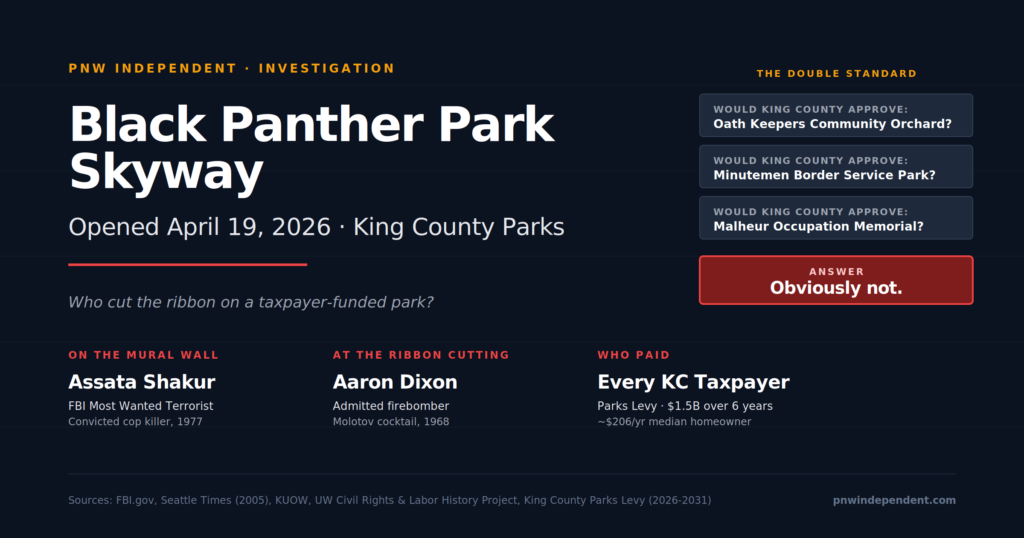
On April 19, 2026, King County Parks cut the ribbon on Black Panther Park Skyway — a public park at Renton Avenue South and 75th Avenue South dedicated to the legacy of the Black Panther Party. The project was funded through the King County Parks Levy, a property tax every county homeowner pays. One of the nine murals depicts Assata Shakur, a convicted cop killer and the first woman ever placed on the FBI Most Wanted Terrorists list. The ribbon was cut by Aaron Dixon, a man who has publicly admitted to firebombing a Seattle real estate office with a Molotov cocktail. This is an investigative look at the Black Panther Park Skyway project — who built it, who paid for it, and why no comparable park exists for any white, conservative, or right-wing group with a remotely similar record of violence against law enforcement.
What Is Black Panther Park Skyway?
Black Panther Park Skyway is a small public park built on the corner of Renton Avenue South and 75th Avenue South in unincorporated King County, Washington. According to the Renton Reporter and Seattle Medium, the park opened officially on April 19, 2026, after roughly a decade of planning. Furthermore, it was built through a partnership between King County Parks, Nurturing Roots (a Seattle nonprofit run by founder Nyema Clark), and Stone Soup Gardens (a Seattle landscaping firm).
The park features nine murals by local artists, a “Power Fist” painted on a concrete patio, raised beds of fruits and vegetables, a community food pantry, a lending library, and a metal statue inspired by the Black Panther Party logo. Additionally, Nurturing Roots has a five-year maintenance contract for the site.
The ribbon cutting was attended by:
- King County Councilmember Rhonda Lewis
- Aaron Dixon, co-founder of the Seattle Black Panther Party
- Elmer Dixon, co-founder of the Seattle Black Panther Party
- Larry Gossett, longtime Seattle political figure and former King County Councilmember
Who Paid for Black Panther Park Skyway?
The short answer: every property taxpayer in King County.
King County Parks operates primarily on revenue from the King County Parks Levy, a property tax measure renewed by voters every six years. In August 2025, voters approved the 2026-2031 Parks Levy, which King County Parks describes as funding roughly 85 percent of the county parks total budget. The levy is projected to generate an estimated $1.5 billion over six years starting January 1, 2026. The median King County homeowner pays about $206 per year in Parks Levy taxes.
In other words, this park was not built with Black Panther Party alumni donations, private foundation money, or community fundraising alone. Rather, it was built with public land and a public-dollar partnership. Every property owner in King County — regardless of race, political belief, or opinion about the Black Panther Party — helped pay for Black Panther Park Skyway through the property tax they cannot opt out of.
That distinction matters. And it’s the foundation of the double standard we’re about to examine.
The Double Standard at the Center of Black Panther Park Skyway
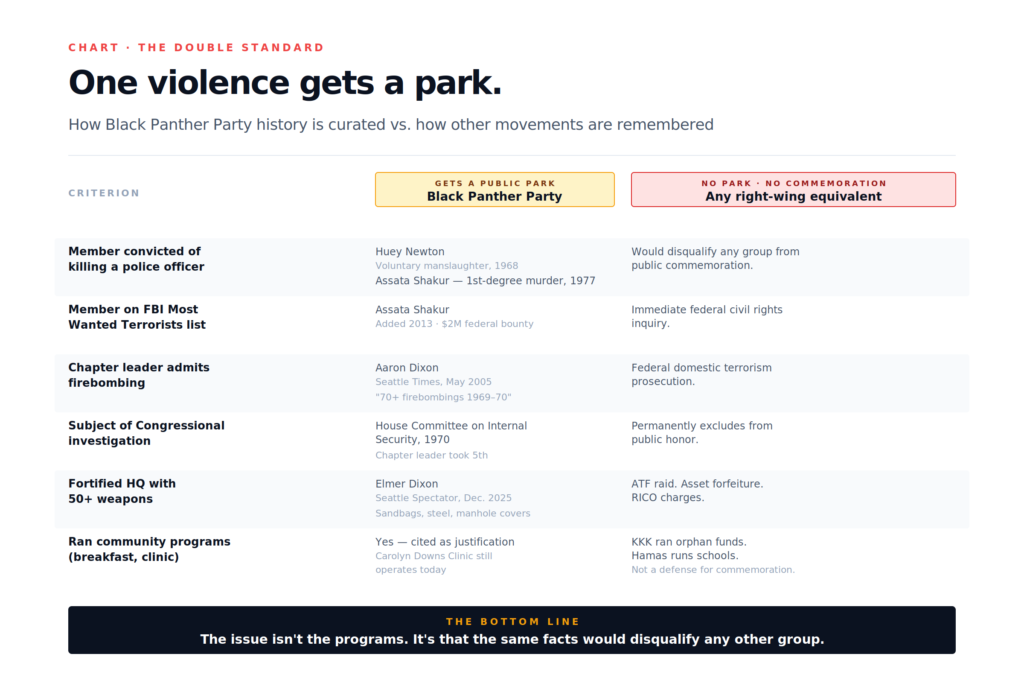
The stated purpose of Black Panther Park Skyway, according to Nurturing Roots and the park’s own branding, is to honor the Black Panther Party’s “People’s Free Food Program,” free medical clinics, and community programs. Those programs are real. Nobody serious disputes them.
However, the Black Panther Party was not just a breakfast program. The Party was also a Marxist-Leninist revolutionary organization whose members were convicted of shooting police officers, whose national leaders oversaw internal purges and violence, and whose Seattle chapter, according to its own co-founder Aaron Dixon, participated in firebombings of businesses and shootings at police and fire stations.
That’s not a Fox News talking point. That’s Aaron Dixon’s own words in the Seattle Times, his own admission to the Seattle Weekly, and the documented record from the 1970 Congressional investigation into the Seattle chapter.
Here’s the question the Black Panther Park Skyway project forces us to ask, and the question King County Parks has not answered:
Would King County Parks dedicate a publicly funded park to any other group with a comparable history of violence against police officers and attacks on the state?
Would there be a John Birch Society Park in Bellevue for their “community self-reliance” programs? A Minutemen Park in Federal Way for “border community service”? A Ruby Ridge Memorial Garden? A Malheur Occupation Historic Site for “protest against federal land management”? An Oath Keepers Community Orchard?
The answer is self-evidently no. Therefore, the issue is not whether the Panthers had community programs. Every extremist movement in American history had community programs — that’s how they recruited. Instead, the issue is whether King County applies the same standard to every group, or whether one ideology gets murals and a publicly funded park while another gets a federal investigation.
The Assata Shakur Problem at Black Panther Park Skyway
Let’s start with the most specific, most documented problem. And it’s the one the park’s own curators made for themselves.
One of the nine murals at Black Panther Park Skyway — painted by incarcerated artist Tomas Afeworki — depicts Assata Shakur. The park’s partner publications have confirmed this. According to the South Seattle Emerald’s original reporting on the park, Afeworki’s mural is “of Black Panther Party founding member Assata Shakur.”
Who Is Assata Shakur?
Assata Shakur, born JoAnne Deborah Byron and also known as Joanne Chesimard, was a member of the Black Panther Party and later the Black Liberation Army. On May 2, 1973, she was in a car stopped by New Jersey State Trooper James Harper on the New Jersey Turnpike. During the traffic stop, a shootout began. When the gunfire stopped, State Trooper Werner Foerster was dead. He was shot at close range with his own service weapon. He left behind a wife and a three-year-old son.
In 1977, Shakur was tried and convicted of first-degree murder in Foerster’s death, along with armed robbery, assault, and other charges. She was sentenced to life in prison plus 26 to 33 years.
In 1979, members of the Black Liberation Army helped Shakur escape from Clinton Correctional Facility in New Jersey. She fled to Cuba, where Fidel Castro granted her political asylum in 1984. She lived there until her death on September 25, 2025.
In May 2013, the FBI added Shakur to its Most Wanted Terrorists list. She was the first woman ever placed on that list. Her name sat beside Taliban commanders and Hezbollah leaders. The FBI offered a $1 million reward. The New Jersey Attorney General added another $1 million. In total, $2 million was offered for her capture. New Jersey Attorney General Gurbir Grewal called her “a domestic terrorist and nothing more.” The bounty was never collected.
Yes — there is a real debate about whether her trial was fair. Yes — COINTELPRO was real, and the FBI’s abuses in the 1960s and 1970s are documented. None of that changes the legal record. A jury convicted her. The conviction was upheld on appeal. The FBI designated her a terrorist. She died a fugitive with a federal bounty on her head.
Why the Mural Matters
In April 2026, less than seven months after Assata Shakur’s death, King County Parks cut the ribbon on a publicly funded park featuring her portrait on the wall. Stop and think about what that means.
Consider the parallel. If a county in another state opened a park featuring a mural of Timothy McVeigh, or Eric Rudolph (the Atlanta Olympic Park bomber), or any member of any right-wing militia convicted of killing federal officers, there would be national news coverage, federal civil rights inquiries, and resignations. The governor would intervene within 48 hours.
Meanwhile, Black Panther Park Skyway gets glowing coverage in the Renton Reporter, the Kent Reporter, the Seattle Medium, and the South Seattle Emerald. No King County official has publicly addressed the Shakur mural. Additionally, no reporter at the ribbon cutting asked Aaron Dixon or Elmer Dixon about it. This silence is the double standard.
The Aaron Dixon Firebombing Admission
The man who cut the ribbon at Black Panther Park Skyway is Aaron Dixon. He co-founded the Seattle chapter of the Black Panther Party in 1968 when he was 19 years old. Furthermore, he served as the chapter’s captain from 1968 to 1972. Today, he runs a nonprofit called Central House that provides transitional housing to homeless young adults. Most people covering the ribbon cutting mentioned the second fact and not the first.
What Aaron Dixon Did in 1968
Here is what Aaron Dixon himself has said on the record, not what his critics say about him:
In a May 2005 Seattle Times interview marking the first Seattle Black Panther Party reunion, reporter Danny Westneat walked Dixon through the Central District. Specifically, they stopped on 34th Avenue in front of what was then a real estate office. Westneat wrote: “Thirty-seven years ago, it was a real-estate office, and he firebombed it with a Molotov cocktail.”
That sentence is not an accusation by a critic. Instead, it is a factual statement based on Dixon’s own admission to a reporter, while standing on the sidewalk in front of the target.
Additionally, Dixon has publicly acknowledged the broader pattern in the same Seattle Times article. The paper wrote: “in their early months, Black Panthers did commit sporadic arsons and fired weapons at police and fire stations, acknowledges former party captain Aaron Dixon.” Dixon described these as “ambushes” in response to government violence.
KUOW, the NPR affiliate in Seattle, reported that congressional records document more than 70 firebombings in Seattle between 1969 and 1970. In that KUOW story, Elmer Dixon conceded: “I won’t say that there weren’t probably some Panthers that were involved in that. Because it was hard to control 300 to 400 Panthers.”
The Fortified Headquarters
In a separate Seattle Times story from the same reunion weekend, Elmer Dixon — the other co-founder who attended the Black Panther Park Skyway ribbon cutting — described reinforcing a house at 20th Avenue and Spruce Street with steel, sandbags, and manhole covers to make it impregnable. “The cops were shocked,” Dixon told the audience at Garfield High School. “Our body armor was better than theirs.”
In a December 2025 interview with the Seattle Spectator, Elmer Dixon described the Seattle chapter’s armaments in plain language: “We had gunclaps. We had thousands of rounds of ammunition, 50 or 60 weapons, so that we could defend our headquarters.”
This is the person King County Parks invited to cut the ribbon on a taxpayer-funded park in April 2026. To be clear: neither Dixon brother has been convicted of any violent offense. Furthermore, both have had meaningful post-Panther careers — Aaron in youth housing, Elmer as a diversity consultant. That is not in dispute. What is in dispute is whether a publicly funded park should be dedicated to the organization they led when it was, by their own admission, firebombing buildings and stockpiling weapons.
Huey Newton and the Origin Story Black Panther Park Skyway Omits
Huey Newton co-founded the Black Panther Party with Bobby Seale in Oakland in 1966. Therefore, he is the organization being commemorated in Skyway. Here is the record the Black Panther Park Skyway project does not put on its signage.
The Shooting of Officer John Frey
On October 28, 1967, Oakland Police Officer John Frey pulled over a vehicle driven by Huey Newton in the early morning hours. A second officer, Herbert Heanes, arrived as backup. Within minutes, all three men had been shot. Frey was shot four times and died. Heanes was left in serious condition with three bullet wounds. Newton was shot in the abdomen and survived.
In September 1968, Newton was convicted of voluntary manslaughter in Frey’s death and sentenced to 2 to 15 years in prison. The conviction was later reversed on appeal due to a jury instruction error. Two subsequent retrials ended in hung juries, and the charge was eventually dismissed. However, the legal reversal was procedural, not an acquittal on the facts. Furthermore, a bus driver eyewitness testified that Newton shot Frey with Frey’s own gun as they wrestled.
Newton’s Other Legal Record
Prior to the Frey shooting, Newton had been convicted of assault with a deadly weapon in 1964 for repeatedly stabbing another man, Odell Lee, with a steak knife. He served six months in prison.
In 1978, Newton was convicted of possessing an illegal weapon but acquitted of assault after allegedly pistol-whipping his tailor. In 1979, charges against him for the murder of a prostitute, Kathleen Smith, were dismissed after two mistrials. In 1989, he pleaded no contest to misappropriating $15,000 from a public grant to a Black Panther Party-operated school. He was sentenced to six months in jail and 18 months probation.
On August 22, 1989, Newton was shot to death by an Oakland drug dealer over what was reportedly a disputed cocaine purchase.
Why This Matters for Black Panther Park Skyway
The park claims to honor a movement. Consequently, honest commemoration requires acknowledging that the movement’s founder was twice tried for killing a police officer, was convicted of voluntary manslaughter before the retrials, pleaded no contest to embezzling state funds from the organization’s own school, and died in a drug-dealer dispute.
None of that appears on the park’s signage. None of it was mentioned at the ribbon cutting. Furthermore, it will not appear on any mural, plaque, or interpretive sign. This is not commemoration. Rather, it is marketing.
The 1970 Congressional Investigation into the Seattle Chapter
The Seattle chapter of the Black Panther Party — the specific chapter now being honored at Black Panther Park Skyway — was the subject of a full-scale Congressional investigation in 1970. The House Committee on Internal Security opened hearings on May 12, 1970, with the Seattle chapter as a primary focus.
According to the University of Washington’s Seattle Civil Rights and Labor History Project, which archives the complete hearing record, the testimony included:
- Archie J. Porter, Seattle Police Sergeant, on the chapter’s activities (May 12, 1970)
- Stanley K. Fridell, Seattle Police Intelligence Division detective, on surveillance findings (May 13, 1970)
- Elmer James Dixon III — the same Elmer Dixon at the ribbon cutting — who refused to testify and invoked the Fifth Amendment (May 14, 1970)
- An undercover agent who had been embedded as a member of the Seattle BPP for eighteen months and testified in secret
The undercover testimony and police intelligence documented in those hearings remain part of the public record. It is the part of Seattle Black Panther Party history that gets the least attention in the coverage of Black Panther Park Skyway, despite being the most extensively documented.
The “Community Programs” Defense
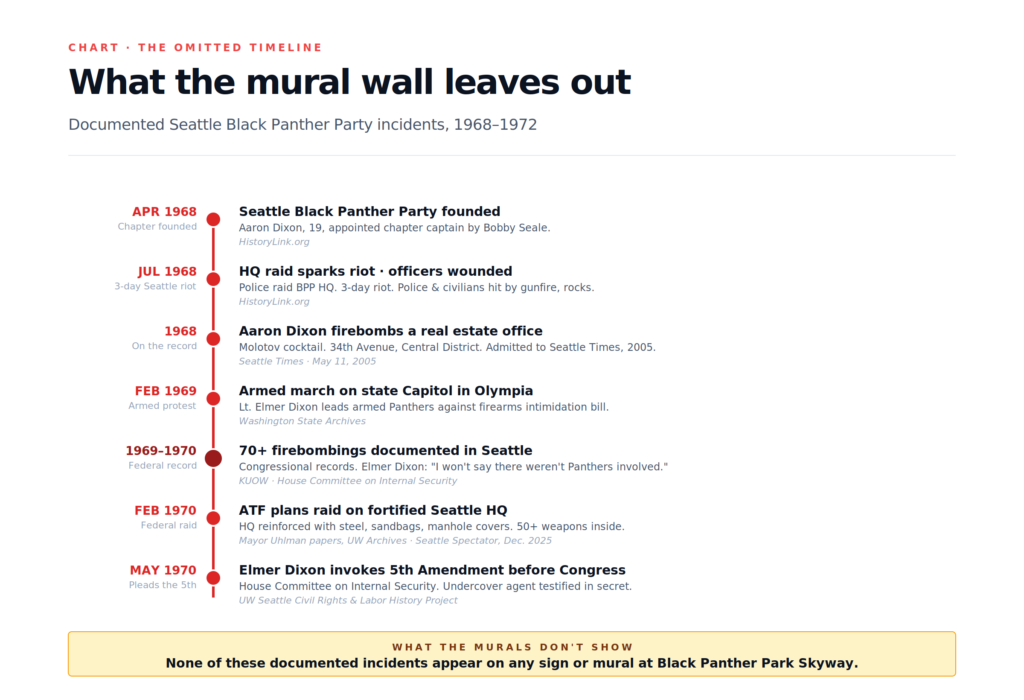
Here is the most common defense of Black Panther Park Skyway, offered repeatedly in the Renton Reporter, Seattle Medium, and South Seattle Emerald coverage. The Panthers ran free breakfast programs. They opened free medical clinics. The Carolyn Downs Family Medical Center in Seattle still operates today and traces its lineage back to the Panthers. That’s true. Nobody disputes it.
But this defense proves too much. Consider:
- The Ku Klux Klan ran burial societies, orphan funds, and widow support networks throughout the early 20th century.
- The Communist Party USA ran unemployment councils, rent strikes, and food relief programs during the Depression.
- Hamas runs schools, hospitals, and social services in Gaza.
- The Mafia ran soup kitchens during Prohibition.
- Even the Nation of Islam ran drug rehabilitation programs that had real success rates.
Nobody would accept “but they ran community programs” as a justification for a publicly funded Hamas Park. Nobody would accept it for a Klan memorial garden. Therefore, the argument only works when it’s applied selectively — and selectivity is another word for double standard.
The Black Panther Party’s breakfast program fed children. That’s good. The Party also harbored members who shot police officers, engaged in internal violence, and by the Seattle captain’s own admission firebombed businesses in his own community. Additionally, the Party’s founder had a life-long pattern of violent charges and convictions. A commemoration that presents the first half and omits the second is not history. It’s hagiography.
What Black Panther Park Skyway Says About King County
King County Parks had options. Many options. Skyway is, by the county’s own admission, one of the most under-resourced neighborhoods in the county — King County Executive Dow Constantine’s own parks levy rollout noted that Skyway lacked a community center, sidewalks, and gathering spaces for decades. The neighborhood deserves investment.
However, King County chose to place its public investment in this specific commemoration. Consider the options the county had, and passed over:
- A park honoring Martin Luther King Jr., whose philosophy of nonviolent direct action is uncontroversial across the political spectrum.
- A park honoring Edwin T. Pratt, the Seattle Urban League director assassinated in 1969 — an actual martyr of the civil rights era, not a figure associated with armed revolution.
- A park honoring Senator Warren G. Magnuson or other Washington civil rights legislators.
- A park honoring the Filipino Cannery Workers Union and Silme Domingo and Gene Viernes.
- A simple community garden named for the Skyway neighborhood itself, without political framing.
Any of these would have served the same community purpose — green space, food access, mural art, a community pantry — without the controversy, the FBI Most Wanted Terrorist mural, and the Fifth-Amendment-invoking former captain at the podium. The fact that King County chose the option with maximum political edge and minimum political balance tells you everything about whose concerns the agency weighs and whose it ignores.
The Media Response to Black Panther Park Skyway
Here is the entire local media coverage of Black Panther Park Skyway as of April 24, 2026:
- South Seattle Emerald (March 16, 2026): glowing feature on the mural unveiling, no mention of Shakur’s FBI designation or any criminal history.
- Renton Reporter (April 20, 2026): ribbon-cutting story, describes the park as “a living tribute to resilience, learning, and collective healing.”
- Kent Reporter (April 22, 2026): same story, same framing.
- Seattle Medium (April 2026): feature interview with organizers celebrating the opening.
- The Facts Newspaper (January 15, 2026): progress update.
- Seattle Spectator (March 4, 2026): interview with the Dixon brothers about their new Interpretive Center.
Zero of these stories asks who Assata Shakur was. Zero ask about Aaron Dixon’s firebombing admission. Additionally, zero ask why King County Parks is funding this particular commemoration with levy dollars. Zero ask whether any conservative or right-wing figure would receive the same treatment.
This is what a double standard looks like in practice. It’s not a law. It’s not a policy. Rather, it’s a set of questions journalists know to ask about some groups and know not to ask about others.
What Should Happen Next
This is not an argument for tearing down Black Panther Park Skyway. Public art, even controversial public art, has a place. However, this is an argument for consistency, disclosure, and accountability. Specifically:
1. Full Public Disclosure
King County Parks should publish the complete funding breakdown for Black Panther Park Skyway — how much came from the Parks Levy, how much from the Capital and Open Space Grant, how much from private and foundation sources, and the full dollar value of the Nurturing Roots five-year maintenance contract.
2. Honest Interpretive Signage
If the park commemorates the Black Panther Party, the signage should note the Party’s full record. It should mention Huey Newton’s manslaughter conviction, the Seattle chapter’s firebombings, Assata Shakur’s conviction and FBI Most Wanted Terrorist designation, and the 1970 Congressional hearings. Furthermore, visitors deserve accurate history, not curated history.
3. Equal Treatment Standard
King County Parks should publicly articulate its standard for dedicating public parks to historical political movements. Specifically, the agency should explain what criteria it would apply to a proposal for a park honoring any other movement associated with violence against law enforcement. If the answer is “we would not approve such a park,” the county owes the public an explanation for why this one was approved.
4. A Media That Asks the Question
Local outlets that covered the ribbon cutting owe their readers a follow-up. Specifically, they owe one that includes the Assata Shakur mural, Aaron Dixon’s firebombing admission, and the 1970 Congressional record. Journalism that covers only half of a story is not journalism.
The Bottom Line on Black Panther Park Skyway
Black Panther Park Skyway is not evil. It is not a scandal of graft or corruption. Rather, it is a monument to a double standard — the idea that some political violence becomes art when enough time passes and the ideology is sympathetic, while other political violence remains forever a disqualifying stain no matter how much time passes and regardless of what community programs ran alongside it.
King County taxpayers paid for this park. They will pay for its upkeep through 2031 under the current parks levy. They deserve to know what they paid for. Furthermore, they deserve a county government that applies the same moral framework to every group, not one that reserves its most generous interpretations for the ideologies it prefers.
One political violence gets a park. Another political violence gets a federal monument — of the kind you visit to remember what not to repeat. The difference between the two is not what the groups actually did. The difference is who is doing the remembering.
That is the double standard at the center of Black Panther Park Skyway. It is also the double standard at the center of almost every other commemorative decision being made in American public life right now. The first step to ending it is naming it.
Related Reading on PNW Independent
- The Portland Homeless Industrial Complex: Inside the $700M Machine
- King County Parks Levy: Where the $1.5 Billion Actually Goes
- Seattle’s Political Monoculture: A Guide to the One-Party City
- Who Decides What Gets Commemorated in Washington State?
External Sources
- Renton Reporter — Park dedicated to Black Panther Party opens in Skyway (April 20, 2026)
- Seattle Medium — New Park Honors Legacy Of Seattle’s Black Panther Party
- South Seattle Emerald — Murals and Memories (March 16, 2026)
- FBI — Joanne Chesimard Added to Most Wanted Terrorists List
- Seattle Times — Reunion of Black Panthers stirs memories of aggression, activism (2005)
- KUOW — These Black Panthers marched on Seattle streets 50 years ago
- UW Seattle Civil Rights and Labor History Project — BPP 1970 Congressional Hearings
- HistoryLink — Black Panther Party Seattle Chapter (1968-1978)
- King County Parks Levy — Official page
- People v. Newton (California Court of Appeal, 1970)
- Nurturing Roots — BPP Skyway project page