How to Fix the Massive Let’s Go Washington PDC Loophole
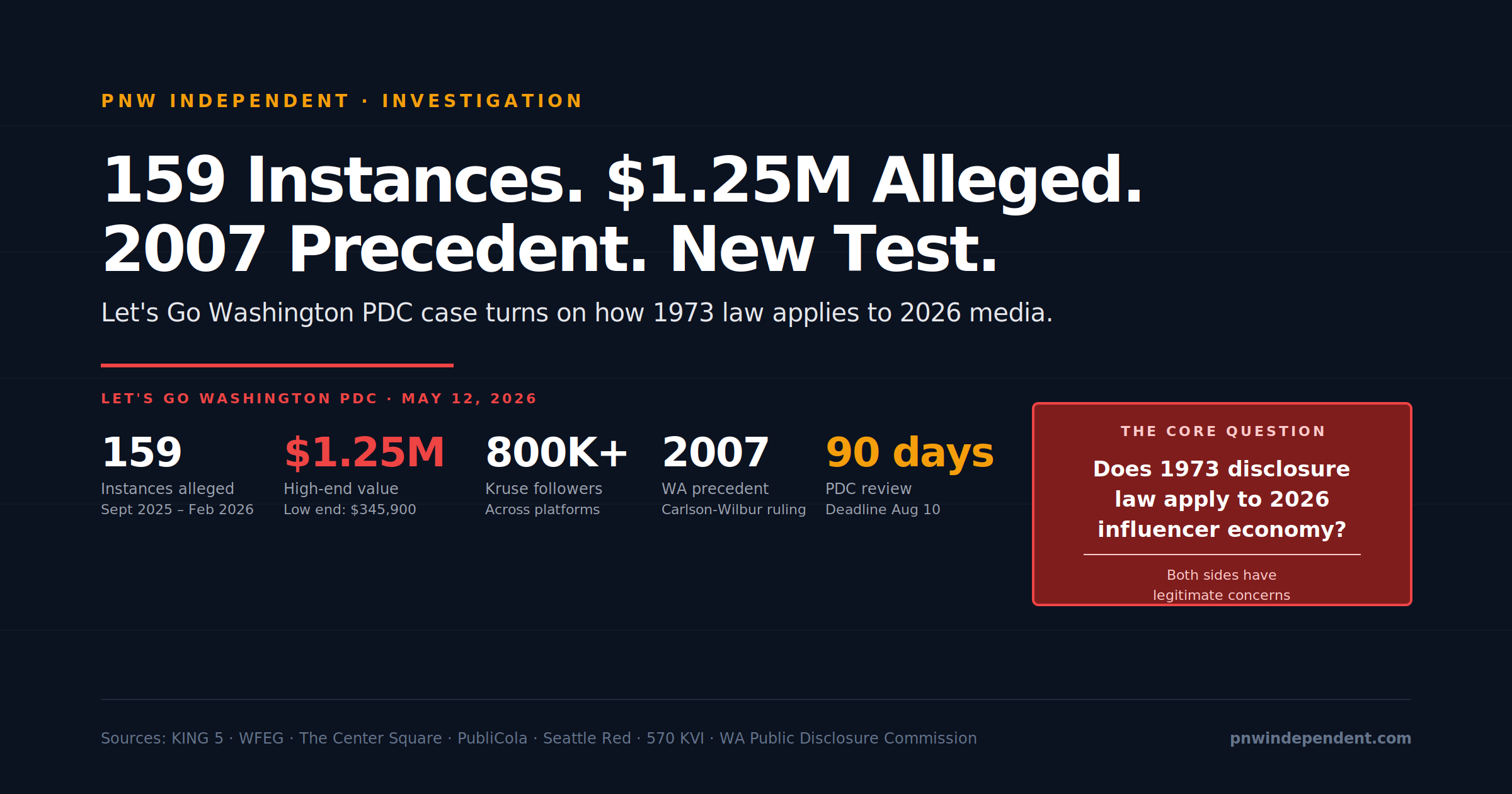
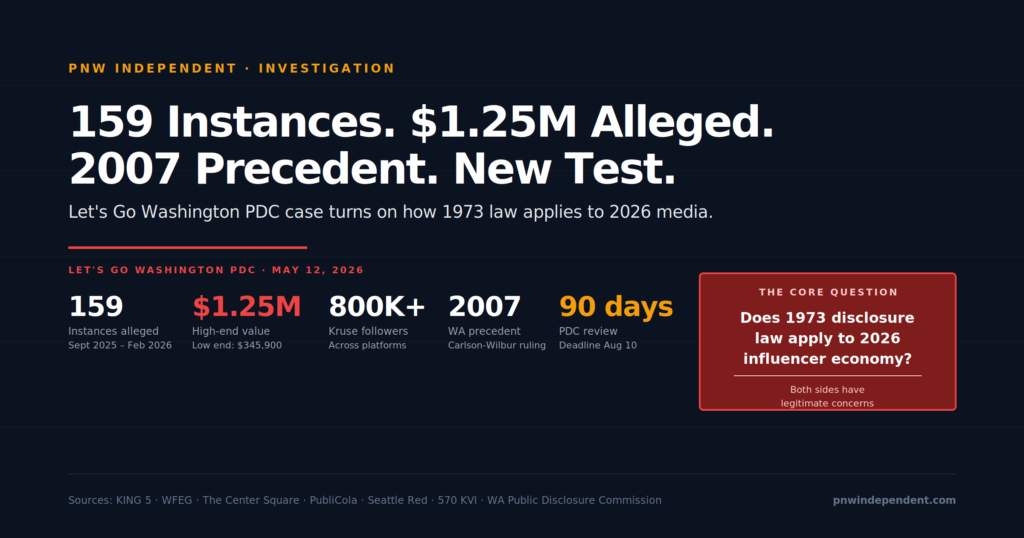
The Let’s Go Washington PDC complaint filed May 12, 2026 alleges that Brian Heywood’s political committee failed to report 159 instances of political content by influencer Brandi Kruse as in-kind contributions. Furthermore, the complaint values those contributions between $345,900 and $1.25 million. The complaint was filed by Washingtonians for Ethical Government (WFEG) — a group with documented ties to public-sector unions opposing Let’s Go Washington initiatives.
The Let’s Go Washington PDC case turns on a single legal question. Specifically, does Washington’s “news or feature reporting” exemption in RCW 42.17A.610(3) apply to a podcaster with 800,000 followers who sells commercial advertising? A 2007 Washington Supreme Court ruling in the John Carlson and Kirby Wilbur case said yes for talk-radio hosts. The PDC has 90 days to decide whether 2026’s influencer economy is different enough to warrant new review. Both sides have legitimate concerns. The structural question is bigger than the partisan fight. Here is what the documents actually show.
What the Let’s Go Washington PDC Complaint Actually Alleges
The Let’s Go Washington PDC complaint runs 24 pages. WFEG filed it with the Washington State Public Disclosure Commission on May 12, 2026. Furthermore, the complaint focuses on a specific allegation: Brandi Kruse provided substantial promotional content for two Let’s Go Washington initiatives without that content being reported as a campaign expense or in-kind contribution.
The 159 Instances
The complaint identifies at least 159 instances of content across:
- Kruse’s UnDivided podcast
- Her YouTube channel
- Her Facebook page
- Her Instagram account
Furthermore, the content ran from September 2025 through February 2026. The complaint argues each instance was, in effect, paid political advertising. Specifically, WFEG calculates the cumulative market value at $345,900 to $1.25 million based on estimated ad rates for similar reach.
The Two Initiatives at Stake
The Let’s Go Washington PDC complaint focuses on two 2026 ballot initiatives:
- IL26-001 — Restores parental notification rights in public schools
- IL26-638 — Restricts participation in girls’ sports to students who are biologically female
Therefore, the complaint isn’t abstract. Both initiatives are highly contested politically. Furthermore, both are backed financially by hedge-fund founder Brian Heywood, who has funded Let’s Go Washington since its 2022 formation.
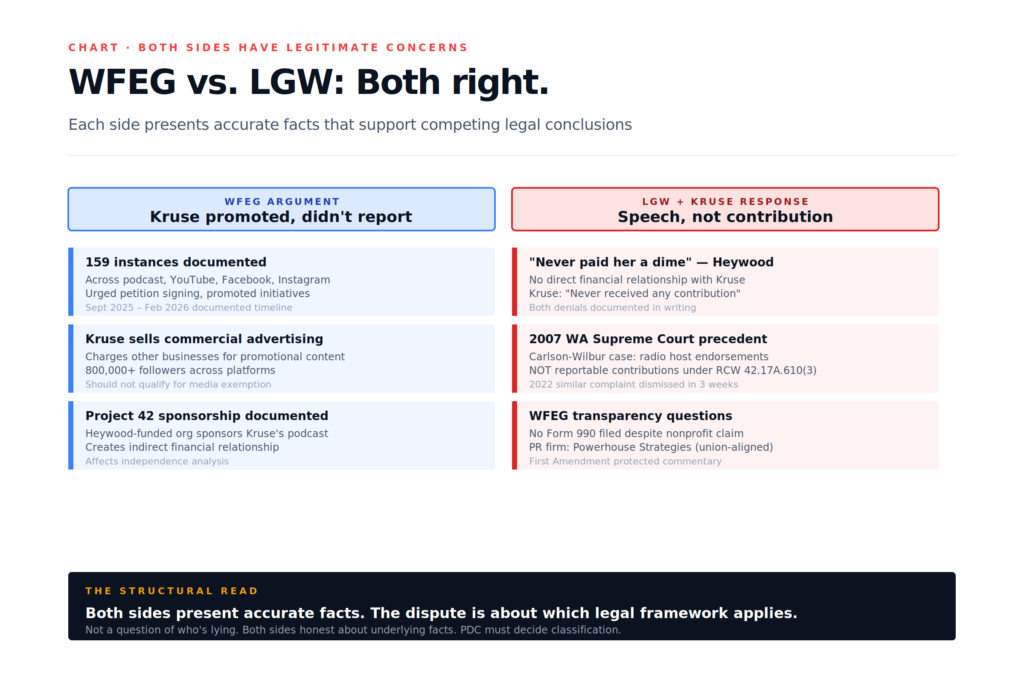
What WFEG Argues
The Let’s Go Washington PDC complaint makes a specific legal argument. Specifically, WFEG argues:
- Kruse’s content urged people to sign initiative petitions
- Kruse’s content promoted support for the measures
- Kruse’s content criticized groups opposed to the initiatives
- Kruse sells advertising on her platforms to other businesses
- Kruse has more than 800,000 followers across her platforms
- Therefore, Kruse should not qualify for the news exemption
The Valuation Methodology
The $345,900 to $1.25 million estimate uses standard influencer-advertising metrics. Furthermore, WFEG calculated by applying typical podcast ad rates to Kruse’s audience size across 159 instances. The methodology is contestable but not unreasonable. Specifically, Kruse charges other businesses for promotional content. WFEG argues the political content should be valued at comparable rates.
How the Let’s Go Washington PDC Complaint Connects to the 2007 Precedent
The Let’s Go Washington PDC complaint runs into a 2007 Washington Supreme Court ruling head-on. Furthermore, that ruling is the central legal precedent. Specifically, it shapes how Washington has handled similar disclosure questions for nearly 20 years.
The Carlson and Wilbur Case
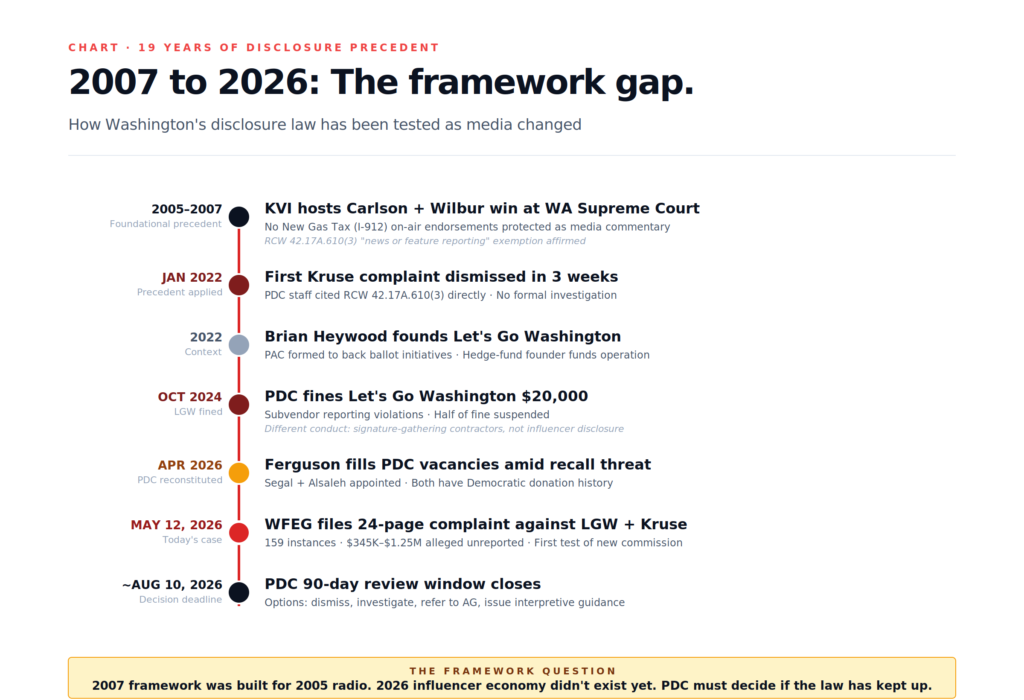
In 2005, KVI radio hosts John Carlson and Kirby Wilbur repeatedly endorsed Initiative 912 — the “No New Gas Tax” measure. Furthermore, opponents argued their on-air advocacy constituted reportable campaign contributions. The case worked its way through Washington courts.
Specifically, the Washington State Supreme Court ruled in 2007 that the radio hosts’ endorsements did not constitute reportable contributions. The court applied RCW 42.17A.610(3) — the “news or feature reporting” exemption. Therefore, the on-air content was protected speech, not regulated political advertising.
Why the 2007 Ruling Matters Now
The 2007 ruling created a clear framework for Washington political speech by media figures. Specifically:
- Working journalists discussing political issues are exempt
- Editorial commentary in regularly published media is exempt
- Talk-radio hosts giving endorsements are protected under the exemption
- The exemption applies regardless of audience size
Furthermore, the precedent has been applied multiple times since 2007. Specifically, when complaints arise against media figures for political commentary, the PDC has consistently cited the exemption to decline investigation.
The 2022 Kruse Precedent
In January 2022, a different complainant filed a similar challenge against Brandi Kruse. Furthermore, the PDC dismissed that complaint in less than three weeks. Specifically, PDC staff cited RCW 42.17A.610(3) directly — the same exemption from the 2007 case.
That history matters for evaluating the 2026 complaint. Specifically, the legal argument has been tested before. Furthermore, the PDC has documented precedent for how it interprets the exemption. Therefore, the 2026 Let’s Go Washington PDC case faces a high evidentiary bar to produce a different outcome.
The 2024 LGW Fine Context
This is not the first time Let’s Go Washington has faced PDC scrutiny. Specifically, in 2024 the PDC fined Let’s Go Washington $20,000 (half suspended) for subvendor reporting violations. Furthermore, that case involved different conduct entirely. Specifically, it was about transparency in signature-gathering contractor reporting — not about influencer disclosure.
Therefore, Let’s Go Washington has a documented pattern of operating in PDC enforcement gray areas. Furthermore, that pattern is part of why WFEG argues the 2026 complaint deserves serious review. Whether the pattern is enough to overcome the 2007 precedent is exactly what the PDC must now decide.
Why the Let’s Go Washington PDC Complaint Tests the Influencer Economy
The case is consequential beyond the immediate partisan dispute. Specifically, it tests how 1973-era campaign finance rules apply to 2026-era media economics. Furthermore, that question has implications far beyond Washington.
What 2007 Did Not Anticipate
The 2007 Carlson-Wilbur case involved radio hosts on a commercial broadcast station. Furthermore, those hosts:
- Were employees of a licensed broadcaster
- Operated under FCC regulations
- Had clear professional designations as commentators
- Generated revenue through traditional advertising sales
Specifically, the 2026 influencer landscape is structurally different. Furthermore, modern political content creators:
- Operate independently across multiple platforms
- Generate revenue through diverse models (sponsorships, ad shares, affiliate marketing)
- Have direct paid relationships with politically-aligned groups
- Reach audiences orders of magnitude larger than 2007-era radio
- Often have no formal “press” credentials
Therefore, applying a 2007 framework to 2026 media may produce inconsistent outcomes. The question is whether the Public Disclosure Commission should update the framework. Or wait for the legislature to do so.
What the Federal Picture Looks Like
This is not just a Washington question. Specifically, the Federal Election Commission has active rulemaking on influencer political advertising disclosure. Furthermore, multiple states are considering legislation to address the gap.
A report from the Center for Democracy & Technology found that “political actors spent tens of millions on creator-driven messaging in 2024.” Specifically, “public reporting suggests that political influencers are commonly paid by campaigns, political committees, and via independent expenditure.” Therefore, the gap between current disclosure rules and current media practice is documented at the federal level too.
Project 42 as a Key Detail
The complaint highlights one specific business relationship. Specifically, Project 42 — a Heywood-funded organization — sponsors Kruse’s UnDivided podcast. Furthermore, that sponsorship is documented and undisputed.
That relationship matters legally. Specifically, sponsorship by a Heywood-funded entity creates a question. Furthermore, does the indirect financial relationship affect whether Kruse’s content qualifies as independent commentary? The PDC will need to evaluate that question on its specific facts.
What Kruse Says
Brandi Kruse has been emphatic in denying any direct financial relationship with Let’s Go Washington. Specifically, in a written statement Kruse said:
“I have never received any form of funds or contribution — undisclosed and unreported or otherwise — from Let’s Go Washington.”
Furthermore, Kruse argued the complaint targets First Amendment-protected speech:
“The state of Washington cannot regulate my speech. There’s a little thing called the First Amendment that, last time I checked, tends to frown on such things.”
That argument has substance. Specifically, the First Amendment generally protects political commentary even when it favors specific ballot measures. Furthermore, the 2007 Washington Supreme Court precedent reinforces that protection.
What State Officials Are Saying About the Let’s Go Washington PDC Case
The complaint drew immediate reactions from both sides. Furthermore, the political dynamics map onto Washington’s broader political fault lines.
Heywood’s Response
Brian Heywood characterized the complaint as politically motivated. Specifically:
“This is a socialist progressive group. If you look at who their clients are, it’s every single public union in the entire state. The unions are deathly afraid the money trough that has been flowing into their coffers… they’re attempting to do a smear campaign.”
Furthermore, Heywood emphasized his organization’s denial: “We never paid her [Brandi Kruse] a dime.” That direct denial matters for the legal case. Specifically, the PDC will need to determine whether the in-kind contribution analysis applies even without direct payment.
WFEG’s Position
Pam Stuart, communications liaison for WFEG and a Sammamish City Council member, defended the filing. Specifically, Stuart told reporters:
“They’re really circumventing the laws to mislead the public.”
Stuart framed the case as a transparency issue. Furthermore, she argued the political content Kruse provided would normally be valued and reported. Specifically, “if I were a sign maker and I were to make signs for Let’s Go Washington and give them to them, I would have to file that as an in-kind donation.”
That framing is reasonable on its face. However, the legal question is whether content creation by a media figure is equivalent to material goods donation. The 2007 Carlson-Wilbur ruling said no.
The Counter-Concern About WFEG
Let’s Go Washington raised legitimate concerns about WFEG itself. Specifically, the group noted WFEG has never filed a Form 990 with the IRS despite claiming nonprofit status. Furthermore, WFEG’s PR work is handled by Powerhouse Strategies — a progressive consulting firm whose clients are predominantly public-sector unions.
Those unions have a direct financial stake in defeating Let’s Go Washington’s initiatives. Furthermore, the millionaire’s tax repeal initiative — separately announced this week — would directly affect union-funded programs. Therefore, WFEG’s institutional positioning is itself relevant to evaluating the complaint’s legal merit.
What This Tells Us
Both sides are presenting accurate facts that support competing conclusions. Specifically, WFEG is right that Kruse did extensive promotional content for Let’s Go Washington initiatives. Furthermore, Let’s Go Washington is right that direct payment did not occur and that media commentary has historically been protected.
The legal question is which framework applies. Specifically, that’s not a question of who’s lying — both sides are honest about the underlying facts. The dispute is about how those facts should be classified under campaign finance law.
How the Let’s Go Washington PDC Case Fits the Broader Accountability Pattern
The complaint connects to PNW Independent’s ongoing structural-accountability coverage. Furthermore, the connections are specific and important. Specifically, the case touches three accountability infrastructure questions documented in recent reporting.
Connection 1: Ferguson’s PDC Vacancies
PNW Independent’s Ferguson Ethics investigation documented Bob Ferguson’s failure to fill PDC vacancies within statutory deadlines. Specifically, Ferguson only filled the seats after a recall threat. Furthermore, his two appointees — Matt Segal and Teebah Alsaleh — have documented Democratic donation histories.
Therefore, the Let’s Go Washington PDC complaint is the first major test of the newly-staffed commission. Specifically, the commission Ferguson reconstituted will decide whether to investigate a complaint filed by a union-aligned group against a Republican-aligned political committee. Furthermore, the optics of that decision will matter as much as the legal merits.
Connection 2: The Millionaire’s Tax Connection
PNW Independent’s millionaire’s tax investigation documented the May 4 Supreme Court ruling blocking the referendum effort. Specifically, Brian Heywood was the plaintiff in that case. Furthermore, Heywood announced a new initiative to repeal the millionaire’s tax at the same press conference where he responded to the PDC complaint.
Therefore, the timing is meaningful. Specifically, the same week WFEG filed against Heywood at the PDC, Heywood announced new initiative activity that would draw further union opposition. Furthermore, the complaint may be a strategic preemption of that new initiative campaign.
Connection 3: The Sheriff Standards Pattern
PNW Independent’s sheriff standards investigation documented courts blocking SB 5974 on First Amendment and vagueness grounds. Specifically, attorney Mark Lamb argued the law amounted to a “loyalty oath” that infringed on speech rights.
Furthermore, the same First Amendment framework applies here. Specifically, both cases test whether state regulators can apply broad rules to politically-protected activity. Therefore, the courts’ willingness to scrutinize state regulation under speech-protective standards will affect both cases.
The Two Machines Connection
PNW Independent’s Two Machines analysis documented how Washington’s political dynamics often pit institutional Democratic infrastructure against the smaller but well-funded Heywood-aligned conservative initiative apparatus. Furthermore, the Let’s Go Washington PDC case is a textbook example.
Specifically, both sides operate through coordinated networks. Furthermore, both sides have legitimate institutional concerns about the other side’s tactics. Therefore, the PDC complaint is partly a substantive legal claim — and partly a continuation of an institutional power struggle that has been ongoing since 2022.
What Should Happen Next on the Let’s Go Washington PDC Complaint
The complaint creates several distinct decision points. Furthermore, each has different implications. Specifically, here is what should happen next.
1. Transparent PDC Review Process
The PDC has 90 days to review the complaint. Furthermore, the review process should be transparent. Specifically, the commission should:
- Publish the legal standard being applied
- Document the evidence reviewed
- Explain the reasoning behind any preliminary determination
- Make public any precedent cited
That transparency is essential. Specifically, the commission’s credibility depends on demonstrating consistent application of standards regardless of which party benefits. Furthermore, the newly-staffed commission has the opportunity to establish a strong reputation by handling this case visibly.
2. Legislative Clarification
The deeper problem is that 2007 case law may not adequately address 2026 influencer media. Specifically, the legislature should consider whether RCW 42.17A.610(3) needs updating. Furthermore, that update should:
- Address paid relationships between political committees and content creators
- Distinguish independent commentary from coordinated advocacy
- Account for the scale differences between 2007 broadcasting and 2026 platform reach
- Preserve First Amendment protections while improving disclosure transparency
Legislative action would be more durable than PDC interpretation. Furthermore, it would give clear guidance to both content creators and political committees about disclosure obligations.
3. Standard for “Coordination”
The key legal question in the Let’s Go Washington PDC case is whether Kruse’s content was coordinated with Let’s Go Washington. Specifically, federal campaign finance law has detailed coordination standards. Furthermore, Washington could adopt similar standards explicitly.
Specifically, coordination factors could include:
- Direct payment from political committee to content creator
- Indirect payment through sponsorships or affiliated entities
- Communication about content timing, themes, or framing
- Shared staff or contractors
- Common editorial direction
The PDC review of this case is the opportunity to articulate these standards clearly. Furthermore, the resulting framework would apply equally to Republican-aligned and Democratic-aligned content creators going forward.
4. WFEG Transparency Requirements
The complaint about Let’s Go Washington also raises questions about WFEG itself. Specifically, an organization filing transparency complaints should itself be transparent. Furthermore, WFEG’s lack of a Form 990 filing — despite claiming nonprofit status — is a documented concern.
Therefore, the legislature should consider whether complainants in PDC cases should themselves meet basic transparency thresholds. Furthermore, that requirement would prevent astroturfing while preserving legitimate watchdog complaints.
5. Influencer Disclosure Standards
The bigger picture is that paid political influencers operate in a regulatory gray zone. Specifically, this applies across all political viewpoints. Furthermore, the gray zone produces predictable disputes like the Let’s Go Washington PDC case.
Therefore, Washington could lead on this issue by:
- Defining clear disclosure thresholds for politically-paid content
- Creating safe-harbor rules for genuinely independent commentary
- Establishing simple registration mechanisms for paid political content
- Aligning state rules with emerging federal standards
That clarity would benefit both sides. Specifically, content creators would know exactly what triggers disclosure obligations. Furthermore, political committees would have certainty about which relationships require reporting.
The Bottom Line on the Let’s Go Washington PDC Complaint
What the Let’s Go Washington PDC Complaint Is Really About
The Let’s Go Washington PDC complaint is about more than two ballot initiatives. Specifically, it tests how Washington’s 1973-era disclosure framework applies to 2026 media economics. Furthermore, that question has no obvious right answer.
Both sides have legitimate concerns. WFEG is correct that Kruse produced extensive promotional content. Furthermore, Let’s Go Washington is correct that no direct payment occurred. Specifically, the legal question is which framework should classify that activity. The 2007 Supreme Court precedent says one thing. The 2026 influencer economy may require something different.
The 90-Day Decision Window
The PDC has 90 days to review the complaint. Furthermore, that window ends around August 10, 2026. Specifically, the commission’s options include:
- Dismiss the complaint citing the 2007 Carlson-Wilbur precedent
- Open a formal investigation to gather additional evidence
- Refer the case to the Attorney General for prosecution
- Issue interpretive guidance on the news exemption
Each option carries different implications. Furthermore, dismissal would likely be quick and consistent with prior PDC decisions. Specifically, opening an investigation would signal the commission believes 2026 facts warrant different analysis than 2007 did.
What This Means for Washington Voters
The Let’s Go Washington PDC case is happening in a specific context. Specifically, Washington voters will see Let’s Go Washington’s parental rights and girls’ sports initiatives on the November ballot. Furthermore, those voters will also be evaluating the millionaire’s tax repeal initiative Heywood announced this week.
Therefore, the PDC’s decision affects voter information access. Specifically, if Kruse’s content is determined to be unreported in-kind contribution, the actual cost of the Let’s Go Washington campaign rises substantially. Furthermore, that revised cost would be relevant to voters evaluating the initiatives.
The Bigger Question
The deeper issue raised by the Let’s Go Washington PDC complaint is structural. Specifically, how should political disclosure law adapt to platforms that didn’t exist when the law was written? Furthermore, that question is bigger than any partisan dispute.
Influencer political content is now a routine part of campaign communication. Specifically, content creators across the political spectrum produce material that supports specific candidates and ballot measures. Furthermore, the disclosure framework was built for a media environment that no longer exists in pure form.
Washington can address this gap through legislation, through PDC interpretation, or through inaction. Each path produces different consequences for democratic transparency. The Let’s Go Washington PDC complaint forces the question. The decisions made in the next 90 days will determine the answer.
For PNW Independent readers, the practical takeaway is clear. The Let’s Go Washington PDC complaint is not a smoking gun. It is also not a smear campaign. Furthermore, it is a real legal question about how disclosure law should work in a transformed media environment. The PDC has the first chance to answer. The legislature will likely have the next. Washington voters will ultimately have the final say.
The clock is running. August 10 is the deadline. The 2026 ballot fight is already underway. The disclosure framework that emerges from this case will shape Washington political speech for years. That framework deserves serious analysis, not just partisan reaction.
Related Reading on PNW Independent
- Ferguson Ethics: How Brutal Failures Exposed Olympia’s Crisis
- Washington Millionaire’s Tax: How a Brutal Court Ruling Exposed Washington’s Tax Crisis
- Washington Sheriff Standards: How a Brutal Court Ruling Exposed Police Crisis
- Who Really Runs Seattle: Two Machines, One Ruling Class
External Sources
- KING 5 — Watchdog complaint says Let’s Go Washington failed to disclose Brandi Kruse political advertising (May 13, 2026)
- Washingtonians for Ethical Government — Complaint announcement (May 12, 2026)
- The Center Square — Complaint alleges Let’s Go WA violated campaign finance rules involving podcaster (May 13, 2026)
- PubliCola — Elections Complaint Targets Conservative Podcaster Brandi Kruse and Let’s Go Washington
- Seattle Red — Complaint targeting Brandi Kruse, Let’s Go Washington easily falls apart
- 570 KVI — Brandi Kruse, Brian Heywood Blast PDC Complaint as Attack on Free Speech
- Washington Public Disclosure Commission — Browse Commission Decisions
- Washington State Legislature — RCW 42.17A.610
- Apple Valley News Now — ‘Let’s Go Washington’ accused of violating state advertising reporting code