How It Failed: The Truth Behind Seattle’s Homeless Complex
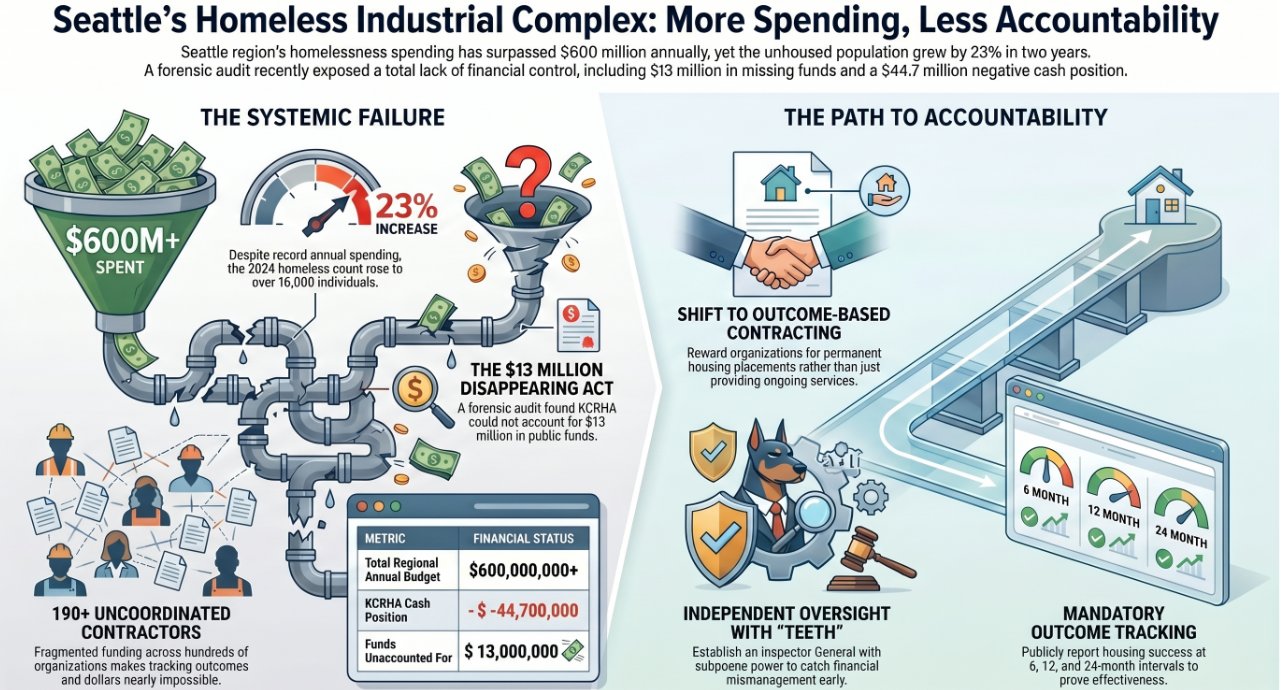
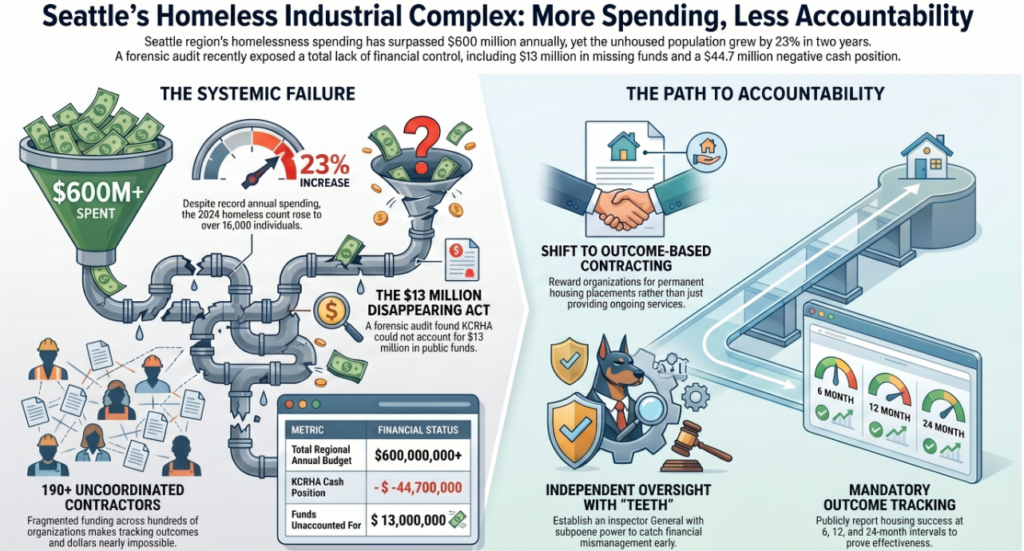
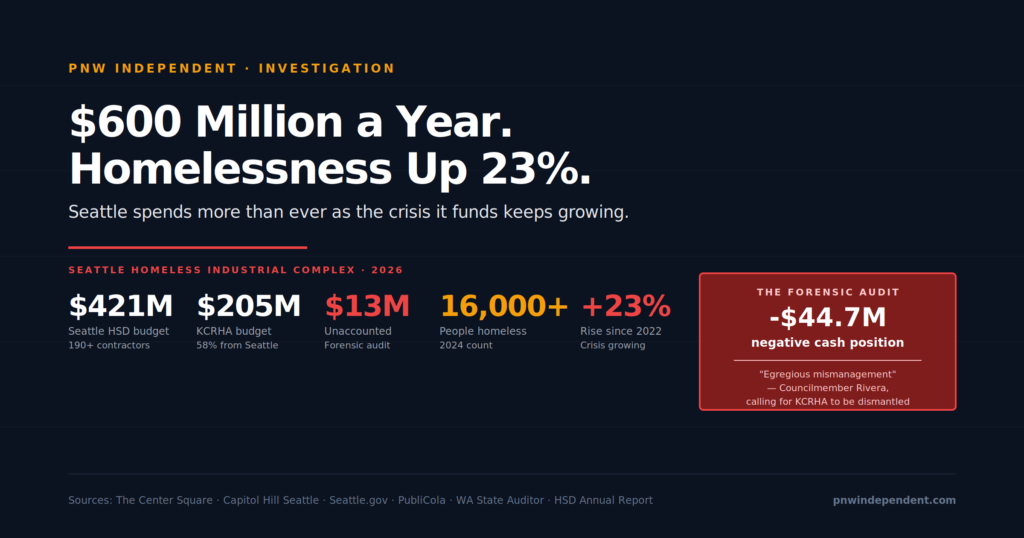
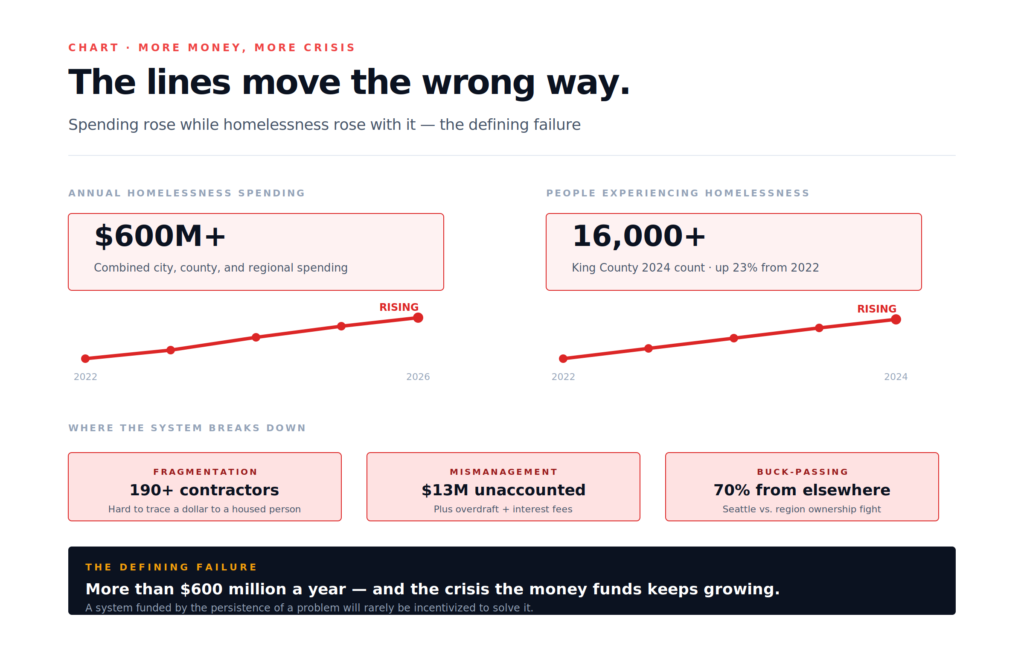
The Seattle homeless industrial complex spends more than $600 million a year across overlapping city, county, and regional agencies. Specifically, Seattle’s Human Services Department alone runs a $421 million 2026 budget, and the King County Regional Homelessness Authority adds another $205 million. Furthermore, the region’s homeless population rose to more than 16,000 in the 2024 count — a 23% jump from 2022.
The Seattle homeless industrial complex also has a documented accountability problem. Specifically, a $600,000 forensic audit found the KCRHA could not account for more than $13 million in public funds. Furthermore, the agency carried a negative cash position of $44.7 million. The money grows. The crisis grows with it. The system increasingly serves the apparatus that administers it — not the poor it claims to help. Here is what the documents actually show.
What the Seattle Homeless Industrial Complex Actually Spends
The system is best understood through documented spending. Specifically, multiple overlapping agencies fund homelessness response in the city and county. Furthermore, the combined total exceeds $600 million annually when all sources are counted.
The Layered Budgets
The spending flows through several agencies. Specifically:
- Seattle Human Services Department: $421 million adopted budget for 2026
- King County Regional Homelessness Authority: $205 million proposed 2026 budget
- Seattle’s share of KCRHA: $118.93 million (about 58% of KCRHA’s budget)
- King County direct funding to KCRHA: $53 million in 2025
- 190+ community-based organizations under HSD contracts
Furthermore, these budgets overlap and pass through one another. Specifically, Seattle funds both its own HSD programs and the majority of KCRHA. Therefore, the true combined spending on homelessness in the Seattle region exceeds $600 million per year.
The Nonprofit Contractor Web
The system runs largely through contractors. Specifically, Seattle’s Human Services Department contracts with more than 190 community-based organizations. Furthermore, KCRHA passes much of its funding through additional service providers.
That structure creates a sprawling web. Specifically, hundreds of organizations depend on this funding stream. Furthermore, the fragmentation makes coordinated outcome-tracking difficult. The more agencies and contractors in the chain, the harder it is to follow a single dollar to a single housed person.
The Scale Compared to Portland
PNW Independent’s Portland Homeless Industrial Complex investigation documented over $700 million in annual Portland-metro spending across 522 different uses. Specifically, Seattle’s system mirrors that pattern. Furthermore, both cities spend enormous sums through fragmented systems while homelessness persists. Seattle is not unique. It is one node in a West Coast pattern.
How the Seattle Homeless Industrial Complex Lost Track of $13 Million
The system has a documented accountability failure at its center. Specifically, a forensic audit of KCRHA revealed missing funds and severe financial mismanagement. Furthermore, the findings were stark enough that officials called for the agency to be dismantled.
The Forensic Audit Findings
City and county officials commissioned a $600,000 forensic audit of KCRHA. Specifically, the audit covered the agency’s inception through July 2025. Furthermore, the findings were released in April 2026 and were severe:
- More than $13 million in public funds could not be accounted for
- Negative cash position of $44.7 million
- Structural spending issues where expenditures consistently outpaced funding inflows
- Serious failures of internal controls, fiscal management, and accountability
Therefore, the agency at the center of this system could not track millions in public money. Furthermore, PNW Independent’s KCRHA audit investigation documented these findings in detail.
The Official Response
The response from officials was sharp. Specifically, Mayor Katie Wilson said “all options are on the table” and ordered KCRHA to freeze spending and stop hiring. Furthermore, Councilmember Maritza Rivera said the report documented “egregious mismanagement” and called for the agency to be “dismantled.”
That bipartisan alarm is notable. Specifically, the criticism came from across the political spectrum. Furthermore, the agency’s defenders struggled to explain how $13 million went unaccounted for. When a homelessness agency cannot find $13 million, the people who suffer most are the unhoused that money was meant to help.
The State Auditor Backup
The forensic audit was not the only red flag. Specifically, a 2025 Washington State Auditor report found KCRHA experienced a negative cash balance of more than $35 million in 2024. Furthermore, the agency incurred hundreds of thousands of dollars in overdraft and interest fees.
Therefore, two separate audits documented severe financial dysfunction. Specifically, the agency was paying bank penalties on money meant for homeless services. Furthermore, those penalties represent funds diverted from the actual mission. Every dollar lost to an overdraft fee is a dollar not spent on housing.
Why the Seattle Homeless Industrial Complex Grows As Homelessness Grows
The system displays a troubling pattern. Specifically, spending has grown substantially while homelessness has risen, not fallen. Furthermore, that inverse relationship is the core accountability question.
The Rising Count
The numbers tell the story. Specifically, the 2024 point-in-time count found more than 16,000 people experiencing homelessness in King County. Furthermore, that represented a 23% increase from 2022. Specifically, KCRHA leadership anticipated the next count would show even more homeless individuals.
Therefore, the spending and the crisis grew together. Specifically, the region poured hundreds of millions into response while the population it aimed to help expanded. Furthermore, that is the defining failure of the Seattle homeless industrial complex. More money has not meant fewer homeless people.
The Per-Person Math
The spending-per-person figures are striking. Specifically, with over $600 million spent annually and roughly 16,000 people counted, the system spends an enormous sum per homeless individual. Furthermore, that figure rivals the cost of simply housing people directly in many cases.
That math raises hard questions. Specifically, if the per-person spending is so high, why does homelessness keep rising? Furthermore, the answer points to where the money actually goes. A large share never reaches the street — it funds the apparatus instead.
Where the Money Goes
Critics argue the spending is misallocated. Specifically, former state legislator Mark Harmsworth argued KCRHA “spends money on stuff on the administrative side of things and doesn’t actually send that money down to the street.” Furthermore, he argued the money should focus on getting people “off the street.”
That critique is contestable but documented. Specifically, the administrative-versus-direct-service balance is a recurring concern. Furthermore, the forensic audit’s findings about internal controls reinforce the worry. When administration consumes the budget, the mission starves.
How the Seattle Homeless Industrial Complex Creates Perverse Incentives
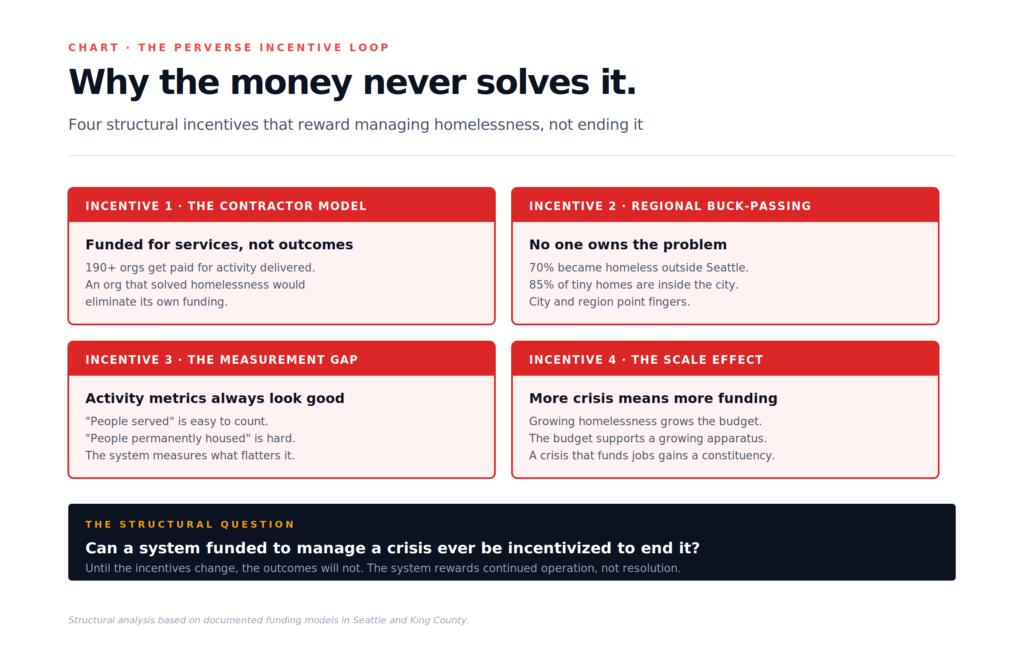
The Seattle homeless industrial complex creates documented perverse incentives. Specifically, the funding structure can reward activity over results. Furthermore, those incentives help explain why spending grows while outcomes do not improve.
The Contractor Incentive
The contractor model creates a structural problem. Specifically, the 190+ organizations under HSD contracts are funded for services delivered, not outcomes achieved. Furthermore, an organization that fully solved homelessness in its area would eliminate its own funding.
That is not an accusation of bad faith. Specifically, most homelessness workers are deeply committed to helping people. Furthermore, the structural incentive exists regardless of individual intentions. The system financially rewards managing homelessness indefinitely, not ending it.
The Regional Buck-Passing Incentive
The Seattle homeless industrial complex also creates jurisdictional buck-passing. Specifically, former Mayor Bruce Harrell noted that some 70% of Seattle’s homeless population became homeless outside the city. Furthermore, he noted that 85% of King County’s tiny homes and 63% of its shelters are located in Seattle.
That imbalance creates finger-pointing. Specifically, the city argues it bears a regional burden. Furthermore, the region argues Seattle is the population center. Therefore, no single entity takes full ownership. When everyone is responsible, no one is accountable.
The Measurement Incentive
The weak outcome-tracking creates its own incentive. Specifically, when outcomes are not rigorously measured, programs can claim success based on activity. Furthermore, “people served” and “contacts made” are easier to count than “people permanently housed.”
Therefore, the system’s measurement frameworks favor activity metrics. Specifically, activity metrics always look positive. Furthermore, outcome metrics often look discouraging. The system measures what flatters it, not what would prove it works.
The Scale Incentive
The final perverse incentive is scale. Specifically, as homelessness grows, so does the funding to address it. Furthermore, the growing funding supports a growing apparatus of administrators, contractors, and consultants. PNW Independent’s Two Machines analysis documented how institutional players develop stakes in the systems they administer. A crisis that funds thousands of jobs develops a constituency for its own continuation.
How the Seattle Homeless Industrial Complex Betrays the People It Claims to Help
The system ultimately betrays the unhoused. Specifically, the system’s failures fall hardest on the people it claims to serve. Furthermore, that betrayal takes several concrete forms.
Funds Lost to Mismanagement
Every dollar lost to mismanagement is a dollar not spent on housing. Specifically, the $13 million KCRHA could not account for represents real services not delivered. Furthermore, the overdraft and interest fees represent more waste. The unhoused pay the price of the apparatus’s dysfunction.
Services That Don’t Reach the Street
The administrative overhead concern means money does not always reach those in need. Specifically, critics argue too much funding stays at the administrative level. Furthermore, the forensic audit’s findings about internal controls reinforce the worry that funds are not efficiently deployed.
A System That Grows on Failure
The deepest betrayal is structural. Specifically, the apparatus grows when homelessness grows. Furthermore, that means the system has no financial incentive to actually end the crisis. A system funded by the persistence of a problem will rarely solve that problem.
The Federal Funding Cliff
The betrayal is compounded by looming federal cuts. Specifically, federal funding changes could make thousands more Seattle residents homeless. Furthermore, new federal rules penalize harm-reduction and certain progressive policies, threatening roughly $36 million in regional funding. Therefore, the system faces a shortfall just as the need grows. The most vulnerable face the sharpest edge of every funding failure.
How the Seattle Homeless Industrial Complex Connects to Broader Accountability Patterns
The system connects directly to PNW Independent’s ongoing accountability reporting. Furthermore, the connections reveal a consistent regional pattern. Specifically, the same structural dynamics appear across multiple investigations.
Connection 1: The KCRHA Audit
PNW Independent’s KCRHA audit investigation is the foundational documentation. Specifically, the $13 million gap and $44.7 million negative cash position anchor the accountability case. Furthermore, the audit is the clearest evidence of the system’s dysfunction.
Connection 2: The Portland Parallel
PNW Independent’s Portland Homeless Industrial Complex investigation documented the same pattern to the south. Specifically, Portland spends over $700 million annually with rising homelessness. Furthermore, the Seattle homeless industrial complex mirrors that failure almost exactly. The two cities share a structural disease.
Connection 3: The Moody’s Fiscal Context
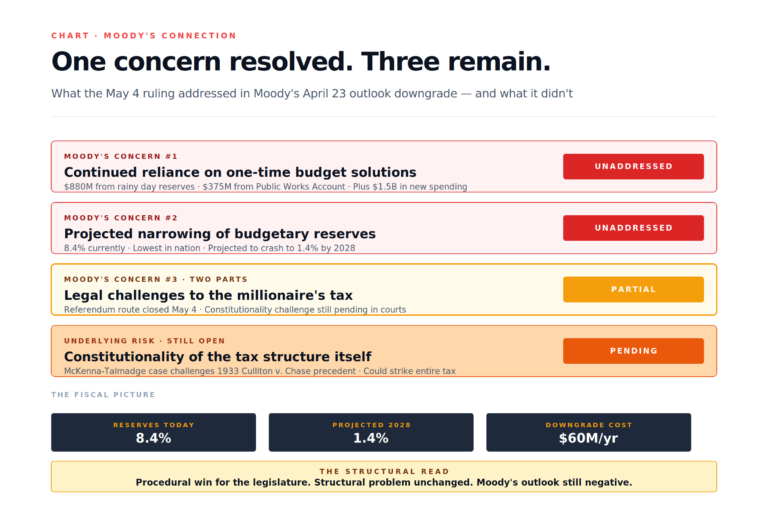
PNW Independent’s Moody’s downgrade investigation documented Washington’s fiscal vulnerabilities. Specifically, homelessness spending is a large and growing budget category. Furthermore, spending that does not produce results represents a structural fiscal risk that rating agencies watch.
The Regional Truth
The pattern reveals a regional truth. Specifically, one of America’s wealthiest, most progressive cities spends over $600 million annually on homelessness. Furthermore, the crisis keeps growing. The spending is not the solution. In some ways, the spending structure is part of the problem.
What Should Happen Next on the Seattle Homeless Industrial Complex
The system requires structural reform. Furthermore, several specific actions could improve outcomes. Specifically, each addresses a documented failure point.
1. Independent Oversight With Teeth
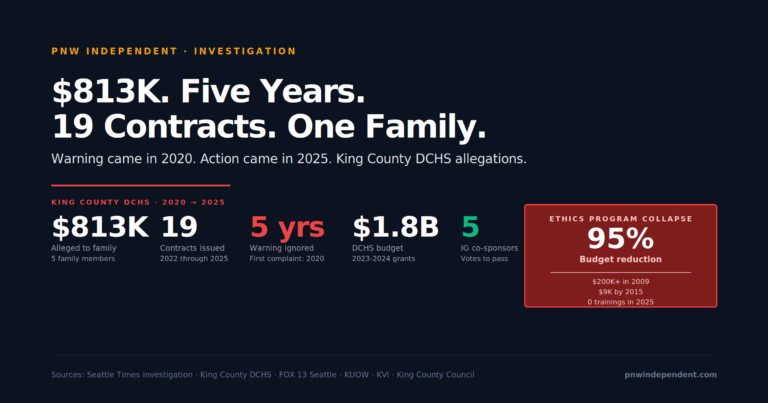
The system needs empowered independent oversight. Specifically, an inspector general for homelessness spending with subpoena power could catch the failures the forensic audit revealed. Furthermore, PNW Independent’s King County DCHS investigation documented the value of independent oversight.
2. Outcome-Based Contracting
The contractor model needs restructuring. Specifically, contracts should reward permanent housing placements, not services delivered. Furthermore, performance-based contracting would shift the incentive from managing homelessness to ending it.
3. Mandatory Outcome Tracking
Every dollar should be tied to measurable outcomes. Specifically, the system should publicly track permanent housing placements at 6, 12, and 24 months. Furthermore, it should report returns to homelessness and cost per successful placement. You cannot improve what you do not measure.
4. Consolidated Accountability
The fragmentation problem requires consolidation. Specifically, the overlap between HSD, KCRHA, and 190+ contractors creates coordination failures. Furthermore, unified outcome measurement and clear lines of responsibility would reduce buck-passing.
5. Honest Public Reporting
The system should report total homelessness honestly. Specifically, the public deserves accurate counts and honest cost-per-person figures. Furthermore, voters cannot evaluate policy without accurate data. Honest numbers are the foundation of accountability.
6. Resolve the KCRHA Question
Officials must resolve KCRHA’s future. Specifically, calls to dismantle the agency deserve a transparent public process. Furthermore, whatever replaces or reforms it must have stronger financial controls than the agency the forensic audit exposed.
The Bottom Line on the Seattle Homeless Industrial Complex
What the Seattle Homeless Industrial Complex Actually Is
The Seattle homeless industrial complex is a documented system spending over $600 million a year. Specifically, the money flows through overlapping agencies and 190+ contractors. Furthermore, the region’s homeless population rose 23% even as the spending grew. The money is real. The crisis is growing. The accountability is missing.
That outcome is not an accident. Specifically, the funding structure rewards activity over results. Furthermore, the measurement systems favor metrics that look positive over metrics that prove effectiveness.
Why the Spending Does Not Solve the Crisis
The system does not solve homelessness because its structure does not reward solving it. Specifically, contractors are funded for services, not outcomes. Furthermore, the apparatus grows when the crisis grows.
Therefore, the spending rises while the crisis persists. Specifically, the 2024 count showed 16,000-plus people despite massive investment. Furthermore, the forensic audit showed the system cannot even track its own money. More money has not meant fewer homeless people.
What This Means for Seattle Voters
The system matters for every Seattle taxpayer. Specifically, voters fund a $600 million-plus system with documented accountability failures. Furthermore, that system is not producing the results its cost would imply.
The practical takeaway is clear. Specifically, voters should demand outcome data, independent audits, and outcome-based contracting. Furthermore, the system will not reform itself — the institutional incentives all point toward continuation. Reform requires external pressure.
The Structural Question
The deepest issue raised by the Seattle homeless industrial complex is structural. Specifically, can a system funded to manage a crisis ever be incentivized to end it? Furthermore, until the incentives change, the outcomes will not.
For Seattle readers, the system is not a distant abstraction. It is the system your tax dollars fund. It is the system that lost $13 million. It is the system that grows as the crisis grows. Furthermore, the documentation is now public — the spending figures, the forensic audit, the rising count. The accountability questions write themselves.
The clock is running on the next budget cycle. Over $600 million will be spent again next year. The structure that produced this year’s results will produce next year’s too — unless something changes. That change starts with demanding the outcome data the system has so far failed to provide — and with deciding whether an agency that cannot track $13 million should keep administering the lives of the poor.
Related Reading on PNW Independent
- How Portland’s Homeless Industrial Complex Betrays the Poor
- KCRHA Audit: $13M Missing in Seattle’s Homeless Agency
- Seattle World Cup Homeless: A Brutal 43% Gap
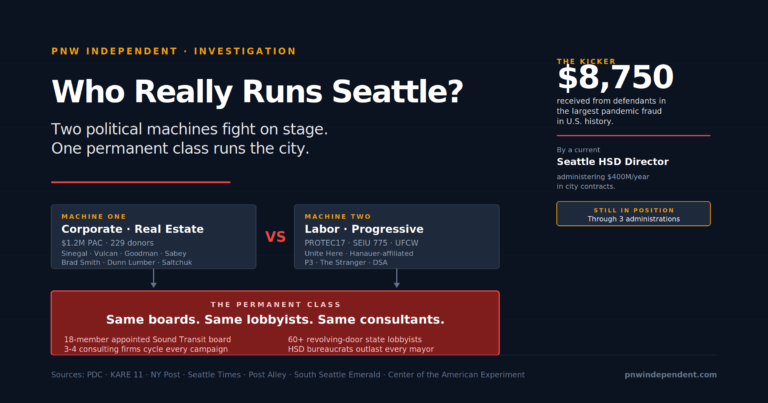
- Who Really Runs Seattle: Two Machines, One Ruling Class
External Sources
- The Center Square — Homelessness rising in King County despite high-cost efforts
- Capitol Hill Seattle — KCRHA has a $44.7M spending hole with millions unaccounted for
- Seattle.gov — Human Services Department Budget Overview
- The Center Square — KCRHA delays 2026 budget vote amid board turnover
- PubliCola — Federal funding changes could make thousands of Seattle residents homeless
- Seattle HSD — 2024 Annual Report on Addressing Homelessness
- Washington State Auditor — KCRHA audit reporting