Live Nation Antitrust: How a Brutal Verdict Exposed Federal Failure
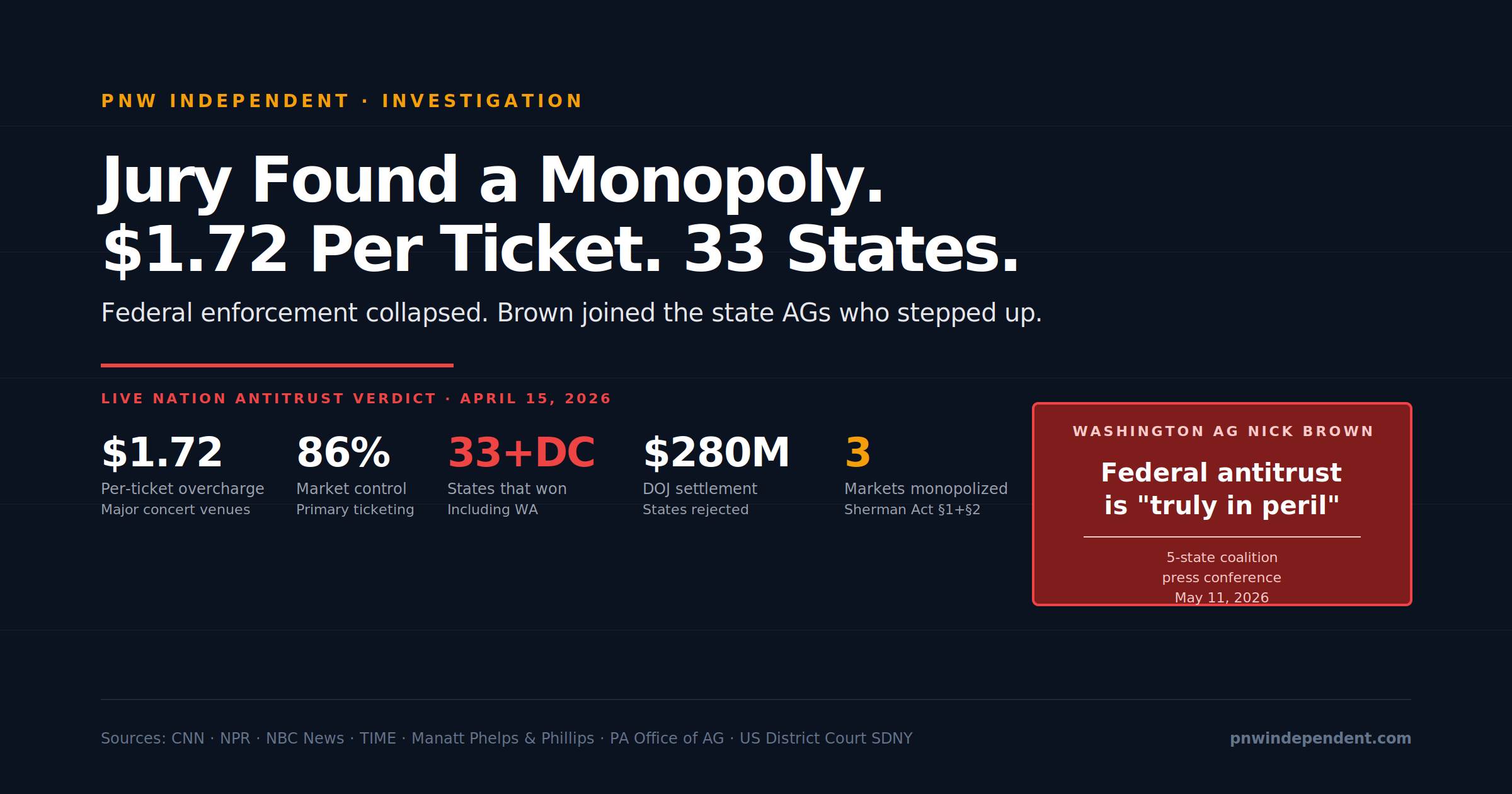
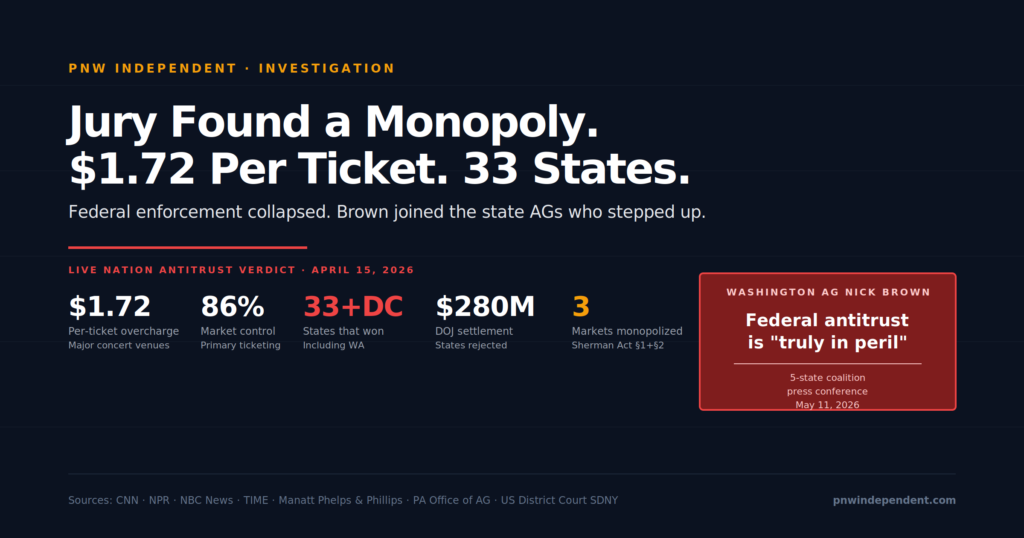
The Live Nation antitrust case ended in a sweeping defeat for the company. Furthermore, a federal jury in Manhattan found on April 15, 2026 that Live Nation and Ticketmaster operated an illegal monopoly. Specifically, the jury found Live Nation overcharged American concert-goers by $1.72 per ticket across 20% of all tickets sold at major venues. The jury issued a clean sweep — finding the company liable on every single antitrust count brought by 33 state attorneys general plus the District of Columbia. Washington’s Nick Brown was part of that coalition.
Furthermore, the U.S. Department of Justice settled separately for $280 million — a settlement most state AGs called insufficient. The states pursued the case to trial. They won. The verdict revealed something larger: federal antitrust enforcement has so visibly weakened that state attorneys general are now the front line of monopoly accountability in America. Brown said the situation is “truly in peril.” Here is what the verdict actually means.
What the Live Nation Antitrust Verdict Actually Found
The Live Nation antitrust verdict came after a 44-day trial in the United States District Court for the Southern District of New York. Specifically, the case was tried before U.S. District Judge Arun Subramanian. Furthermore, the jury deliberated and returned its verdict on April 15, 2026 — a 33-state coalition win on every count.
The Top-Line Findings
The 11-page jury verdict form contained extraordinary detail. Specifically, the jury made:
- 13 specific “yes” findings on antitrust liability issues
- 34 specific “yes” findings on harm-to-competition questions (one for each state plaintiff)
- $1.72 per ticket specific overcharge finding for tickets sold at major concert venues
- Specific violation findings under the antitrust, unfair competition, or trade practices acts of California, Florida, Illinois, Indiana, Kansas, New York, South Carolina, Tennessee, and Vermont
Therefore, this was not a marginal verdict. Furthermore, the jury found Live Nation violated Section 2 of the Sherman Act through unlawful monopolization of three distinct markets:
- Primary Ticketing Markets
- The Market for the Use of Large Amphitheaters
- Concert Promotion Services
The jury also found Live Nation violated Section 1 of the Sherman Act through unlawful tying arrangements — using its dominance in one market to force participation in another.
The Market Control Numbers
According to the Department of Justice’s underlying complaint and trial evidence, Ticketmaster controlled:
- 80% of concert ticketing in the primary marketplace (DOJ estimate)
- 86% of primary ticketing at major concert venues specifically (state AG trial figure)
- A growing share of the resale market
- Virtually every aspect of the live music ecosystem when promotion, venue control, and ticketing are combined
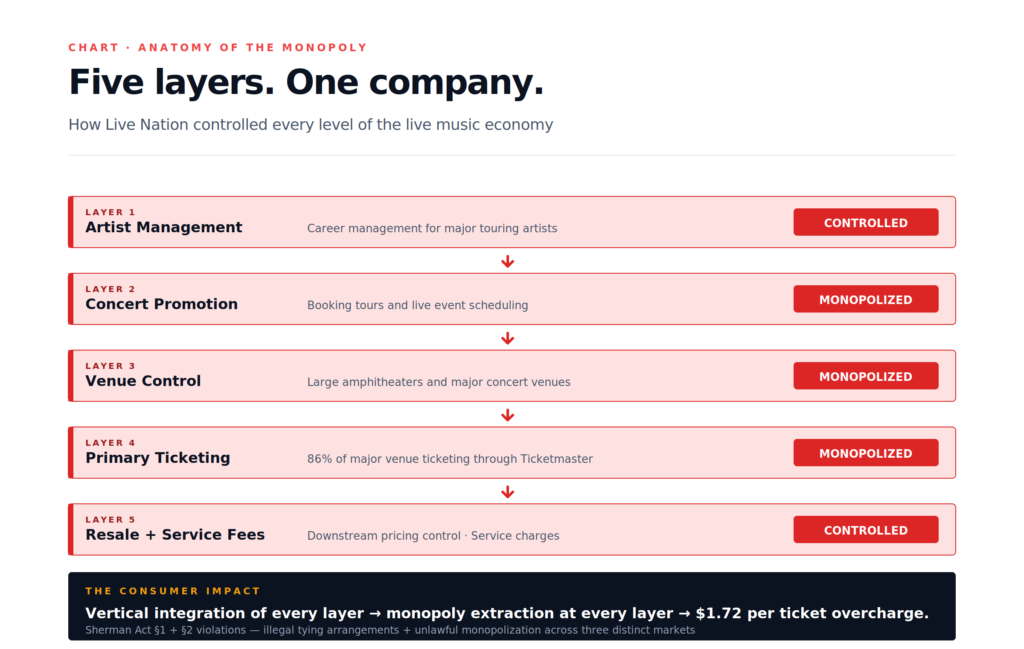
Therefore, when a major artist toured a major venue in 2024 or 2025, Live Nation-Ticketmaster was statistically certain to control the venue booking, the ticket sale, the service fees, the resale market, and often the artist management relationship. Furthermore, that vertical integration is exactly what made the monopoly so durable.
What “Monopoly” Means Legally
For a finding of illegal monopolization under the Sherman Act, the jury had to find that Live Nation:
- Possessed monopoly power in a relevant market
- Acquired or maintained that power through anticompetitive conduct
- Caused antitrust injury to competition (not just to specific competitors)
Specifically, the jury found all three elements present. Furthermore, the finding applies across three separate markets — ticketing, venues, and promotion. Therefore, this is among the broadest antitrust monopoly findings against a single company since the Microsoft case in the early 2000s.
How the Live Nation Antitrust Case Got Here
The Live Nation antitrust case did not begin in 2026. Specifically, it began with a 2010 merger that the Department of Justice approved with conditions — conditions Live Nation has been accused of systematically violating ever since.
The 2010 Merger
In 2010, Live Nation merged with Ticketmaster — combining the largest concert promoter with the largest ticketing platform. Specifically, the DOJ approved the merger only after Live Nation agreed to a consent decree that prohibited:
- Retaliation against venues that chose competing ticketing services
- Conditioning Live Nation concerts on Ticketmaster ticketing exclusives
- Various other vertical restraints designed to prevent monopolization
Therefore, the 2010 consent decree explicitly anticipated the exact conduct the 2026 jury found. Furthermore, the merger was approved on the theory that those restraints would prevent monopoly formation. They did not work.
The DOJ Filing
On May 23, 2024, the Department of Justice and 39 state attorneys general (joined by D.C.) filed suit. Specifically, the complaint alleged Live Nation had monopolized the live event sector through systematic anticompetitive conduct. Furthermore, the original DOJ complaint sought forced divestiture — the breakup of Live Nation and Ticketmaster.
The case proceeded through extensive pretrial discovery. Specifically, the trial began on March 2, 2026. Furthermore, it included testimony from top executives across the music and entertainment industries.
The DOJ Settlement Surprise
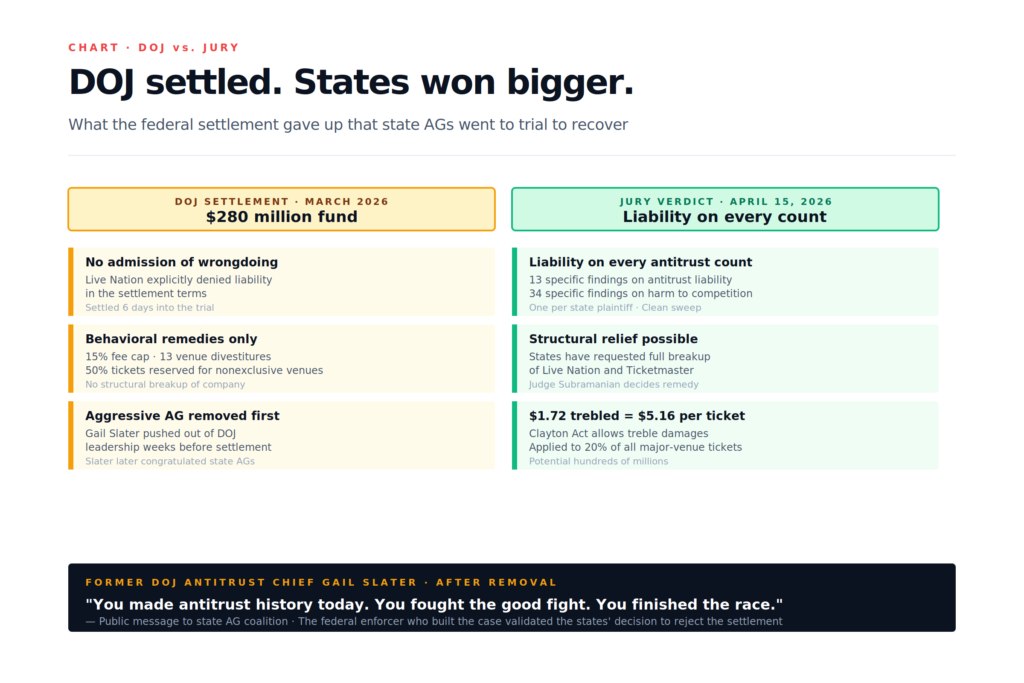
Six days into trial, the DOJ reached a tentative settlement with Live Nation. Specifically, the settlement included:
- $280 million settlement fund for participating states
- 15% cap on ticketing service fees
- Divestiture of 13 amphitheater booking agreements
- 50% of tickets reserved for nonexclusive venues
- Allowing competitors like SeatGeek and StubHub to offer tickets to Live Nation events
- No admission of wrongdoing by Live Nation
Furthermore, the timing of the settlement was unusual. Specifically, the DOJ settled just weeks after acting Assistant Attorney General Gail Slater — the antitrust division head known for aggressive enforcement — was pushed out of DOJ leadership. Therefore, the settlement was widely viewed as the new DOJ leadership backing away from the case the prior leadership had built.
The 33-State Coalition That Said No
Most state attorneys general rejected the DOJ settlement. Specifically, 33 states and the District of Columbia decided the settlement fell far short of meaningful remedy. Furthermore, those state AGs continued the case to jury verdict — and won on every count.
Washington Attorney General Nick Brown was among the AGs who pursued the case after the DOJ settlement. Furthermore, Brown’s office has continued to position Washington as part of the multi-state coalition holding monopolists accountable when federal enforcement weakens.
What the Live Nation Antitrust Verdict Means for Washington
The Live Nation antitrust verdict has direct consequences for Washington concert-goers, Washington venues, and the broader question of how antitrust enforcement is structured in the United States. Furthermore, those consequences flow from the verdict’s specific findings — not from speculation about future remedies.
The Direct Cost to Washington Consumers
The jury’s $1.72-per-ticket overcharge finding applies to roughly 20% of all tickets sold at major venues during the relevant period. Specifically, that means for every five tickets sold to a major Live Nation concert, the jury found the company had illegally extracted $1.72 in monopoly rents from one of them.
For Washington concert-goers, the math is straightforward. Specifically, major Washington venues including Climate Pledge Arena, T-Mobile Park, Lumen Field, and the WaMu Theater all host Live Nation events regularly. Furthermore, every ticket purchased at one of those venues from a Live Nation-controlled chain involved the overcharge framework the jury found illegal.
Therefore, Washington consumers were among the millions of Americans whose concert spending was inflated by the monopoly conduct. Specifically, the overcharge represents not just $1.72 per ticket but the broader pattern of fees, service charges, and resale market controls the jury identified.
What the Trebling Could Mean
Under the Clayton Act, antitrust damages are subject to trebling — meaning the court can impose damages of up to three times the amount actually proven. Specifically, the $1.72 per ticket finding could become $5.16 per ticket after trebling. Furthermore, applied across the universe of tickets sold during the period:
- If $1.72 × 20% of tickets at major venues = monopoly extraction
- Then trebled to $5.16 × 20% of tickets = the maximum possible award
Specifically, the total damages could reach hundreds of millions — and possibly more depending on what the court determines is the relevant universe of tickets. Furthermore, those damages would be distributed across the 33 state plaintiffs based on the share of tickets sold in each state.
The Breakup Question
The most consequential question is whether Judge Subramanian will order structural relief — meaning forced divestiture of Ticketmaster from Live Nation. Specifically, the states have requested this. Furthermore, the DOJ originally requested it before settling.
If Subramanian orders the breakup, the live music industry would be fundamentally restructured. Specifically:
- Ticketmaster would be separated from concert promotion
- Venue control would be separated from ticketing
- Competitive ticketing platforms could enter major venues
- Service fees could fall as competition emerges
- Artist management relationships could be unbundled from venue access
That outcome would be the most significant antitrust structural remedy since the Microsoft consent decree era. Furthermore, it would be a direct result of state attorneys general — not federal enforcers — pursuing the case to verdict.
How the Live Nation Antitrust Case Connects to Brown’s Broader Push
Nick Brown’s involvement in the Live Nation antitrust case is part of a broader pattern. Specifically, Brown has joined Brown has joined a multi-state coalition that includes attorneys general from California, Oregon, Nevada, and New York. Furthermore, that coalition went public on May 11, 2026 with a stark assessment of federal antitrust enforcement.
The “Truly in Peril” Press Conference
The multi-state coalition press conference featured AGs from four other states alongside Brown. Specifically, the message: federal antitrust enforcement is “truly in peril.” Furthermore, Brown’s argument:
“Giant corporations know their mergers will get approved if they have friends in the Trump administration. We’re seeing what happens when federal enforcers step back. State attorneys general are stepping up because someone has to.”
Therefore, Brown is positioning Washington as part of a coordinated multi-state response to federal enforcement weakness. Furthermore, that positioning has specific consequences for how antitrust cases will be handled going forward.
The Resource Reality
State antitrust enforcement is resource-constrained. Specifically, Washington’s antitrust team has grown from approximately 4 lawyers 20 years ago to 15 today. Furthermore, that growth has been entirely funded by attorney fee recoveries from successful enforcement actions — not from taxpayer general fund appropriations.
That funding structure matters. Specifically, it means Washington’s antitrust capacity is self-sustaining as long as enforcement actions continue to produce settlement and judgment recoveries. Furthermore, the Live Nation case is exactly the type of large enforcement action that funds the next generation of state-level antitrust work.
California AG Rob Bonta put a specific cost on major antitrust cases. Specifically, Bonta estimated that a single antitrust case at the scale of the Live Nation litigation requires roughly $20 million and 20 lawyers to pursue through trial. Furthermore, that resource requirement is well beyond what most individual states can sustain alone. Therefore, multi-state coalitions are not just politically useful — they are operationally necessary.
The Nexstar-TEGNA Concern
A separate antitrust concern shaping Brown’s public stance is the proposed Nexstar-TEGNA merger. Specifically, that merger would combine two large local broadcast television companies. Furthermore, TEGNA owns KING 5 in Seattle — one of the largest broadcast news operations in Washington state.
If approved, the merger would consolidate local broadcast ownership in ways Brown has questioned. Furthermore, the merger is exactly the type of major media consolidation that federal antitrust enforcers would historically scrutinize closely. Specifically, Brown has signaled that Washington will examine the merger’s impact on local news markets — particularly in a state where local political coverage matters for accountability.
That signaling matters even before any formal action. Specifically, it tells the merging parties that state-level antitrust review will continue even if federal review weakens. Furthermore, it sends a clear message that state AGs are prepared to coordinate on multi-state merger reviews when federal enforcement falls short.
How the Live Nation Antitrust Verdict Connects to Federal Enforcement Collapse
The Live Nation antitrust verdict is consequential primarily because of what it reveals about the broader federal antitrust enforcement landscape. Furthermore, that landscape has shifted significantly over the past 18 months — in ways that have direct implications for consumer protection across the country.
The Slater Removal
Gail Slater led the DOJ Antitrust Division during the early phases of the Live Nation case. Specifically, Slater was known for an aggressive enforcement approach that pursued structural remedies — including breakups — rather than just behavioral remedies. Furthermore, Slater’s removal from DOJ leadership came just weeks before the Live Nation settlement.
The pattern matters. Specifically, Slater’s removal preceded the federal settlement that the 33-state AG coalition called insufficient. Furthermore, after the jury verdict found Live Nation liable on every count, Slater publicly congratulated the state AG coalition:
“You made antitrust history today. You fought the good fight, you finished the race, and you kept the faith.”
That endorsement from the recently-departed federal enforcement chief is itself significant. Specifically, it confirms that the state AG coalition succeeded where federal enforcement had been told to back away. The federal enforcer with the most knowledge of the case publicly validated the states’ decision to reject the federal settlement.
The Settlement Comparison
The contrast between the DOJ settlement and the jury verdict reveals the enforcement gap. Specifically:
| Element | DOJ Settlement | Jury Verdict |
|---|---|---|
| Liability admission | No | Yes — every count |
| Damages | $280M fund | $1.72/ticket × 20% of tickets, trebled |
| Structural relief | 13 venue divestitures | Potential full breakup pending |
| Future enforcement | Conduct restrictions | Court-ordered remedy phase |
| State AG control | Limited | Direct |
Furthermore, the DOJ settlement was characterized by trial attorney Ray Seilie as setting “a floor or minimum” for further remedies in the states’ case. Specifically, that framing positioned the federal settlement as the least the states could get — not the most. The jury verdict has now confirmed that interpretation.
The Multi-State Antitrust Model
The Live Nation verdict demonstrates a model for state-level antitrust enforcement that did not exist at this scale a decade ago. Specifically, the model includes:
- Multi-state coalitions that pool resources and legal capacity
- Outside trial counsel retained on contingency or hybrid fee structures
- Coordinated case management across state plaintiffs
- Direct trial pursuit when federal settlements are inadequate
- State-level structural remedies that operate independently of federal enforcement
Furthermore, this model is now being applied to other antitrust cases. Specifically, multi-state coalitions are pursuing actions against:
- Google (advertising market monopolization)
- Meta (social media market consolidation)
- Amazon (online retail and cloud services)
- Pharmaceutical pricing (multiple drug-specific cases)
- Major mergers in healthcare, broadcasting, and energy
Therefore, the Live Nation precedent is not isolated. Specifically, it is the most visible recent example of a structural shift in how antitrust enforcement actually operates in the United States. Federal enforcement weakened. State enforcement filled the gap.
How the Live Nation Antitrust Verdict Connects to Pacific Northwest Accountability
The Live Nation antitrust verdict is also part of PNW Independent’s broader documentation of Pacific Northwest governance and accountability. Furthermore, the case reinforces a pattern visible across multiple recent investigations.
The State-Federal Accountability Gap
PNW Independent has documented numerous cases where federal accountability mechanisms have weakened or failed. Specifically:
- FEMA denied Washington $36.6 million for hazard mitigation — leaving the state to fund flood protection alone
- The Moody’s outlook downgrade signaled federal-state fiscal alignment problems
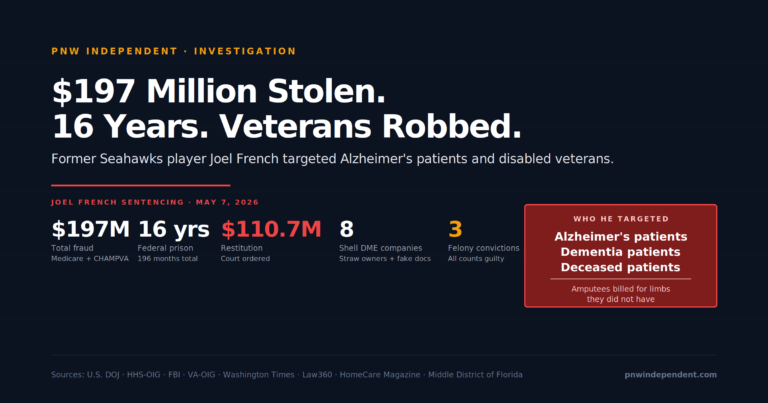
- Federal Medicare fraud detection caught the Joel French $197M scheme — but only after the fraud was complete
The Live Nation case adds a different dimension: federal antitrust enforcement weakening while state enforcement strengthens. Furthermore, this is the inverse of the federal-state gap visible in fraud and disaster relief. Specifically, in antitrust, states have built capacity to handle cases the federal government has stepped back from.
The Two Machines Connection
PNW Independent’s Two Machines analysis documented how regional power structures concentrate among small numbers of major corporations, political insiders, and institutional players. Furthermore, the Live Nation case is exactly the type of corporate concentration that the Two Machines framework predicts.
Specifically, Live Nation’s vertical integration of:
- Concert promotion (the artist’s career)
- Venue control (where they perform)
- Ticketing (how fans buy access)
- Service fees (what consumers actually pay)
- Resale market (downstream pricing control)
Each of these is a separate market that should function independently. Furthermore, when one company controls all of them, the result is exactly what the jury found: monopoly extraction at every layer. The Two Machines framework applies directly. A single corporate entity controlling every layer of an ecosystem is the textbook definition of how machines operate.
What This Means for Local Venues
Washington has several major venues affected by Live Nation’s market position:
- Climate Pledge Arena — Seattle
- T-Mobile Park — Seattle (concerts)
- WaMu Theater — Seattle
- The Showbox (multiple locations)
- Spokane Arena — Spokane
- Tacoma Dome — Tacoma
Specifically, each of these venues operates within the broader live music ecosystem that the jury found Live Nation had illegally monopolized. Furthermore, the remedy phase of the case could change how those venues book talent, sell tickets, and structure their relationships with promoters. The verdict matters for every concert ticket sold in Washington going forward.
What State Officials Are Saying About Live Nation Antitrust
The Live Nation antitrust verdict drew reactions from across the state AG coalition. Furthermore, the language reveals how state-level antitrust enforcement is positioning itself going forward.
Brown: “Stepping Up”
Washington AG Nick Brown framed the verdict as validation of the multi-state approach. Specifically, Brown’s position has been consistent: when federal enforcement weakens, state attorneys general must step up. Furthermore, Brown’s office has signaled it will continue pursuing major antitrust matters with multi-state partners.
New York AG James: “What We Have Long Known to Be True”
New York Attorney General Letitia James characterized the verdict in stark terms:
“A jury found what we have long known to be true: Live Nation and Ticketmaster are breaking the law and costing consumers millions of dollars in the process.”
That framing positions the verdict not as discovery but as confirmation. Furthermore, James added a direct reference to federal enforcement gaps:
“In the face of dwindling antitrust enforcement by the Trump administration, this verdict shows just how far states will go to protect consumers.”
California AG Bonta: Resource Reality
California AG Rob Bonta has been explicit about the resource intensity of major antitrust cases. Specifically, Bonta’s framing focuses on operational requirements — $20 million and 20 lawyers per case at the Live Nation scale. Furthermore, Bonta’s office has emphasized the multi-state coalition model as the only way states can sustain major antitrust enforcement without dedicated federal partners.
Live Nation: Confidence and Appeal
Live Nation’s response has been to minimize the verdict’s practical impact. Specifically, the company said it is confident “that the ultimate outcome of the States’ case will not be materially different than what is envisioned by the DOJ settlement.” Furthermore, Live Nation has signaled it will appeal — extending the case timeline by years.
That positioning is strategic. Specifically, it sets up Live Nation’s argument that the DOJ settlement already provides adequate remedy. Furthermore, the company will likely argue to Judge Subramanian that additional structural relief is unnecessary because the federal settlement already addresses the conduct. The states will counter that the DOJ settlement was insufficient by design — and the jury verdict proves it.
What Should Happen Next on Live Nation Antitrust
The Live Nation antitrust verdict creates a clear pathway forward. Furthermore, several specific actions could shape whether the verdict produces meaningful consumer relief or gets diluted through appeal and procedural maneuver.
1. Judge Subramanian’s Remedy Determination
The most consequential next step is Judge Subramanian’s remedy determination. Specifically, the judge has ordered the parties to schedule proceedings to determine damages and structural relief. Furthermore, the states have asked for full divestiture — the breakup of Live Nation and Ticketmaster.
If Subramanian orders the breakup, the antitrust law landscape changes substantially. Specifically, the precedent of a state AG coalition forcing structural divestiture would influence every major monopoly case going forward. Furthermore, it would demonstrate that federal enforcement gaps can be filled through state action.
2. The Appeal Strategy
Live Nation will appeal. Specifically, the company has consistently signaled this. Furthermore, the appellate path will take years and could produce multiple rounds of remedy reduction.
State AGs should anticipate the appeal strategy and prepare accordingly. Specifically, the strongest remedy proposals will be those that survive appellate review — meaning proposals grounded in established antitrust precedent rather than novel theories. Furthermore, the breakup remedy has substantial historical precedent (AT&T, Standard Oil) that should be cited explicitly.
3. Consumer Restitution Mechanism
The $1.72-per-ticket overcharge finding creates a basis for consumer restitution. However, distributing damages to millions of individual concert-goers requires a workable mechanism. Specifically:
- A claims fund with documented purchase verification
- Automatic credits for documented Ticketmaster purchases during the period
- Streamlined claim processes for affected consumers
- Public notice requirements to maximize claim rates
Furthermore, the mechanism should be designed to maximize consumer recovery — not minimize claim rates. Specifically, prior antitrust class actions have often produced low claim rates because mechanisms favored claim administrators over consumers.
4. Structural Relief Specifics
If Subramanian orders structural relief beyond just behavioral remedies, the specifics matter substantially. Specifically:
- Full divestiture of Ticketmaster from Live Nation
- Mandatory access for competing ticketing platforms at Live Nation-controlled venues
- Prohibition on exclusive booking arrangements
- Service fee caps with enforcement teeth
- Independent monitor for compliance
Furthermore, each of these has different implications for the competitive landscape. Specifically, full divestiture is the strongest remedy. Behavioral remedies without divestiture have historically failed — as the 2010 consent decree demonstrated.
5. Multi-State Coalition Funding
The multi-state coalition model that produced this verdict requires sustained funding. Specifically, Washington’s antitrust capacity is currently funded by enforcement recoveries. Furthermore, the legislature should consider whether dedicated antitrust funding would strengthen state-level enforcement capacity beyond what enforcement recoveries can sustain alone.
That funding question matters because the next major antitrust case is already in development. Specifically, multi-state coalitions are actively pursuing cases against major technology platforms, healthcare consolidators, and other dominant market players. Each of those cases will require resources comparable to the Live Nation case. States need to be prepared.
The Bottom Line on Live Nation Antitrust
What the Live Nation Antitrust Verdict Settled
The Live Nation antitrust verdict closes a critical chapter in American antitrust enforcement. A federal jury found a major corporation liable on every count. State attorneys general — not federal enforcers — drove the case to verdict. Furthermore, the remedy phase will determine whether the verdict produces meaningful consumer relief. Washington’s Nick Brown was part of the coalition that made it possible.
That outcome matters beyond the live music industry. It demonstrates that state attorneys general have built the capacity to pursue major antitrust cases. Furthermore, that capacity is the result of nearly two decades of multi-state coalition building. It reflects dedicated antitrust staff development. And it shows accumulated experience pursuing complex cases.
Why Federal Enforcement Collapsed
The federal enforcement collapse is not abstract. The DOJ settled for $280 million when state AGs believed the case warranted far more. Furthermore, the DOJ settled days after its aggressive antitrust chief was removed from leadership. The pattern is documented. The implications are clear.
For Washington concert-goers, the practical implication is also clear. Every ticket purchased through Ticketmaster at a major Washington venue was part of a monopoly scheme. Furthermore, the jury found that scheme illegal. The remedy phase could produce direct consumer restitution, structural changes to the industry, or both.
What This Means for Other Industries
The deeper implication is structural. Specifically, the live music industry is not the only sector facing major antitrust questions. Tech platforms, healthcare consolidators, broadcast media, and other concentrated industries all face similar questions. Furthermore, state attorneys general are now the front line of enforcement on all of them.
The Live Nation antitrust verdict closes one fight. It opens many others. Furthermore, those fights will define the antitrust landscape of the late 2020s. Brown’s position — that federal enforcement is “truly in peril” — is now documented, not theoretical. The question is whether state-level enforcement can sustain the pressure.
What Washington Readers Should Take Away
For Pacific Northwest readers, the practical takeaway is this. Your concert tickets cost more because of monopoly conduct that a federal jury just found illegal. Furthermore, the next time a major merger comes before federal regulators, Washington’s AG is part of a coalition prepared to fill the gap. That coalition is the immune response to federal enforcement failure. It is also the only such response currently functional at scale.
The clock is running on the remedy phase. The clock is running on the appeal. The clock is also running on whether federal antitrust enforcement gets restored. Or whether state enforcement remains the front line indefinitely.
Related Reading on PNW Independent
- Who Really Runs Seattle: Two Machines, One Ruling Class
- Moody’s Downgrade: Washington State Built This Hole
- Ferguson Ethics: How Brutal Failures Exposed Olympia’s Crisis
- Joel French Medicare Fraud: How a Brutal NFL Fraud Stole $197M From Disabled Veterans
External Sources
- CNN — Jury finds Live Nation and Ticketmaster operated as a monopoly and overcharged fans (April 15, 2026)
- NPR — Jury finds that Live Nation and Ticketmaster acted as a monopoly (April 15, 2026)
- NBC News — Live Nation illegally monopolized ticketing market, jury in antitrust trial finds
- TIME — How Live Nation Verdict May Affect Ticket Prices
- Manatt, Phelps & Phillips — Federal Jury Finds Live Nation and Ticketmaster Act as Monopoly in Antitrust Trial
- Pennsylvania Office of Attorney General — VERDICT Announcement
- NPR — Ticketmaster-Live Nation monopoly verdict impact on ticket prices
- United States v. Live Nation Entertainment — Case background
- Washington State Office of the Attorney General