FEMA Denial: Washington Loses $36.6M for Future Floods
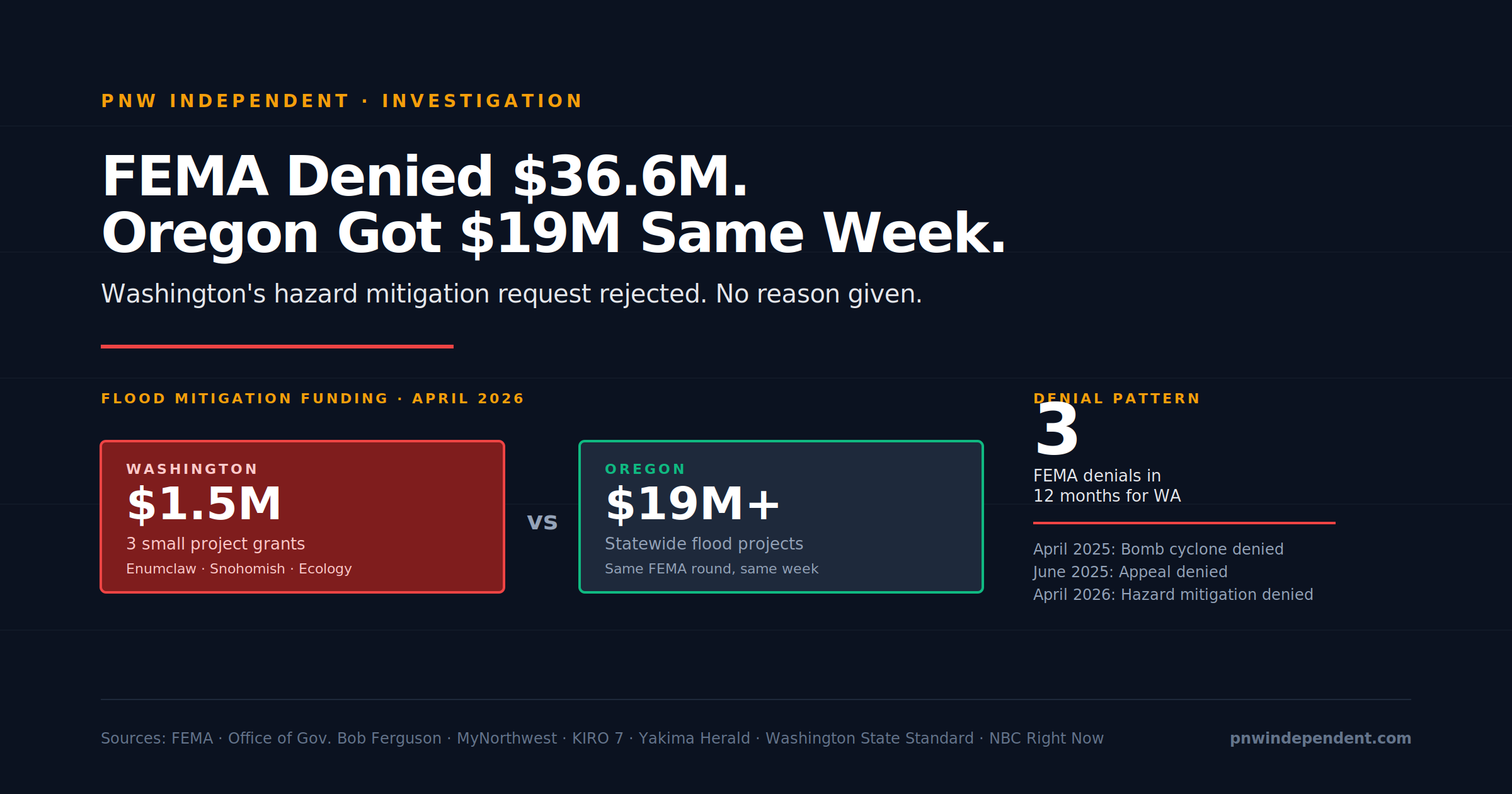
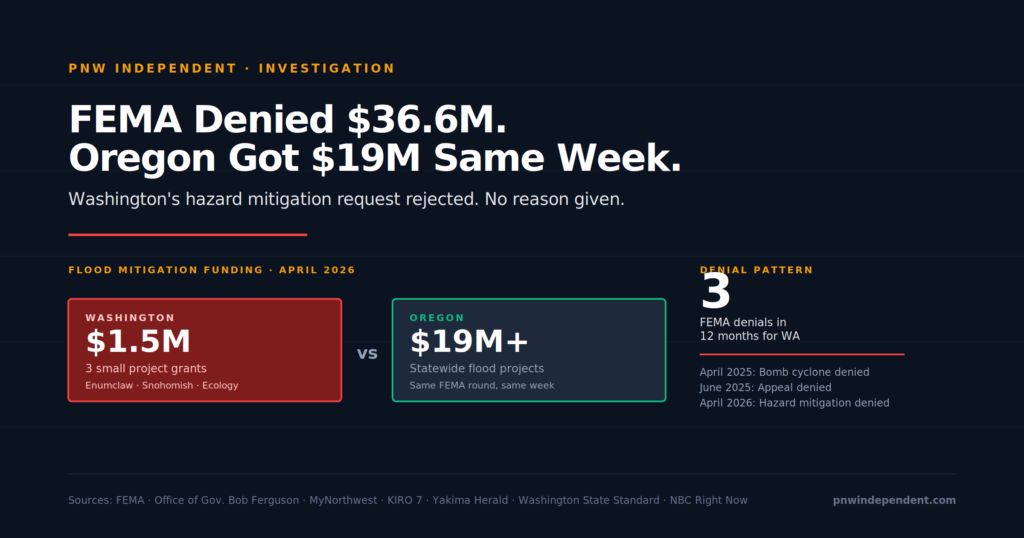
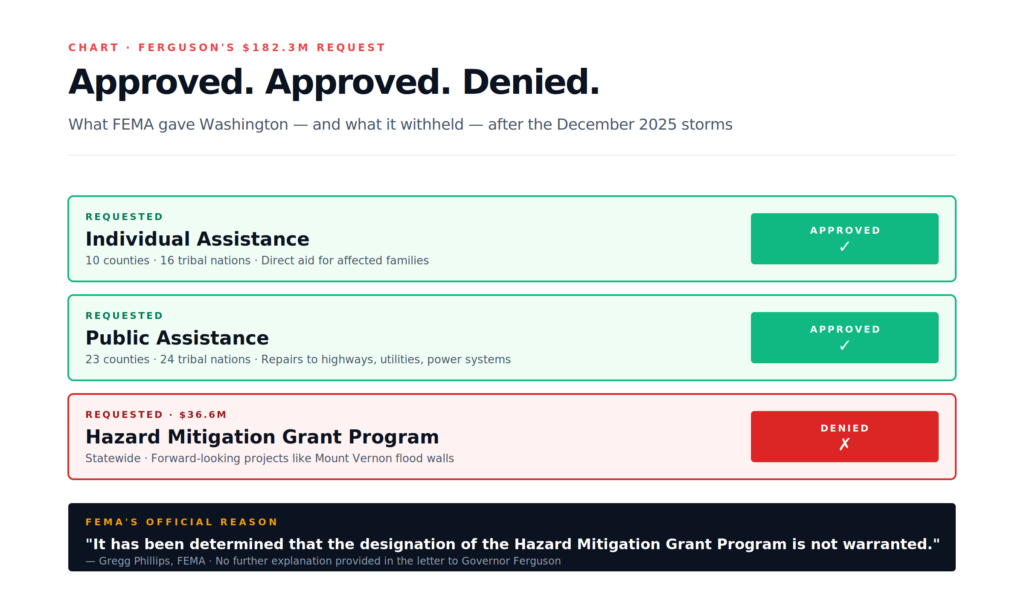
The denial of Washington’s $36.6 million Hazard Mitigation Grant Program request landed last Friday. Governor Bob Ferguson asked for $182.3 million in February to recover from December 2025’s historic flooding. FEMA approved Individual Assistance and Public Assistance — but flatly denied the statewide hazard mitigation funding. No reason was given. Meanwhile, Oregon received over $19 million from the same FEMA program the same week. Washington got $1.5 million for three specific projects. This is the third FEMA denial Washington has received in 12 months. Ferguson has 30 days to appeal. The deadline is May 23, 2026.
What the FEMA Denial Actually Says
The denial arrived in a letter from Gregg Phillips, FEMA associate administrator in the Office of Response and Recovery, addressed to Governor Bob Ferguson. The letter acknowledged the storm damage. Furthermore, it approved most of what Washington requested. However, the Hazard Mitigation Grant Program request was rejected outright.
The exact language from Phillips’ letter:
“You specifically requested Individual Assistance for 10 counties and 16 tribal nations; Public Assistance for 23 counties and 24 tribal nations, and Hazard Mitigation statewide. The impact to individuals and households and the infrastructure was significant in the areas designated for Individual Assistance and Public Assistance. However, it has been determined that the designation of the Hazard Mitigation Grant Program is not warranted.”
Notice what is missing from that letter. No reason for the denial. No explanation of what threshold Washington failed to meet. No documentation gap identified. No data Washington failed to provide. The letter simply states that statewide hazard mitigation funding “is not warranted.”
That phrasing matters. It is a discretionary determination, not a finding of fact.
The Numbers in the FEMA Denial
The denial blocks $36.6 million in funding. To put that in context:
- Total Ferguson requested: $182.3 million
- Hazard Mitigation portion denied: $36.6 million
- Specific Washington flood mitigation projects approved: $1.5 million
- Oregon’s parallel flood mitigation funding the same week: Over $19 million
In other words, Oregon got more than ten times what Washington received in flood mitigation grants from the same FEMA program announcement. Both states experience similar flooding patterns. Both states have similar populations in flood-prone areas. Both states are governed by Democrats — but only Oregon was approved at scale.
What Washington Actually Got
The denial of the statewide hazard mitigation request did not mean zero flood mitigation funding. Specifically, FEMA approved three small project-specific grants in Washington:
- $930,000 to the City of Enumclaw for culvert design replacement to reduce flooding from Newaukum Creek
- $300,000 to Snohomish County for a countywide flood risk study of dikes and levees
- $180,000 to the Washington State Department of Ecology to develop a flood-risk reduction strategy for frequently flooded areas
These three grants total approximately $1.5 million. By contrast, Oregon’s allocation in the same FEMA announcement exceeded $19 million. Furthermore, FEMA released $250 million nationwide for more than 100 flood mitigation projects in that round of funding. Washington’s $1.5 million represents about 0.6% of the total.
For a state that just experienced historic December flooding affecting 23 counties, that share is conspicuously small.
The Snohomish Grant Was Already Held Up
Buried in Representative Suzan DelBene’s press release on the announcement is a detail worth highlighting. The Snohomish County flood-risk study grant was initially approved in June 2025 — nearly a year before it was finally announced. The funding was held up “awaiting the signature of then-Homeland Security Secretary Kristi Noem.”
That’s not a quibble. A federal grant that should have moved in weeks took ten months to clear the Department of Homeland Security signature line. The damage in December 2025 happened during that delay.
How Washington Got Here
Washington’s December 2025 storms were not a minor weather event. The flooding that ran from December 5 through December 22, 2025 was historic by every measure used to evaluate disaster declarations.
The Damage
In December 2025 alone, the storms produced:
- Record flooding across 23 Washington counties
- Affected 24 tribal nations
- Killed multiple people
- Destroyed or damaged thousands of homes
- Caused widespread power outages
- Damaged public highways, utilities, and electrical power systems
- Required Governor Ferguson to declare a statewide emergency
- Triggered evacuation orders potentially affecting 100,000 residents
The Initial Federal Response
President Donald Trump signed Ferguson’s request for an emergency declaration in December 2025, opening immediate federal assistance. FEMA partnered with state officials on the preliminary damage assessment. State Military Department Emergency Management Division Director Robert Ezelle publicly described FEMA at the time as “great partners in this whole thing.”
Therefore, the initial federal response was cooperative. The question is what happened between December 2025 and April 2026 that changed the calculus.
The Mount Vernon Comparison
Ferguson made a specific argument in February 2026 when filing the request. He pointed to the Mount Vernon flood wall — a piece of infrastructure built in the past decade — that prevented downtown Mount Vernon from being flooded during the December storms.
“The damage in many parts of our state, as I’ve mentioned many times, would have been even worse, significantly worse, without infrastructure to protect against the flooding,” Ferguson said. “It’s clear that the flood wall saved downtown from being flooded and saved an awful lot of pain and suffering costs to many Washingtonians.”
That is the case for hazard mitigation funding in plain English: infrastructure investment now prevents disaster spending later. FEMA’s denial of the statewide program forecloses exactly that approach for the next round of storms.
The FEMA Denial Pattern Washington Has Seen Before
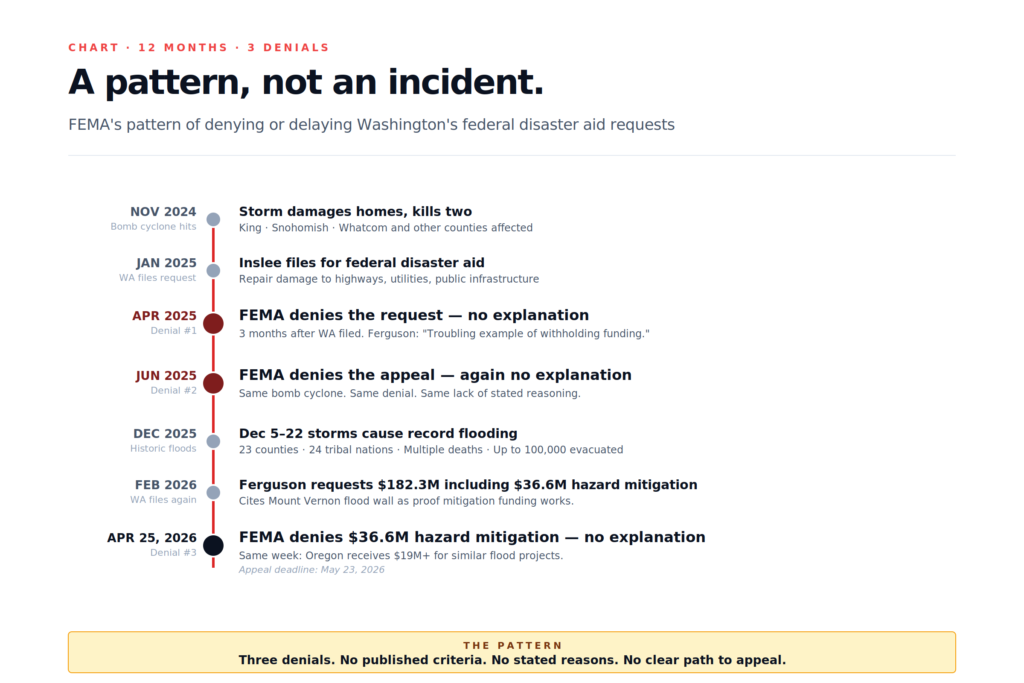
This is not the first FEMA denial Washington has received in the past 12 months. Therefore, the April 2026 letter to Ferguson sits inside a documented pattern.
April 2025: Bomb Cyclone Denial #1
Washington applied for federal disaster relief funds in January 2025 to repair damage from the November 2024 bomb cyclone. The storm had caused widespread damage across King, Snohomish, Whatcom, and other counties. Three months later, FEMA denied the application without explanation.
Ferguson’s response at the time: “This is another troubling example of the federal government withholding funding.”
June 2025: Bomb Cyclone Denial #2
Washington appealed the April denial. FEMA denied the appeal in June 2025. Again, no detailed explanation was provided.
April 2026: The December 2025 Storm Denial
Now the denial pattern extends into Year 2. The April 2026 letter denying the $36.6 million hazard mitigation portion of the December 2025 storm request is the third partial or full denial Washington has received in 12 months.
The Geographic Pattern
PNW Independent reviewed the same week’s FEMA announcements. The denial of Washington’s hazard mitigation request happened in the same announcement cycle that:
- Approved over $19 million for Oregon flood mitigation projects
- Canceled FEMA’s agreement to fully reimburse North Carolina for ongoing Hurricane Helene response
- Released $250 million nationwide for over 100 flood mitigation projects, of which Washington received $1.5M (0.6%)
Oregon’s governor: a Democrat. North Carolina’s governor: a Democrat (with a Republican-controlled legislature). Washington’s governor: a Democrat. The pattern across these three states is mixed — Oregon got funded, North Carolina got cut, Washington got partially denied.
That mix makes a clean partisan-targeting narrative difficult to assert. However, it also makes the discretionary nature of the denial process more concerning. These decisions are being made without published criteria. State governments cannot predict outcomes. Furthermore, they cannot effectively appeal what they cannot understand.
What State Leaders Are Saying About the FEMA Denial
The political reaction to the denial broke along predictable partisan lines, but with one important nuance.
Ferguson’s Response
Ferguson plans to appeal the decision. His office did not immediately publish a detailed statement on the April 2026 denial. However, his April 2025 statement on the previous FEMA denial set the framework: “This is another troubling example of the federal government withholding funding.”
His office told FOX 13 Seattle on the broader budget context: “Washington has the highest bond rating in the country, and we’re working hard to keep it.” That statement does not directly address the denial. However, it suggests the administration views the federal funding as part of broader fiscal pressure on the state.
Republican Reaction
Republican Representative — quoted in MyNorthwest’s reporting — said the decision was “an unacceptable decision for the families and businesses that I represent.”
That is notable. Republican criticism of a Republican-administration FEMA decision is the kind of bipartisan response that suggests the denial is not being viewed primarily through a partisan lens at the state level. Washington families need the funding regardless of which party occupies the White House.
The Treasurer Position
State Treasurer Mike Pellicciotti, who has been publicly warning about Washington’s structural budget problems for two sessions, has not yet released a statement on the denial. However, the math is straightforward. Federal disaster funds that do not arrive must come from somewhere else. Specifically:
- The state’s already-strained reserves
- The Public Works Assistance Account (already raided $375M to balance the budget)
- New tax revenue (the contested millionaire’s tax)
- Or — the option Olympia is using by default — deferred infrastructure investment
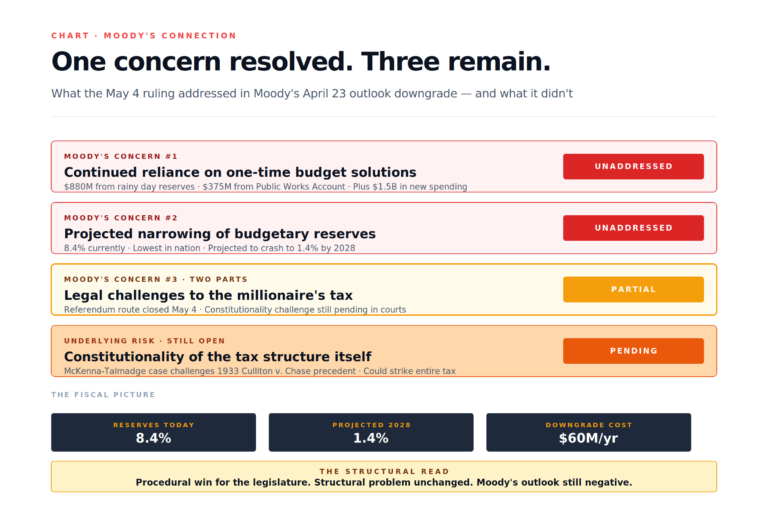
Each of those options has costs. None are free. The denial therefore compounds the same structural budget problem PNW Independent documented in our Moody’s downgrade investigation.
What Comes Next After the FEMA Denial
Ferguson has 30 days to appeal the denial. The deadline is May 23, 2026.
What an Appeal Requires
A FEMA appeal requires the state to provide additional damage information or documentation supporting the original request. However, the agency’s letter did not specify what was missing from Washington’s original submission. Therefore, the state is appealing without a clear target.
That is the structural problem with the denial process for hazard mitigation funding. Specifically:
- No published criteria for “warranted” determinations
- No itemized rejection reasons in denial letters
- No transparency on what comparable states received and why
- No standard appeals process beyond resubmitting the original case
What Washington Could Do Differently
Several options are available to Washington beyond appealing this single denial:
1. Congressional pressure. Washington’s congressional delegation includes ranking members on relevant committees. A coordinated push through Senator Maria Cantwell and Senator Patty Murray could elevate the denial to the level of public hearing.
2. Litigation. If the denial cannot be justified by published criteria, the state may have grounds for an Administrative Procedure Act challenge. Other states have sued FEMA successfully on similar process grounds.
3. Transparency demand. The state can file a Freedom of Information Act request for the underlying FEMA decision documents — the analyst notes, the regional administrator review, the comparison data with Oregon. Sunshine matters.
4. State self-funding. Washington can fund hazard mitigation projects from state resources. However, this option compounds the budget problem Moody’s just flagged. Furthermore, it sets a precedent that erodes the federal-state disaster response framework.
5. Public accountability. Document every FEMA denial, every approval, every comparable-state outcome, and make it public. Build a record that future appeals and future congressional inquiries can use.
The Bottom Line on the FEMA Denial
The denial is not the largest dollar figure in Washington’s recent fiscal news. The Moody’s downgrade implies $60 million per year in additional borrowing costs. The KCRHA audit found $13 million missing. Sound Transit faces a $34.5 billion shortfall.
However, the denial matters for a different reason. It is the first level at which the structural problems documented across Washington’s state and regional governance are now being priced in by the federal government. When Washington asks for $36.6 million in hazard mitigation funding to prevent the next disaster, and FEMA returns that request with no explanation while approving Oregon’s parallel ask, the message is unambiguous.
Federal partners are recalibrating their relationship with Washington State. That recalibration costs money — money Washington’s reserves cannot absorb, money the contested millionaire’s tax cannot replace, and money the Public Works Assistance Account cannot lend because it has already been raided.
The denial is the smallest of the recent fiscal warnings. However, it is also the most predictive. What gets denied at $36.6 million today gets denied at $360 million tomorrow. Federal disaster aid is one of the most reliable revenue streams a state has. When that stream becomes contingent on discretionary review without published criteria, the structural problem is no longer Washington’s alone. It is the federal-state relationship itself.
Ferguson has until May 23, 2026 to file an appeal. Washington taxpayers have until then to ask why this keeps happening.
Related Reading on PNW Independent
- Moody’s Downgrade: Washington State Built This Hole
- KCRHA Audit: $13M Missing in Seattle’s Homeless Agency
- Sound Transit Failure: $185B Boondoggle Run by Insiders
- Pierce County Voted No on ST3. Now They Lose the Train.
External Sources
- MyNorthwest — FEMA rejects hazard mitigation funding after Washington’s December storms (April 25, 2026)
- KIRO 7 — FEMA rejects hazard mitigation funding after Washington’s December storms
- Yakima Herald — FEMA funds some Washington flood mitigation, but denies statewide funds
- Washington State Standard — FEMA denies WA request for bomb cyclone disaster aid (April 2025)
- Washington State Standard — Ferguson taps emergency funding to aid WA residents hit by flooding (December 2025)
- NBC Right Now — Trump administration denies hazard mitigation aid after Washington floods
- Governor Bob Ferguson statement on denial of federal disaster funds (April 2025)
- FEMA Hazard Mitigation Grant Program