How Brutal Seattle Data Center Plans Exposed a Power Crisis
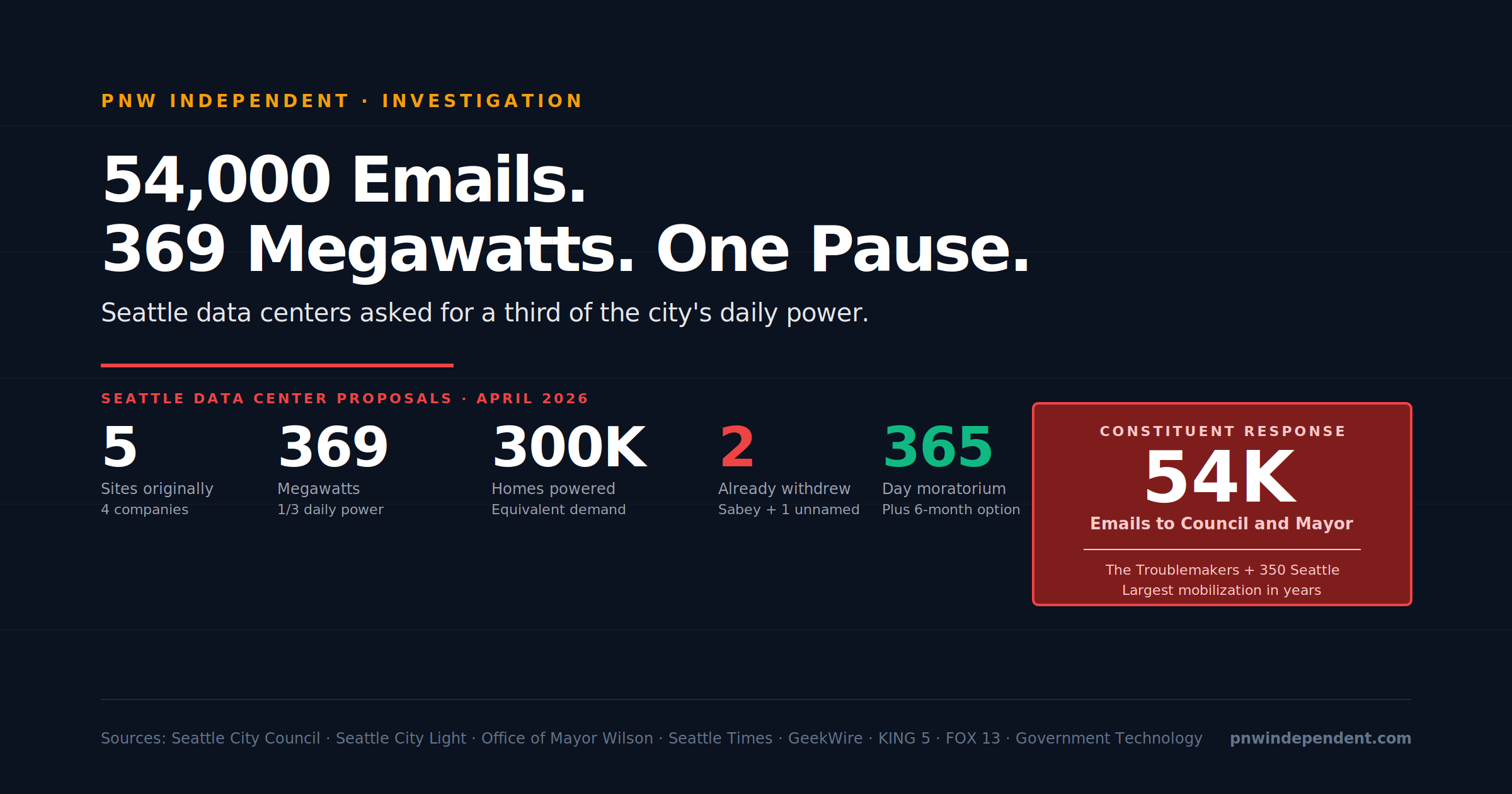
Seattle data center plans triggered the largest constituent response City Hall has seen in years. 54,000 messages flooded council inboxes after the Seattle Times revealed four tech companies wanted to build five hyperscale data centers consuming 369 megawatts — roughly one-third of Seattle’s average daily power. Two developers have since withdrawn. Three Council members introduced a 365-day moratorium on April 30. Two firms remain — Equinix and Prologis — with three sites still seeking 249 MW. Furthermore, Mayor Katie Wilson backed the pause. Washington is in its fourth consecutive year of drought emergency. Hydropower is declining. Ratepayers would absorb the costs. Here is the data — and what it actually means.
What the Seattle Data Center Proposals Actually Asked For
The data center conversation began with a Seattle Times report on April 10, 2026. Specifically, the report revealed that four tech companies had approached Seattle City Light about building five large-scale data centers in the city. Furthermore, the combined maximum demand was staggering.
The Original 369-Megawatt Ask
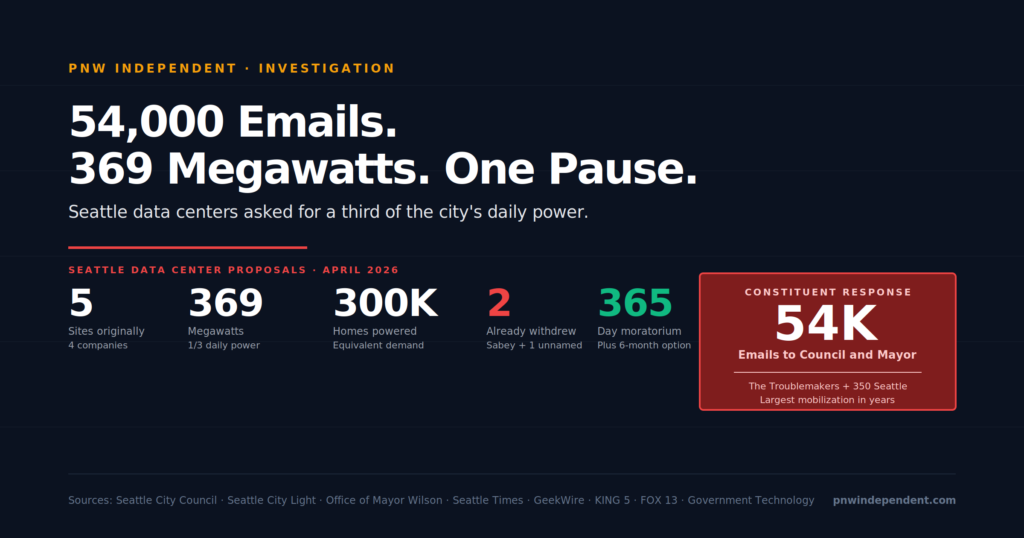
The five originally proposed Seattle data center sites would have consumed:
- 369 megawatts combined maximum demand
- Roughly one-third of Seattle’s average daily power consumption
- Enough electricity to power approximately 300,000 homes
- Each individual facility would draw between 54 and 117 megawatts
For context, a 117 MW data center typically occupies 500,000 to 1 million square feet of space. Therefore, these were not incremental upgrades to existing facilities. They would be among the largest power consumers in the city’s electrical system.
How That Compares to Existing Seattle Capacity
Seattle currently has approximately 30 small data centers with a total inventory of 155.8 megawatts as of early 2025, according to commercial real estate firm CBRE. Therefore, the proposed Seattle data center expansion would have:
- More than doubled the city’s total data center capacity
- Created facilities roughly 10 times larger than existing ones at full capacity
- Established Seattle as a hyperscale data center market for the first time
In other words, the proposals represented a fundamental change in scale, not an incremental growth pattern.
The Companies Behind the Proposals
The four companies originally identified were:
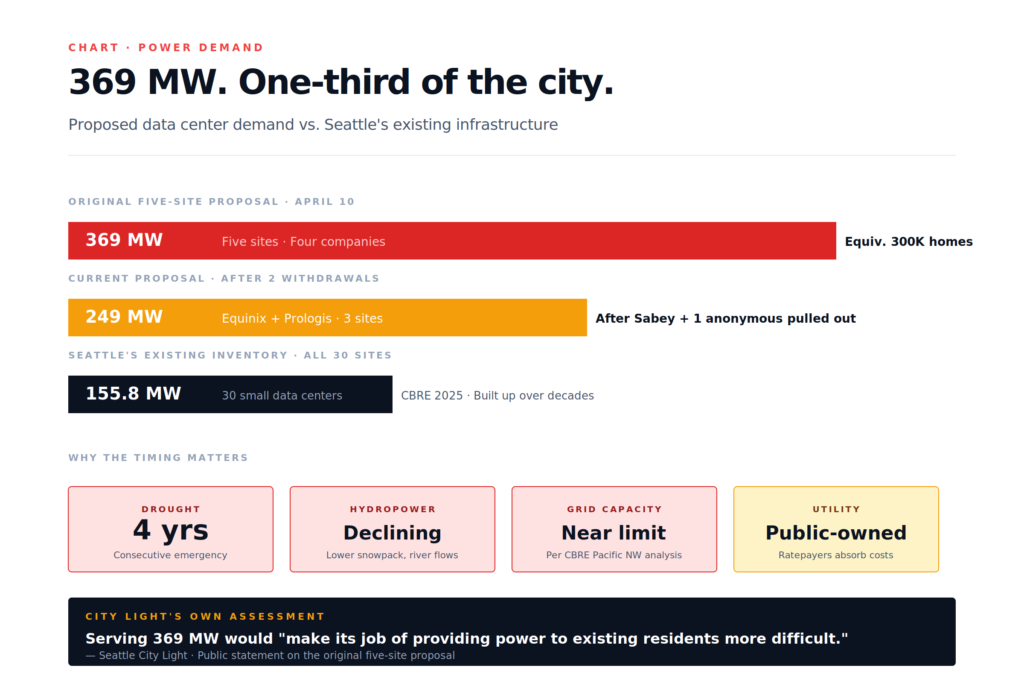
- Prologis (San Francisco, California)
- Equinix (Redwood City, California)
- Sabey (Tukwila, Washington)
- One unidentified company that withdrew within a week of the original report
Specifically, neither Microsoft nor Amazon were among the companies. Furthermore, Sabey withdrew on Thursday, May 1, citing internal design constraints. Therefore, only Equinix and Prologis remain — with three combined facilities still seeking 249 megawatts of power.
A Late Entry: Pacland
Separately, Pacland — acting on behalf of an unidentified stakeholder — filed early-stage permits for a $220 million site at 3625 1st Avenue South. The company has not returned phone calls or email requests for information. Furthermore, Pacland’s project was not part of the original four-company application that drove the public outcry. Therefore, the data center moratorium would also affect this late-entry project if passed.
How 54,000 Emails Drove the Seattle Data Center Moratorium
The data center proposals triggered the largest organized constituent response City Hall has seen in years. Specifically, more than 54,000 messages flooded the Seattle City Council and Mayor’s Office inboxes between April 10 and the moratorium announcement.
The Activist Coalition
Two groups led the public mobilization:
- The Troublemakers — local activist group focused on tech accountability
- 350 Seattle — climate activism organization
Specifically, Bryce Sutton of The Troublemakers told FOX 13 that the campaign was structured around protecting ratepayers and environmental justice concerns. “I want folks to know that they should care, if nothing else, because it’s going to be their power bills, it’s going to be their quality of life,” Sutton said.
Why the Response Was So Large
Three factors drove the unusually high constituent engagement:
1. Direct cost concern. Seattle City Light is a publicly-owned utility. Therefore, every additional megawatt of demand affects rates that every Seattle resident pays directly. Unlike most policy debates where the financial connection is abstract, Seattle data center costs would land on every monthly utility bill.
2. Drought context. Washington is in its fourth consecutive year of drought emergency. Hydropower availability has been declining. Furthermore, City Light has increasingly relied on wholesale electricity markets to make up the gap. Adding 369 MW of new demand during a drought emergency triggered immediate concern from environmentally-focused residents.
3. National pattern recognition. Similar data center moratorium debates were happening in Maine, Missouri, and North Carolina at the same time. Therefore, Seattle activists could point to documented examples of utility rate spikes elsewhere as evidence of what could happen locally.
The Seattle Data Center Moratorium Legislation
On April 30, 2026, three Council members announced plans to introduce a 365-day moratorium on new Seattle data center siting. Furthermore, the legislation would be paired with a resolution requiring detailed impact studies.
The Sponsors
The moratorium has three named sponsors:
- Councilmember Eddie Lin (District 2) — prime sponsor of the moratorium legislation
- Council President Joy Hollingsworth (District 3) — co-sponsor
- Councilmember Debora Juarez (District 5) — author of the accompanying resolution
Specifically, Juarez said she had been working on the resolution for several months before the public outcry crystallized political support.
What the Moratorium Does
The data center moratorium structure includes:
- 365-day pause on the siting of new data centers
- Option for a six-month extension by City Council
- Effective immediately upon adoption
- Public hearing required within 60 days
- Both moratorium and resolution to be introduced by mid-May
- Impact studies required on infrastructure, water, utility rates, land use, jobs, and public health
Furthermore, the legislation will move through the Land Use and Sustainability Committee and the City Light and Parks Committee for review.
What the Resolution Requires
The accompanying resolution calls for studies on:
- Electrical grid capacity and reliability
- Water usage
- Environmental sustainability
- Utility rates
- Land use and development
- Jobs and the economy
- Public health
- Community well-being
Therefore, the moratorium creates time for the city to actually understand what large-scale data center development would do — before approving any of it.
What Council Members Are Saying About Seattle Data Centers
The political coalition behind the data center moratorium is broader than the three named sponsors. Furthermore, the language across statements points to a unified concern about ratepayer protection.
Lin: “We Should Not Be Subsidizing”
Councilmember Eddie Lin, the moratorium’s prime sponsor, framed the issue in stark economic terms:
“Mega data centers are popping up across the country, driving up utility costs for residents and small businesses and increasing air, water and noise pollution when not properly regulated. Thousands of Seattleites have made their voices heard — we should not be subsidizing the massive and record profits of tech corporations pursuing large AI data centers in our city.”
That phrase — “subsidizing the massive and record profits of tech corporations” — is unusual political language for Seattle. Specifically, it directly characterizes the data center expansion as a transfer from ratepayers to corporate shareholders. Therefore, Lin is not framing this as a regulatory question but as a wealth-distribution question.
Hollingsworth: “Necessary Safeguards”
Council President Joy Hollingsworth’s framing emphasized infrastructure protection:
“It is essential to put necessary safeguards in place for our communities, our infrastructure, and our environment from the impacts of large-scale data centers. Data centers can bring both negatives and positives to a city — ultimately, we need to learn more about the second-hand effects of these facilities, including utility rates.”
Therefore, Hollingsworth is keeping the door open to eventual approvals while demanding full data before commitments. That posture matters because she controls the council agenda.
Juarez: South Seattle Equity Concern
Councilmember Debora Juarez specifically raised equity concerns about which neighborhoods would absorb the impact:
“South Seattle already suffers disproportionately from higher levels of pollution as well as heat islands. We need to hit pause on data centers, engage with neighboring jurisdictions, and develop regulations that prohibit mega data centers unless they can be done in economically and environmentally sustainable ways that benefit all of us.”
That equity framing is important. Specifically, hyperscale data centers tend to be sited in industrial zones — which in Seattle disproportionately fall in South Seattle communities that already face pollution burdens. Therefore, the data center decision is also a decision about who absorbs the environmental costs.
Why the Seattle Data Center Power Demand Matters
The numbers behind Seattle data center power demand are important to walk through carefully. Furthermore, the implications go beyond simple supply-and-demand.
What 369 Megawatts Actually Means
To put 369 megawatts in context:
- Average household uses about 1.2 kW at peak
- One megawatt powers approximately 800 homes
- 369 MW powers approximately 300,000 homes
- Seattle’s existing 30 data centers combined draw 155.8 MW
- The proposed five sites would have drawn 369 MW
Therefore, the proposals would have demanded more than twice the entire existing Seattle data center inventory — and that inventory took decades to develop.
The Hydropower Decline
Seattle City Light gets the majority of its power from hydroelectric sources. However, declining snowpack, drought, and changing river flow patterns have reduced hydropower reliability over recent years. Specifically:
- Washington is in its fourth consecutive year of drought emergency
- City Light has been relying more on wholesale electricity markets to make up gaps
- Wholesale prices vary significantly and are typically more expensive
- Therefore, every additional megawatt of demand pushes more of City Light’s portfolio into volatile market purchases
In other words, Seattle data center demand would not just consume existing capacity. It would push the utility deeper into expensive, less-reliable supply.
What Industry Experts Say
CBRE’s Jane Blair, senior vice president for Data Center Solutions in Seattle, told KING 5 that the Pacific Northwest is constrained: “Many of the state’s power grids are operating near capacity.”
Furthermore, City Light itself acknowledged that serving 369 MW of additional load would “make its job of providing power to existing residents more difficult.” That is the utility saying — in writing — that residential ratepayers would be affected.
How Wilson Responded to the Seattle Data Center Push
Mayor Katie Wilson’s administration moved relatively quickly on the data center issue. Specifically, her response unfolded across three phases.
Phase 1: Public Acknowledgment (April 18)
Wilson posted on Facebook on April 18 acknowledging the concerns. Specifically, her statement read:
“It is important to know that the City of Seattle has not authorized nor permitted any new data centers. However, the prospect of massive new data centers being built in Seattle has raised understandably intense public alarm. I share community concerns about environmental justice, economic resilience, and impacts of increased costs for Seattle rate payers.”
Therefore, Wilson publicly aligned with constituent concerns rather than corporate interests within eight days of the original Seattle Times report.
Phase 2: Policy Direction (Late April)
Two weeks after her initial Facebook statement, Wilson instructed relevant city departments to develop a coordinated approach. Specifically, the directive covered Seattle City Light, the City Attorney’s Office, the Office of Sustainability and Environment, and other relevant departments.
Phase 3: Council Partnership (May 1)
On May 1 — one day after the Council moratorium announcement — Wilson’s office released a statement describing “continued partnership with City Council on legislation creating a one-year moratorium on new or expanded large-load (10MW+) data centers.” Furthermore, her office announced specific initial steps:
- Seattle City Light is finalizing a large-load policy for data centers to ensure infrastructure costs are not borne by Seattle residents
- The City will prioritize advocating for state legislation regulating large-load data centers in the 2027 legislative session
- A report analyzing economic impacts will be prepared
Therefore, the Wilson administration is treating this as a coordinated city-state-utility policy response rather than just a council action.
How Other States Are Handling Mega Data Centers
The data center moratorium is not happening in isolation. Furthermore, similar policy debates are active in multiple states experiencing similar pressure from AI-driven data center demand.
The National Pattern
Cities and states currently considering or implementing data center restrictions include:
- Maine — moratorium discussions tied to grid capacity
- Missouri — local restrictions in several jurisdictions
- North Carolina — moratorium debate at multiple government levels
- Several Texas cities — facing similar grid pressure from AI workloads
The common thread is that AI-driven computing demand has escalated faster than utility infrastructure can absorb. Therefore, communities are pausing approvals while they figure out who pays for grid expansion.
Why Seattle Is Different
However, Seattle’s situation has specific local factors:
1. Public utility ownership. Seattle City Light is a publicly-owned utility. Therefore, ratepayers — not shareholders — absorb infrastructure costs and benefits. This makes the financial transfer from ratepayers to data center operators more visible.
2. Drought constraints. Washington’s drought emergency makes the supply-side question more acute than in states with abundant fossil-fuel generation capacity.
3. Equity geography. Seattle’s industrial zones — where data centers typically site — overlap with communities of color in South Seattle. Furthermore, those communities already face documented disproportionate pollution and heat-island exposure.
Therefore, Seattle’s data center debate combines economic, environmental, and equity dimensions in ways that make it an unusually clear case for restrictive policy.
What Should Happen Next on Seattle Data Centers
The data center moratorium is moving forward. However, several specific decisions still require attention.
1. Pass the Moratorium with the 60-Day Hearing Built In
The current proposal includes a 60-day public hearing requirement. Therefore, the council should pass the moratorium quickly while ensuring the hearing actually engages the constituents who drove the 54,000-email response. Furthermore, the hearing should include ratepayer representatives, environmental justice advocates, and labor voices — not just industry representatives.
2. Set Specific Pre-Approval Criteria
Any future Seattle data center approval should require, at minimum:
- Demonstrated own-source electricity supply (not from City Light’s residential pool)
- Documented water-use plan consistent with drought constraints
- Local labor commitments with specific job-quality standards
- Environmental impact bonds to cover documented harms
- Quarterly performance reporting with public access
Without specific criteria, the moratorium just delays the same approval process.
3. State-Level Coordination
Wilson’s administration has signaled intent to push state legislation in 2027. Furthermore, that effort should include:
- Large-load customer rate structures that prevent residential cross-subsidy
- Regional grid coordination to prevent jurisdiction shopping
- Data center transparency requirements for power, water, and labor data
- Tax structure review to ensure state and local revenues match the actual costs
4. Address the Broader Power Question
Seattle City Light has been operating under increasing pressure from declining hydropower, growing electrification of transportation, and rising peak demand. Therefore, the data center conversation is also a conversation about the city’s broader energy future. Specifically: how does Seattle modernize the grid, expand renewable capacity, and protect residential rates simultaneously? The data center moratorium creates space for that conversation. The conversation itself still needs to happen.
5. Track the Withdrawals
Two developers have already withdrawn. Furthermore, both withdrew without naming the underlying reasons clearly. Therefore, the city should track whether withdrawn proposals reappear under different corporate names or in neighboring jurisdictions. Specifically, “withdrew” does not mean “abandoned the Pacific Northwest market.”
The Bottom Line on the Seattle Data Center Moratorium
The data center moratorium represents one of the clearest cases of constituent pressure shaping local policy in recent memory. 54,000 emails. Three council co-sponsors. Mayoral support. Two developers already pulled out. Furthermore, the policy response — a 365-day moratorium with mandatory impact studies — actually matches the scale of the public concern.
That alignment is unusual. Specifically, Seattle has documented patterns across KCRHA, Sound Transit, and other regional pass-through agencies of policy responses that lag far behind constituent concerns. Therefore, the data center moratorium is the rare case where the political response is moving at roughly the pace of public alarm.
That speed matters. Specifically, the underlying question — should Seattle ratepayers subsidize the AI data center buildout for tech corporations? — is the kind of question that, in many cities, gets answered before constituents realize the question was asked. In Seattle, the public asked the question first.
However, the harder work is still ahead. Furthermore, the moratorium does not actually prohibit data centers. It pauses approvals while studies are completed. Specifically: when the studies arrive, will the council actually use the findings to set meaningful restrictions? Or will the moratorium expire with a few cosmetic adjustments while the underlying economic pressure pushes the same approvals through anyway?
The answer to that question will not be available for at least 12 months. Therefore, the next year is what determines whether the 54,000 emails actually changed Seattle’s energy future — or just delayed the inevitable by one budget cycle. The data is now public. The pressure is now on. The clock is running.
Related Reading on PNW Independent
- KCRHA Dissolution: Legislation Introduced. Vote in August.
- Moody’s Downgrade: Washington State Built This Hole
- Yesler Terrace Gunfire: Wilson Paused Cameras Six Weeks Ago
- Who Really Runs Seattle: Two Machines, One Ruling Class
External Sources
- Seattle City Council — Councilmembers introducing moratorium on data centers in Seattle (April 30, 2026)
- Office of Mayor Wilson — Mayor Wilson identifies initial steps for action on data centers (May 1, 2026)
- Seattle Times via Spokesman-Review — 2 data center developers pull Seattle plans amid opposition
- GeekWire — Seattle mayor floats moratorium on new data centers in city limits
- KING 5 — Seattle considers ban on new data centers after reported expansion interest
- FOX 13 Seattle — Seattle mayor responds to growing concerns surrounding data center proposals
- Broadband Breakfast — Seattle Considers 365-Day Data Center Moratorium
- Government Technology — Data Center Developers Pull Seattle Plans Amid Opposition
- The Daily Chronicle — New Seattle data centers could spike electric rates