How a Brutal NFL Fraud Stole $197M From Disabled Veterans
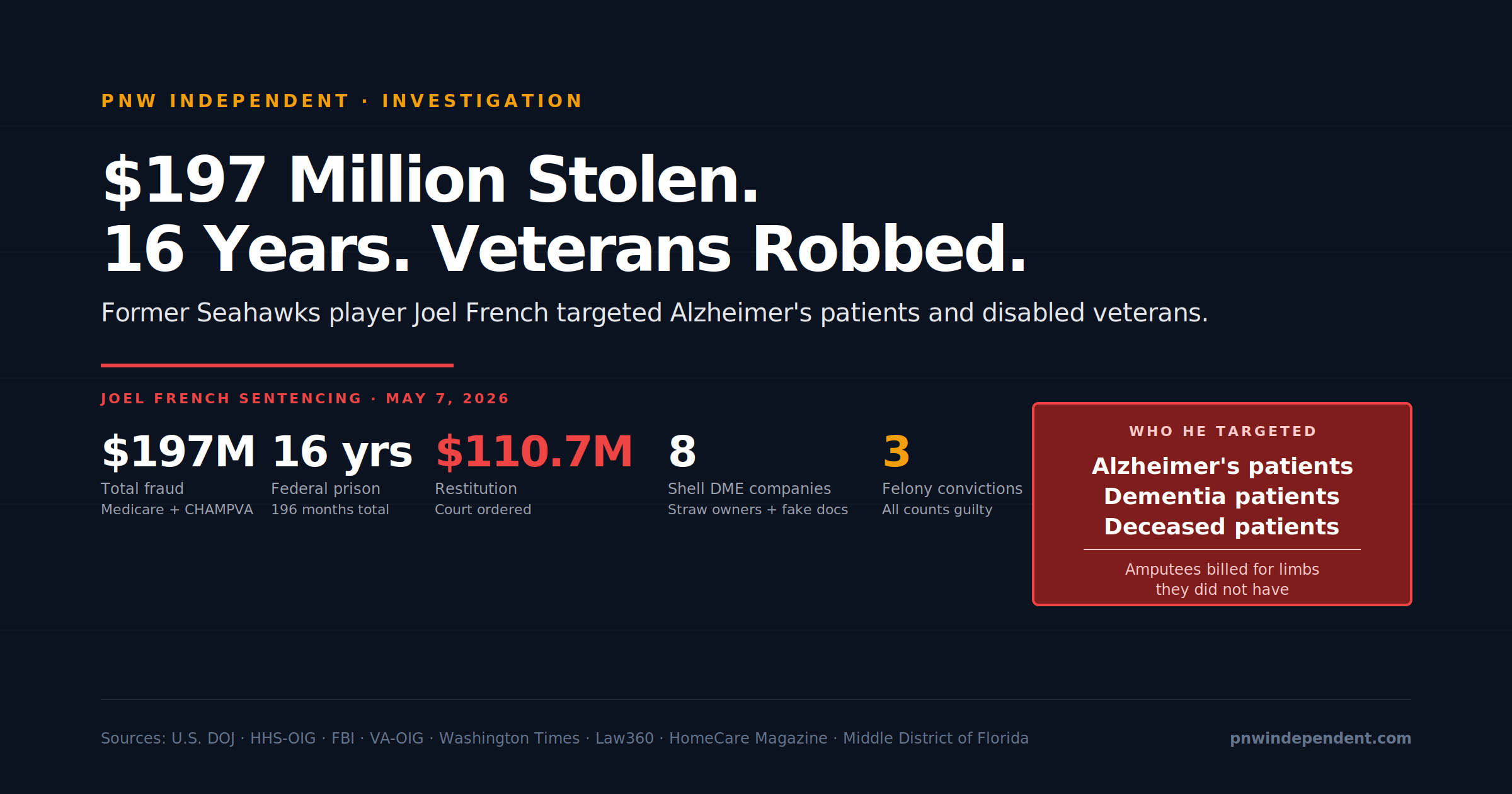
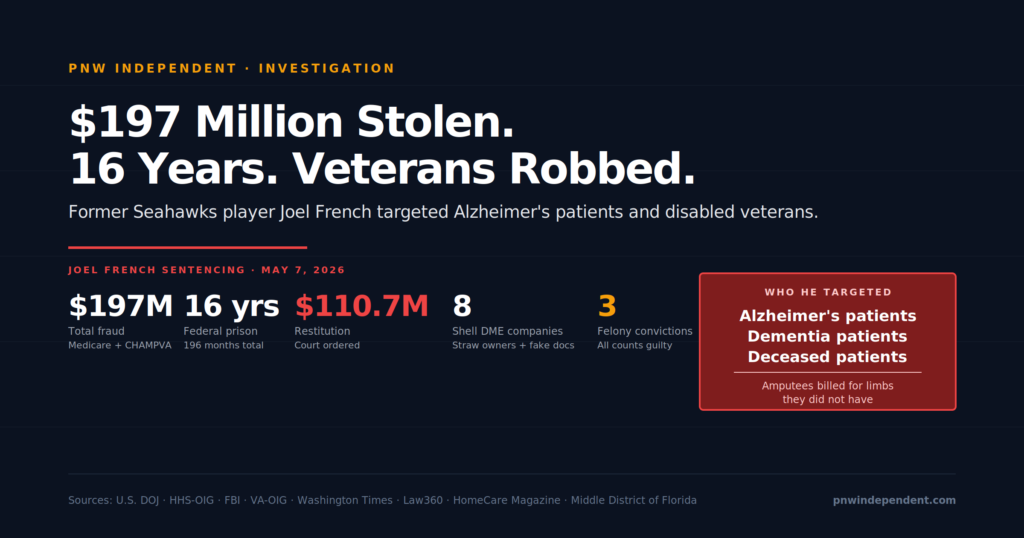
Former Seattle Seahawks and Green Bay Packers player Joel Rufus French was sentenced May 7, 2026 to 16 years and 4 months in federal prison for orchestrating a $197 million Medicare and CHAMPVA fraud scheme. Furthermore, the operation targeted some of America’s most vulnerable people — elderly Americans with Alzheimer’s and dementia, and the families of disabled or deceased veterans. French billed Medicare for orthotic braces for amputees who didn’t have the limbs the braces were for. He billed for deceased patients. He used overseas telemarketing call centers that altered recordings to fake patient consent. Eight shell companies routed the fraudulent claims. $110.7 million in restitution was ordered. Federal investigators recovered $17 million in seized assets. The fraud was caught. However, Medicare loses approximately $60 billion per year to similar schemes. Here is how the operation actually worked — and why most fraud like it never gets prosecuted.
What the Joel French Medicare Fraud Indictment Actually Says
The Joel French Medicare fraud case unfolded in the Middle District of Florida. Specifically, federal prosecutors documented a multi-year scheme that combined overseas call centers, sham medical practices, and shell companies to extract nearly $200 million from federal healthcare programs. Furthermore, the documentation came from court records, evidence presented at trial, and a Department of Justice press release dated May 8, 2026.
The Top-Line Facts
The Joel French Medicare fraud verdict and sentencing produced specific documented numbers:
- Sentence: 196 months (16 years, 4 months) in federal prison
- Restitution: $110,753,619 ordered to be paid back to Medicare and CHAMPVA
- Asset forfeiture: Approximately $17 million seized from bank accounts and other holdings
- Total fraud: Nearly $200 million ($197 million per DOJ documentation)
- Conviction date: February 3, 2026 (six-day jury trial)
- Sentencing date: May 7, 2026
- Charges convicted: Three felony counts — conspiracy to commit healthcare fraud and wire fraud, conspiracy to commit money laundering, and conspiracy to offer, pay, solicit, and receive illegal kickbacks
- Maximum possible sentence: 35 years
- Sentence imposed: Approximately 47% of maximum
Who Joel French Is
Joel Rufus French is 47 years old, originally from Amory, Mississippi. Specifically, French was an All-American tight end at Ole Miss before briefly playing in the NFL. Furthermore, his NFL career included stints with the Seattle Seahawks and the Green Bay Packers. After retiring from professional football, French transitioned to the healthcare and medical equipment business.
That career transition matters for understanding the scale of the scheme. Specifically, French was not a back-of-the-house criminal scraping by on the margins. He was a former professional athlete with capital, networks, and operational sophistication. Furthermore, that operational sophistication is exactly what allowed the scheme to grow to nine-figure scale before federal investigators caught it.
What the Joel French Operation Did
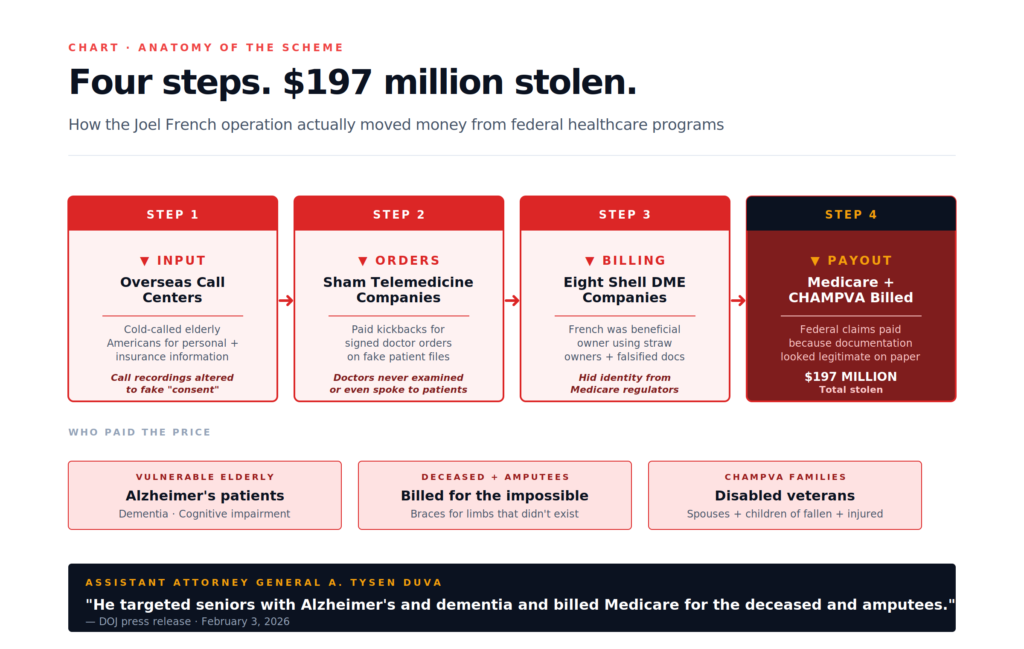
The Joel French Medicare fraud operated through a layered structure. Specifically, prosecutors documented four interlocking components:
1. Marketing company — French owned a marketing company that served as the operational hub.
2. Eight durable medical equipment companies — French was the beneficial owner of eight DME companies that he managed using straw owners and falsified documents. Furthermore, these companies are how Medicare and CHAMPVA were directly billed.
3. Overseas telemarketing call centers — French worked with foreign call centers that cold-called elderly Americans to pressure them into accepting medically unnecessary orthotic braces. Specifically, those call centers were located outside U.S. jurisdiction, making enforcement difficult.
4. Sham telemedicine companies — French paid kickbacks to fraudulent telemedicine businesses to obtain signed doctors’ orders from physicians and nurse practitioners who had never examined and often had never spoken to the patients.
Therefore, the scheme combined fake patient consent with fake medical justification to produce fake claims that Medicare and CHAMPVA paid as if they were legitimate.
How the Joel French Scheme Actually Targeted Victims
The Joel French Medicare fraud is most consequential not for its dollar value — though that value is staggering. Specifically, it is consequential for the documented targeting patterns. Furthermore, the targeting reveals what fraud at this scale actually looks like in practice.
Elderly Patients with Alzheimer’s and Dementia
Court documents specifically identified that some of the victims pressured into accepting fraudulent braces suffered from Alzheimer’s and dementia. Furthermore, Assistant Attorney General A. Tysen Duva characterized the conduct directly:
“This defendant’s conduct was egregious: he targeted seniors suffering from Alzheimer’s and dementia and billed Medicare for orthotic braces for deceased patients and amputees.”
Therefore, this was not opportunistic fraud that happened to catch confused patients. Specifically, the operation deliberately targeted patients whose cognitive impairment made them less likely to understand or remember the calls. Furthermore, those patients were also less likely to detect the fraudulent charges on Medicare statements they no longer reviewed clearly.
Deceased Patients
Federal prosecutors presented evidence at trial that French and his co-conspirators billed Medicare for braces for deceased beneficiaries. Specifically, that means claims were submitted under the names of patients who were already dead when the supposed treatment occurred.
Therefore, somewhere in the documentation chain, someone falsified records to make it appear that Medicare beneficiaries were receiving services they could not have received. Furthermore, because Medicare’s verification systems are designed primarily to detect duplicate billing rather than to confirm patient survival, those false claims were paid.
Amputees Billed for Limbs They Did Not Have
The most striking detail in the trial evidence: the scheme billed Medicare for orthotic braces sent to amputees for limbs they did not have. Specifically, federal investigators documented cases where claims for knee braces were submitted for patients whose legs had been amputated above the knee. Furthermore, similar claims existed for arm braces submitted for patients with upper-extremity amputations.
That detail is what separates ordinary fraud from systemic predation. Specifically, billing for braces sent to non-existent limbs requires:
- Either deliberate billing for items never delivered (pure paper fraud), or
- Automated billing systems that cannot detect that claims are physically impossible
In either case, Medicare’s claims-processing infrastructure paid for items that could not have been used. Furthermore, that payment occurred not just once but at sufficient scale to contribute to the $197 million total.
Disabled Veterans’ Families
The fraud targeted CHAMPVA — the Civilian Health and Medical Program of the Department of Veterans Affairs. Specifically, CHAMPVA serves the spouses and children of veterans who:
- Have or had a permanent and total service-connected disability, OR
- Died from a service-connected condition
Therefore, CHAMPVA beneficiaries are by definition the families of America’s most seriously injured and deceased veterans. Furthermore, those families rely on CHAMPVA for essential healthcare coverage during periods of significant family stress.
The Joel French Medicare fraud directly billed CHAMPVA for fraudulent equipment. Specifically, every dollar the scheme stole from CHAMPVA was a dollar that should have funded healthcare for the families of disabled or deceased veterans. That is not theft from an abstract government program. That is theft from veterans’ surviving spouses and orphaned children.
The Altered Call Recordings
Court documents revealed a particularly damning detail about how the scheme manufactured fake consent. Specifically, in certain instances, call center staff altered recordings to make it falsely appear that patients had agreed to accept the braces. Therefore, when investigators reviewed records of patient interactions, the recordings appeared to show consent that had never actually occurred.
That detail matters for two reasons. First, it shows the operation was technically sophisticated enough to manipulate digital evidence. Furthermore, it shows the operation anticipated regulatory scrutiny and built fake compliance documentation into its workflow. Both elements indicate this was not crude opportunistic fraud — it was professional criminal infrastructure.
How the Joel French Medicare Fraud Got Caught
The Joel French Medicare fraud was eventually caught through coordinated federal enforcement. Specifically, three federal agencies worked the investigation:
- Department of Health and Human Services Office of Inspector General (HHS-OIG)
- Federal Bureau of Investigation (FBI)
- Veterans Affairs Office of Inspector General (VA-OIG)
That triple-agency structure reflects the dual program impact. Furthermore, both HHS-OIG and VA-OIG have specific statutory authority to investigate fraud in their respective programs. Specifically, HHS-OIG handles Medicare and Medicaid fraud, while VA-OIG handles fraud affecting CHAMPVA and other VA-administered programs.
The Triggers
While the specific tip or analysis that initiated the case has not been disclosed publicly, several common patterns trigger DME fraud investigations:
1. Statistical billing anomalies — When a small DME company suddenly bills at orders of magnitude beyond peer companies, audit systems flag the pattern.
2. Patient complaints — Beneficiaries or family members who notice unfamiliar charges on Medicare summary notices can trigger investigations.
3. Provider self-reports — Doctors who notice their names attached to orders they did not write sometimes report to OIG.
4. Whistleblower complaints — Employees of fraudulent operations who file qui tam lawsuits under the False Claims Act can trigger major federal investigations and recover a percentage of recovered funds.
For this scheme, the combination of eight straw-owned DME companies billing for impossible services likely triggered statistical anomaly detection at HHS-OIG. Furthermore, the pattern of claims for amputees and deceased beneficiaries would have eventually surfaced through routine audit cross-checks against Social Security death records and existing patient records.
The Trial and Conviction
The Joel French case went to jury trial in the Middle District of Florida. Specifically, the trial lasted six days and concluded with conviction on February 3, 2026. Furthermore, the jury convicted French on all three counts:
- Conspiracy to commit health care fraud and wire fraud
- Conspiracy to commit money laundering
- Conspiracy to offer, pay, solicit, and receive illegal kickbacks
That all-three-count conviction is significant. Specifically, it indicates the prosecution presented strong evidence on each element of the case. Furthermore, the jury found beyond reasonable doubt that French not only participated but knowingly orchestrated the operation.
The Sentencing Calculus
The federal judge who sentenced French had statutory authority to impose up to 35 years total — 20 years for the healthcare fraud and wire fraud conspiracy, 10 years for the money laundering conspiracy, and 5 years for the kickback conspiracy. Specifically, the judge imposed 196 months (16 years, 4 months) — approximately 47% of the maximum.
That sentence calibration reflects multiple factors. Furthermore, federal sentencing guidelines consider:
- The dollar value of the fraud
- The vulnerability of the victims
- The defendant’s role in the conspiracy
- The presence of aggravating factors (targeting Alzheimer’s patients, billing for the deceased)
- Whether the defendant accepted responsibility
The 16-year sentence indicates the judge weighed the aggravating factors heavily while still considering French’s lack of prior criminal history and the absence of physical violence. Specifically, the targeting of dementia patients and deceased beneficiaries is what pushed the sentence above the lower bound.
What the Joel French Medicare Fraud Means for Federal Healthcare Programs
The Joel French Medicare fraud is one piece of a much larger pattern. Furthermore, the larger pattern is what should drive policy attention now that the case is resolved.
The Scale of Medicare Fraud
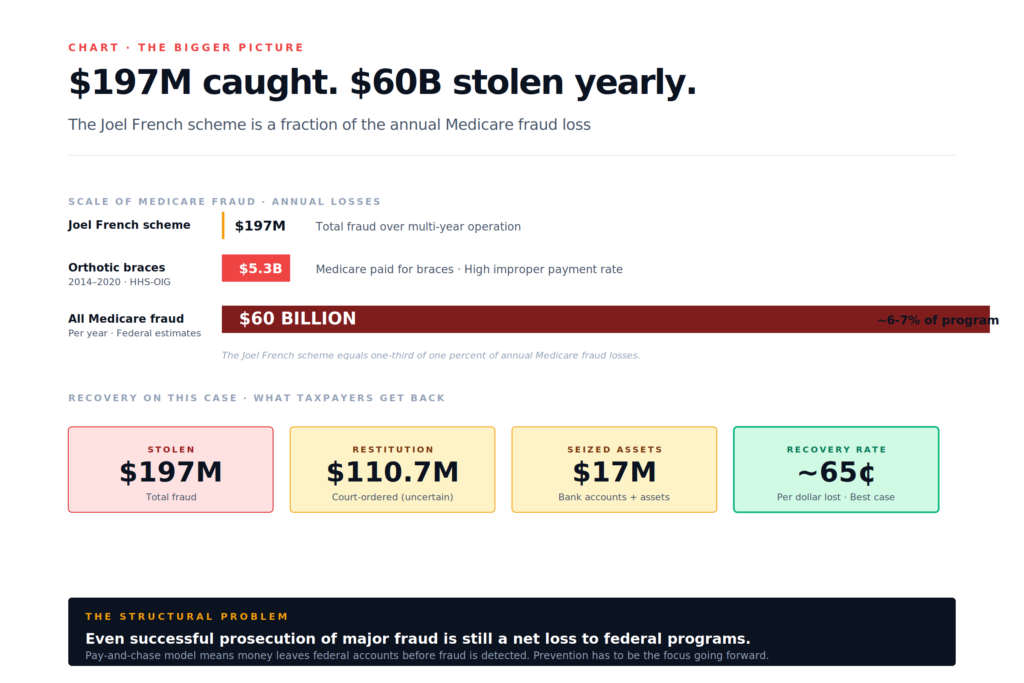
According to multiple federal estimates, Medicare loses approximately $60 billion per year to fraud. Specifically, that estimate aggregates outright fraud, improper payments, and abuse-related losses. Furthermore, that $60 billion represents roughly 6-7% of total Medicare program spending.
For context: the entire annual budget of the Washington State Department of Social and Health Services is approximately $20 billion. Therefore, Medicare loses roughly three times Washington’s entire DSHS budget every year to fraud. Furthermore, the Joel French scheme — at $197 million — represents roughly 0.3% of one year’s federal Medicare fraud losses.
That is not a comforting statistic. Specifically, it means federal investigators are processing fraud schemes of French’s scale on a routine basis — and the public only hears about a fraction of them.
The Orthotic Brace Pattern Specifically
Medicare paid approximately $5.3 billion for orthotic braces between 2014 and 2020, according to HHS-OIG. Furthermore, orthotic braces are consistently among the top items with the highest improper payment rates in the entire Medicare program. The DOJ has been pursuing brace fraud for years.
Specifically, in one of the largest related cases, the DOJ charged 24 defendants connected to telemedicine brace fraud schemes totaling over $1.2 billion. Furthermore, those operations involved call centers in the Philippines and Latin America.
Therefore, the Joel French scheme is not an outlier. Specifically, it is part of a documented industry pattern in which:
- Overseas call centers harvest patient information
- Sham telemedicine companies generate fake doctor orders
- Shell DME companies submit claims to Medicare
- Medicare pays the claims because the documentation looks compliant on paper
That pattern produces fraud losses sufficient to alter federal program economics. Furthermore, every dollar paid to the Joel French operation was a dollar that did not fund legitimate healthcare for actual Medicare beneficiaries.
Why the System Catches Some But Not All
The Joel French Medicare fraud was caught. Furthermore, the resulting prosecution should produce documented deterrence. However, the underlying systemic vulnerabilities remain.
Specifically, Medicare’s claims processing operates on a pay-and-chase model. Claims are paid first, then audited. Furthermore, this model is fast for legitimate providers but inherently vulnerable to fraud — by the time fraudulent claims are detected, the money has already left federal accounts and can be difficult to recover.
The Joel French case illustrates this directly. Specifically, $197 million in fraudulent claims were paid. Furthermore, the asset recovery is $17 million seized + $110.7 million restitution ordered. Even if French pays the full restitution amount over the rest of his life — which is uncertain — the federal government recovers only roughly 65 cents on every dollar lost.
That math means even successful prosecutions of major fraud are still net losses to federal programs. Therefore, prevention has to be the focus going forward — not just prosecution after the fact.
How the Joel French Fraud Connects to Pacific Northwest Accountability
The Joel French case has direct local relevance for Pacific Northwest readers. Specifically, French played for the Seattle Seahawks, making this a regional sports story as well as a federal fraud case. Furthermore, the broader patterns connect to documented oversight gaps PNW Independent has investigated across other federal and state programs.
The Pattern of Federal Healthcare Vulnerabilities
PNW Independent has documented structural oversight failures across multiple government programs. Specifically:
- KCRHA — $13 million unaccounted for in regional homelessness funding
- Multnomah County JOHS — ~$700M/year in homelessness spending with worsening outcomes
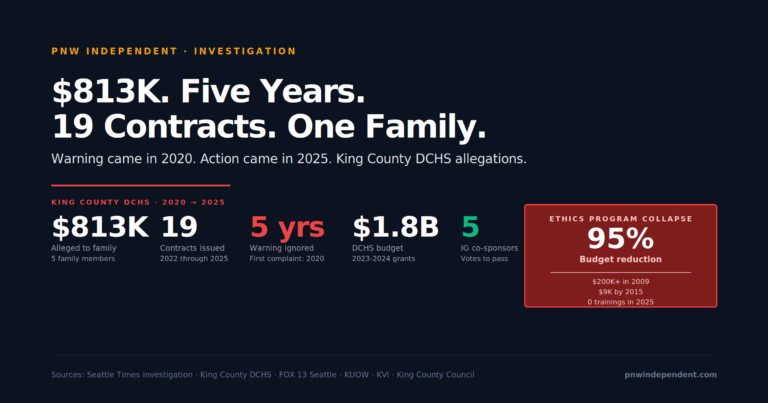
- King County DCHS — Recent allegations of $813K steered to family
- Federal Medicare — $60 billion/year in fraud losses
Each of these reflects the same underlying pattern: large pools of public money with insufficient oversight infrastructure. Furthermore, that pattern is not specific to any one program or any one level of government. It is a systemic feature of how American public funds are distributed.
The Inspector General Connection
Federal agencies that catch fraud at the scale of the Joel French scheme have functional Inspector General offices. Specifically, HHS-OIG and VA-OIG have:
- Subpoena power
- Independent investigative authority
- Statutory mandate to report findings publicly
- Direct enforcement coordination with FBI and U.S. Attorney offices
Furthermore, those structural features are exactly what King County is now creating through the Inspector General legislation introduced by Councilmembers Dembowski, Dunn, Perry, and von Reichbauer.
Therefore, the Joel French case provides a useful comparison. Specifically, the federal Inspector General model works when properly funded and staffed. Furthermore, replicating that model at the county and state level could produce similar outcomes for regional accountability.
What CHAMPVA Beneficiaries in Washington Should Do
CHAMPVA serves the families of disabled veterans and deceased service members. Specifically, Washington has approximately 600,000 veterans — one of the highest concentrations in the country relative to population. Furthermore, many of those veterans have spouses and children who depend on CHAMPVA.
For CHAMPVA beneficiaries who suspect they may have been targeted by similar schemes, federal resources include:
- HHS-OIG fraud hotline: 1-800-HHS-TIPS (1-800-447-8477)
- CHAMPVA Customer Service: 1-800-733-8387
- Medicare fraud reporting: 1-800-MEDICARE (1-800-633-4227)
Furthermore, families should:
- Review Medicare and CHAMPVA statements monthly
- Report any unfamiliar charges immediately
- Save documentation of any cold-call solicitations for medical equipment
- Never provide insurance information to unsolicited callers
- Verify any “doctor’s order” with their actual primary care physician
The Joel French scheme worked partly because beneficiaries did not detect the fraudulent claims on their statements. Specifically, attentive review can catch fraud before it accumulates to scheme-scale dollar values.
What Should Happen Next on Medicare Fraud Like Joel French’s
The Joel French Medicare fraud is now resolved at the prosecution level. However, the systemic issues the case reveals require additional action. Specifically, several reforms could reduce the scale of similar schemes going forward.
1. Tighter Pre-Payment Verification for High-Risk Categories
Orthotic braces are documented as a high-fraud category. Furthermore, Medicare could implement enhanced pre-payment verification specifically for braces — including automatic cross-checks against patient records for prior amputations and recent death indicators. Specifically, this would catch the most egregious “amputee billing” fraud before payment.
That change would slow legitimate claim processing slightly. However, the cost savings from preventing schemes like French’s would more than offset the operational impact. The math favors prevention.
2. Stronger Telemedicine Standards
The Joel French Medicare fraud relied heavily on sham telemedicine to generate fake doctor orders. Furthermore, current federal telemedicine standards do not always require documented physician-patient interaction prior to writing orders for medical equipment. Specifically, Medicare should require:
- Documented physician-patient interaction (audio or video) before orders are written
- Cross-verification of the ordering provider’s identity
- Audit logs for all telemedicine encounters
- Prohibition on payment-per-prescription compensation arrangements
Those reforms are in active discussion at HHS but have not been universally implemented. Furthermore, every additional day without those standards is a day fraudulent operations like French’s can continue.
3. Beneficiary Notification System
When fraudulent claims are submitted in a beneficiary’s name, the beneficiary often does not know until they review their Medicare summary notice — sometimes months later. Specifically, Medicare should implement:
- Real-time text or email notifications when claims are submitted under a beneficiary’s identity
- Easy one-click reporting of unrecognized claims
- Automatic claim holds when beneficiaries flag potential fraud
Furthermore, this system could be opt-in to address privacy concerns. The technology exists. The question is implementation priority.
4. Overseas Call Center Enforcement Coordination
The Joel French scheme used overseas call centers specifically because they are difficult for U.S. law enforcement to reach. Furthermore, similar schemes consistently rely on call centers in the Philippines, Latin America, and Eastern Europe. Specifically, the U.S. should:
- Strengthen mutual legal assistance treaties with major call center jurisdictions
- Pursue coordinated international enforcement against telemarketing fraud
- Require U.S. companies to verify the operating jurisdiction of any call centers they contract with
- Impose penalties on U.S. companies that knowingly use call centers in non-cooperative jurisdictions
That last item is the most enforceable specifically. Furthermore, it shifts liability to entities that are reachable by U.S. law.
5. Whistleblower Protection Enhancement
Many major fraud cases break only when whistleblowers come forward. Specifically, the False Claims Act provides for whistleblowers to receive a percentage of recovered funds in successful cases. However, whistleblower protections vary by employer and circumstance. Furthermore, employees of fraud operations often face retaliation that current law does not adequately address.
Strengthening whistleblower protections — specifically extending strong retaliation protections to contractors and consultants, not just employees — would expand the pool of people willing to report fraud. The fraud industry depends on insider silence. Eroding that silence is the most cost-effective fraud prevention available.
The Bottom Line on the Joel French Medicare Fraud
The Joel French Medicare fraud is now in the books. A 16-year-and-four-month sentence. $110.7 million in restitution ordered. $17 million seized. Three felony convictions. Furthermore, the federal investigation that caught the scheme worked exactly as designed — HHS-OIG, FBI, and VA-OIG coordinated, evidence was developed, a jury convicted, and a federal judge imposed a substantial sentence.
That success matters. Specifically, it demonstrates that federal Inspector General offices with subpoena authority and adequate resources can hold even sophisticated criminals accountable for fraud at nine-figure scales. Furthermore, the model is replicable for state and local oversight gaps where similar fraud patterns occur with less detection.
However, the Joel French case is one of dozens of major Medicare fraud prosecutions per year. Specifically, Medicare loses approximately $60 billion annually to fraud at every scale — from individual provider abuse to organized international operations. Furthermore, the Joel French scheme — at $197 million — represents one-third of one percent of those annual losses.
The deeper question is not whether French should serve 16 years. Specifically, given that he targeted Alzheimer’s patients, billed for amputees and the deceased, and stole from the families of disabled veterans, the case for substantial punishment is overwhelming. The deeper question is what to do about the structural vulnerabilities that allow schemes of this scale to develop in the first place.
For Pacific Northwest residents, the most consequential implications are local. Washington has approximately 600,000 veterans — many with families who rely on CHAMPVA. Furthermore, similar schemes targeting those families likely operate today. Reviewing Medicare and CHAMPVA statements, reporting unfamiliar charges, and treating unsolicited medical equipment calls as suspicious is not paranoid. It is exactly the practice that catches fraud before it reaches scheme-scale dollars.
The Joel French case ended with a sentence and a forfeiture. The next case is forming somewhere right now. Furthermore, whether it ends with a similar prosecution or with another $197 million transferred from elderly Americans and disabled veterans to an organized fraud operation depends on whether federal regulators, state oversight agencies, and beneficiary-facing systems implement the prevention reforms the Joel French case has now made unavoidable.
The fraud was caught. The pattern continues. Implementation is what matters next.
Related Reading on PNW Independent
- King County DCHS: How Brutal Failures Exposed the IG Gap
- Ferguson Ethics: How Brutal Failures Exposed Olympia’s Crisis
- KCRHA Audit: $13M Missing in Seattle’s Homeless Agency
- Who Really Runs Seattle: Two Machines, One Ruling Class
External Sources
- DOJ Press Release — Former NFL Player Sentenced for Health Care Fraud and Money Laundering Conspiracy (May 8, 2026)
- The Washington Times — Former NFL player sentenced to 16 years in prison for Medicare fraud scheme
- Law360 — Ex-NFL Player Gets 16-Plus Years For $200M Healthcare Fraud
- DOJ — Former NFL Player Convicted for $197M Medicare Fraud (February 3, 2026)
- HomeCare Magazine — Former NFL Player Convicted for $197M Medicare Fraud
- Get Out of Debt Guy — Former NFL Player Convicted in $197M Medicare Fraud Targeting Seniors
- HHS Office of Inspector General — Healthcare Fraud Reporting
- VA CHAMPVA Customer Service — Fraud Reporting Resources
- Medicare.gov — Reporting Medicare Fraud